



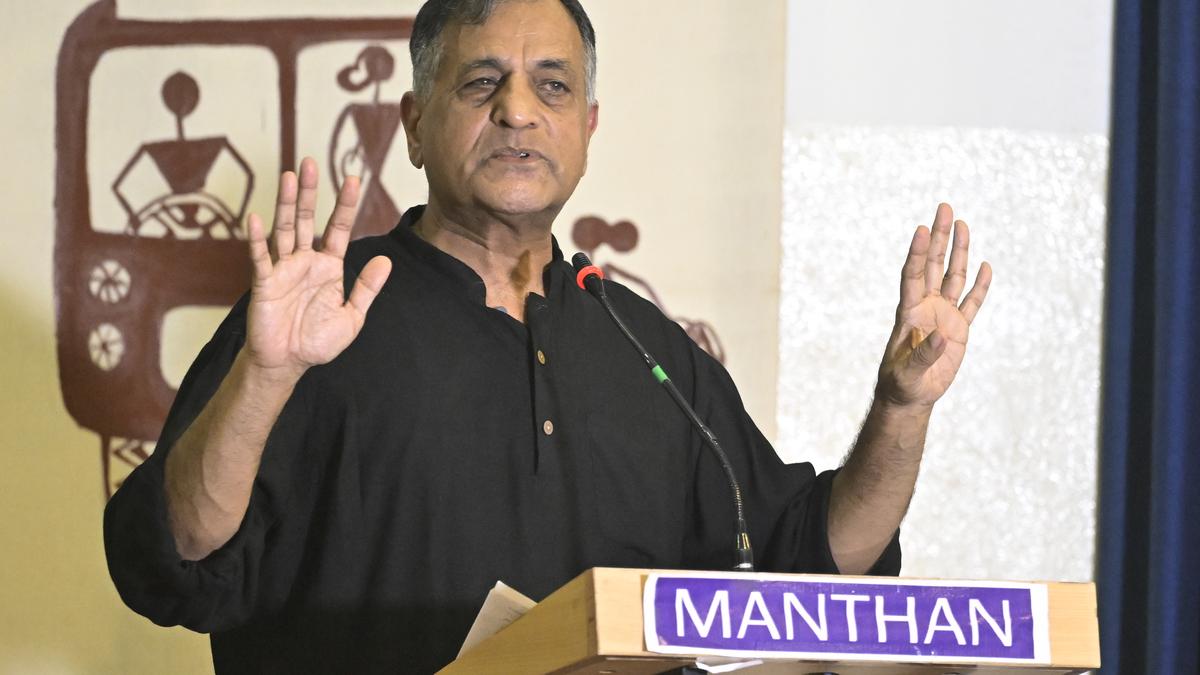
Former Election Commissioner of India Ashok Lavasa speaking on ‘Election Commission of India: A Sentry Under Attack”, as part of the Ajay Gandhi Memorial Lecture, in Hyderabad on Saturday.
| Photo Credit: SIDDHANT THAKUR
Former Election Commissioner Ashok Lavasa cautioned that the Election Commission of India (ECI) risks undermining public trust by shifting the burden of proving citizenship onto voters during the ongoing special intensive revision (SIR) of electoral rolls.
Delivering the Ajay Gandhi Memorial Lecture in Hyderabad on Saturday, September 13, Mr. Lavasa described the exercise in Bihar as ‘unprecedented’ in the ECI’s history and warned that its methodology could set troubling precedents if expanded nationwide.
Mr. Lavasa recalled that the ECI was unique among constitutional bodies because its functioning related directly to citizens rather than government institutions. Since its inception in 1949, followed an inclusive approach, he said, and contrasted this inclusiveness with the ongoing revision in Bihar, where the Commission has for the first time created categories of voters based on whether they were enrolled before or after 2003, the year of the last intensive revision.
Those already on the rolls in 2003 were treated as presumptively eligible, while those added later were asked to furnish additional documentation. Further sub-categories required proof based on date of birth, voters born before July 1987 needed only the 2003 roll, those born between 1987 and 2004 had to provide parental proof, and those born after 2004 had to show documents for both parents, he said.
“This shift of onus created immense practical difficulties,” he added, citing challenges in states such as Bihar where floods, migration, and low document possession rates meant many could not comply. When the draft roll was published, out of 7.89 crore electors, only 7.24 crore names were retained,” he said.
Lavasa questioned both the legality and fairness of the process. “If someone has been on the roll since 1951, in 2003, and again in 2025, but fails to return a signed form, how fair is it to exclude them?” he asked. He pointed out that 65 lakh names were obliterated without serving individual notices, as required under law, under the pretext of creating a fresh roll.
The Supreme Court, he noted, had to intervene to permit Aadhaar as proof, observing that none of the 11 prescribed documents established citizenship conclusively. “By venturing into the determination of citizenship, the Commission has entered very slippery territory,” Lavasa remarked.
He also criticised the claim that the exercise was meant to ‘purify’ the rolls. The methodology, he argued, merely inherited existing discrepancies since it relied on pre-filled forms drawn from the ECI’s own database. Unlike earlier field surveys, where enumerators verified household details directly, the present approach lacked independent verification, and yet resulted in mass exclusions under the categories of ‘dead’, ‘migrated’, or ‘duplicate’, he said.
Published – September 13, 2025 09:40 pm IST



