


In the far reaches of Greater Noida, Uttar Pradesh, an electricity substation – spread over 10,000 square metres and fenced off from wanderers – hums on. Its purpose: to provide a dedicated and unbroken stream of electricity to a 60-metre-high building. This is ND1, Yotta Infrastructure’s data centre in the National Capital Region, one of many complexes to come up around cities like Delhi, Mumbai, Chennai, Hyderabad and, most recently, Visakhapatnam in Andhra Pradesh.
Yotta’s data centre is, compared with the newest projects announced, mid-sized, but even at this scale, workers appear like pins on the upper floors’ scaffolding on ND2, an identical tower being built right next to the first one, which is already operational. ND2 isn’t the only one – four others are under construction.
Also Read: What will power AI data centres? | Explained
Data centres are the engines of the digital economy. Like any other engine, they are loud – inside a server room, rows of metal cages extend across over 1,000 square metres. Behind the metal cages lie the servers belonging to everyone from small firms to big tech firms: some choose to rent the building to place their gear in the racks, while others ask firms like Yotta to take care of the process end to end.
India’s data centre industry is growing rapidly. In 2019, it only had an installed power capacity of less than 650 megawatts. Now, at 1.4 gigawatts it has more than doubled, according to an estimate by credit ratings agency S&P. It will hit 2 gigawatts by 2028 if all the announced projects roll out on time.
Then there is the largest part of this building: the hyperscaler. Nearly every commercial data centre in India has entire floors locked away for one of four or five tech companies that shoulder the back-end of much of the Internet. Ditto for ND1, where the Yotta tour guide and a high-powered head of security are generally not admitted to the hyperscaler’s floor.
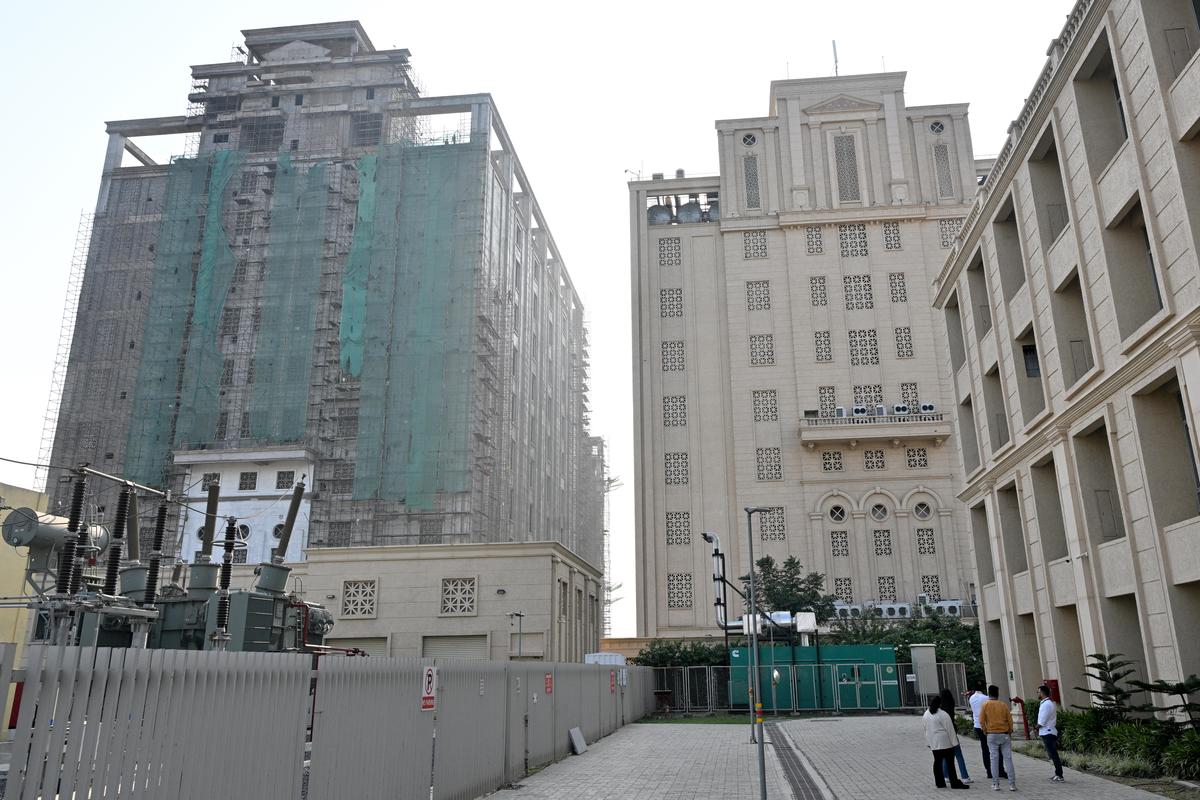
Yotta’s data centre, a hyperscale service provider in India, owned by the Hiranandani Group in Greater Noida, Uttar Pradesh, a part of the National Capital Region.
| Photo Credit:
SHASHI SHEKHAR KASHYAP
Can the guide tell us who the hyperscaler is? “No, we can’t disclose that” is the quick response. But not much is left to the imagination. “You definitely know them.” The firms that hire entire floors of a data centre facility like this are usually Amazon Web Services, Meta, Microsoft, and Google.

The size of the campus doesn’t match the number of people working in it. There are only a few dozen people on the premises at any given time – with three shifts covering the day. Massive chillers on the roof funnel cool air to prevent the machines from heating up. The building uses a 3.5-tonne lift that inches up and down at a snail’s pace lest the sensitive equipment en route to the server rooms suffers damage.
Deep underground – though visitors are not told where – thick pipes carry in cables from every telecom operator and Internet service provider in India. They funnel in requests and data out to millions of people around the country. They also provide a link to cable landing stations on India’s shores, connecting the data centres with Internet users and the backbone of the Internet – subsea cables.
Driving data and real estate
The data centre industry is unlike other tech firms or electronics manufacturing plants. The firms running these buildings don’t need a sprawling ecosystem of suppliers and firms around them. In fact, they prefer avoiding it.
Surajit Chatterjee is the India data centre head at CapitaLand, a Singapore-headquartered firm that is setting up and operating a clutch of properties around India. “There should not be any school, fire, police, mall…. The data centre has very few people moving; it’s a mechanical building,” he said in an interview during a visit to Delhi earlier in November.

Mumbai-based Chatterjee has been in the business for over two decades. It is as much a real estate business as it is a tech business or a power business – CapitaLand builds and runs IT parks and residential properties. While Chatterjee refers to his purview as an “asset class”, data centre firms refer to the tech firms buying dedicated capacity there as “tenants”, real-estate speak.
It is a dream asset class for a real estate business – land for data centres must be located practically in the middle of nowhere and States are eager to attract them, with some dangling subsidies on the polar opposite of prime real estate. The build-out is quick too. “From the moment we have approval, we are up and running in 28 to 30 months,” he says. For States that have developed power infrastructure, electricity revenue for their distribution companies is a draw.
Much of the growth is coming on the back of spending by the main American players whose sprawling global infrastructure is where much of the Internet runs. “Up to 70% of the revenue today in the country is generated by hyperscalers,” Chatterjee says. While Google, Amazon Web Services, Meta, and Microsoft have confidentially purchased space in data centres run by dedicated players like Yotta and CapitaLand, they have also announced data centres that they will be building just for themselves.
In October, Google announced an “AI-powered data centre in Visakhapatnam” with a ₹87,520-crore investment. An Adani group subsidiary and Bharti Airtel will be supporting the roll-out. Amazon Web Services has committed over ₹1 lakh crore in Maharashtra alone. Microsoft announced over ₹25,000 crore in India data centre investments in January – the firm was hiring an individual real estate lawyer in every single State and Union Territory in the country, scouting for land wherever they could find some.
Banks and finance firms spend massively on data centres due to the sensitivity and importance of handling money, and that is a major chunk of data centre revenue.
Powered by power
Data centre power draw has been a subject of scrutiny around the world. The industry even has a measure – PUE (power usage effectiveness) – to ensure that the electricity being supplied to them is leveraged fully.
India has been at a disadvantage because a tropical climate means that data centres need to spend more money on cooling and reliable electricity supply is not always a given. Hyperscalers’ data centres are climbing too as AI requires higher “rack density” or more hardware pulling more power packed into each shelf.
In Mumbai and Chennai, data centres have been able to ensure reliable electricity supplies. At 2-3 gigawatts of capacity, the industry accounts for less than 1% of India’s total installed electrical capacity.

The United States, which possesses 44% of the world’s data centres, has 25 gigawatts of installed capacity, which McKinsey Research indicates will more than triple by 2030. That translates to over a dozen times India’s data centre consumption for a fourth of the country’s population.
“Data centres don’t depend on the local distribution of a city; they directly take their extra speeder (own substation),” Sunil Gupta, Yotta’s founder and CEO, says over Zoom from Mumbai. In Mumbai and Delhi, where Yotta’s data centres are based, he says, power supply was not an issue in recent years.
In the couple of instances of power outage, it hasn’t been for more than around half an hour, during which battery backup was able to keep things running without interruption. Failing that, data centres have a separate building with a diesel generator – like the one at the Greater Noida campus – that can whirl into action and keep the place running for a few hours.
Yotta’s Delhi data centre has not been fully populated or built, meaning its power consumption isn’t anywhere near its capacity. Representatives declined to say exactly how much headroom there was. But once AI gear-like graphics processing units (GPUs) come into play, consumption is bound to go up.
“For the normal cloud [set-up], which was running on CPUs (central processing units) like in data centres, we were okay with 6- to 8-kilowatt racks for running a typical platform,” Gupta says. “With GPUs, the minimum power per rack is 50 kilowatts and it can go up to one 150-200 kilowatts as well.”
The Ministry of Electronics and Information Technology (MeitY)’s IndiaAI Mission is providing AI researchers with subsidised access to Nvidia’s GPUs through providers like Yotta.
What lies ahead
With investments coming in hot and demand seeing no sign of slowing down, MeitY has not announced any specific subsidies or sops for data centres. Hyperscalers and Indian firms are pouring billions of dollars into building Indian data centres, with one industry estimate pegging it at $30 billion over the next two years alone.
In 2020, MeitY put out a draft data centre policy, but never finalised it. Since much of the clearances required for building data centres is in the States’ hands, the Union government only recommended better coordination by States and single-window facilities for permissions.
States have not waited. Uttar Pradesh, Tamil Nadu, Maharashtra, and Karnataka already have a data centre policy of their own, courting hyperscalers to set up their facilities. “States are competing with each other to attract data centre investments,” Gupta says. These States have been updating their building codes to accommodate data centres’ unique needs (fewer parking requirements, an adjusted floor-to-ceiling height regulation, and sweetener subsidies for facilities with good PUEs), he says.
One more force encouraging demand has been the looming threat of data localisation mandates. Since 2016, the Union government has tried to nudge companies to store Indian users’ data locally. Storage costs have historically been higher for data centres located in the country, but with Singapore (which has punched above its weight in the data centre industry) running out of land and the Digital Personal Data Protection Act, 2023 allowing the government to restrict foreign jurisdictions for holding data, the industry is preparing in advance.
Tech firms are also capitalising on the fact that China’s data centre industry is largely cut off from the rest of the world. In early November, Microsoft announced that it would allow Indian enterprise users to have their AI queries processed fully in India. As India’s undersea cable ecosystem also grows – with capacity outweighing demand – partly due to the existence of a growing number of data centres, “Vizag is just one cable away from Singapore and Malaysia,” Gupta says.
The boom could also loosen the dependence of the industry on just two hubs – Mumbai and Chennai – and expand it to places like Visakhapatnam. Mumbai accounts for half of the data centre market even from the demand side. The city “is a hotbed of hyperscalers and is the financial capital of the country”, Chatterjee says.
“Up to 70% of the market is between these two States,” he says, referring to Maharashtra and Tamil Nadu. The boom may just be getting started, he adds. “AI is still yet to enter India in a full-fledged way.”
aroon.deep@thehindu.co.in



