


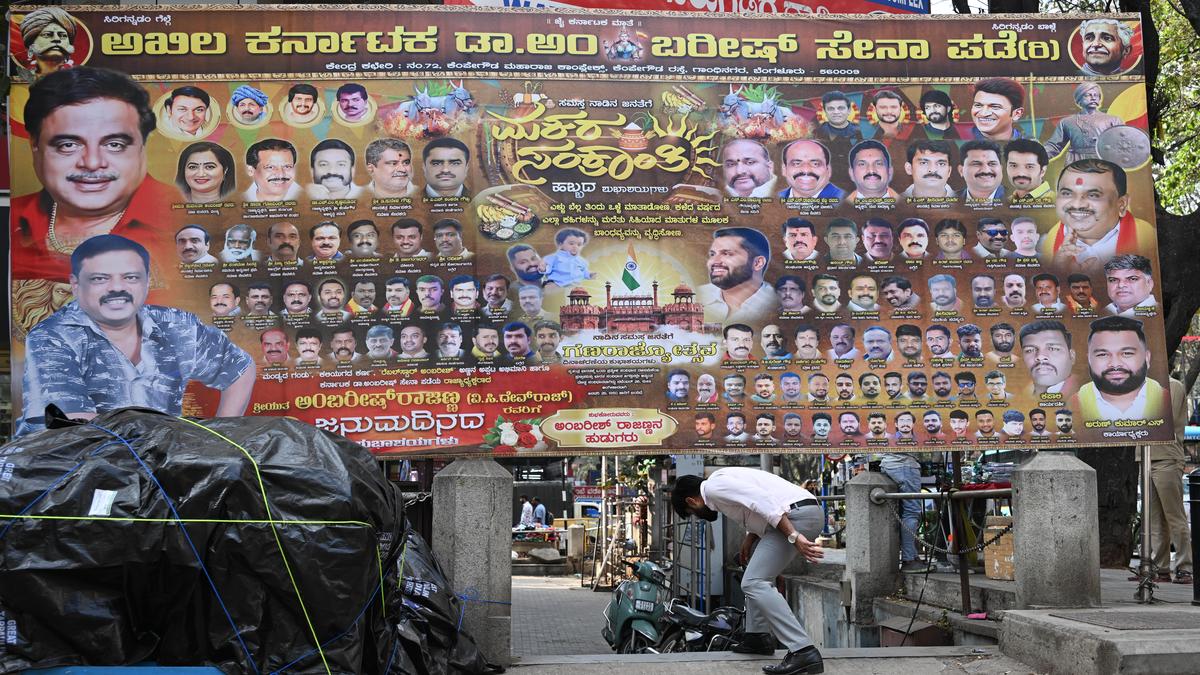
Pedestrians struggle as they enter the Kempegowda Complex due to a huge Sankranti wishes banner blocking the entrance at Chickpet in Bengaluru on Friday.
| Photo Credit: ALLEN EGENUSE J
Despite a ban in place, Bengaluru continues to be flooded with illegal hoardings across corporations, posing a threat to public safety and, in many instances, blocking pedestrian pathways.
Ahead of Sankranti, hoardings dotted the city, turning into an eyesore. Citizens could spot hoardings every 100 metres or less in areas such as Shantinagar, BTM Layout, Jayanagar, Vijayanagar, and RR Nagar.
On Srinivagilu Road near Ejipura, a tall single flex spanning at least 30 to 40 feet, featuring Ramalinga Reddy and Sowmya Reddy, was erected by party workers on Wednesday. Many streets in South Bengaluru also featured hoardings displaying C.K. Ramamurthy.
The corporations conducted a clearance drive on Friday.
Permissions
A senior Greater Bengaluru Authority (GBA) official said that during the festival season, corporation offices receive hundreds of applications seeking permission to install hoardings. “We permit a few, setting a specific deadline of certain hours, considering religious sentiments. However, failure to remove them even after the programme is over prompts action,” the officer said.
In many instances, event organisers and those installing hoardings merely seek permission but do not bother to wait for approval. “They simply go ahead and install banners irrespective of whether permission is granted or not. In many cases, people do not seek permission at all,” the officer said, adding that such elements are fined substantially, yet they continue to repeat the violations.
Officials said many event organisers violate the law and then pay the fines, highlighting the need to revisit the existing fine structure. Currently, fines of ₹1,000 and above, depending on the extent of the violation, are imposed in the city. Police officers also book cases under the Karnataka Open Places (Prevention of Disfigurement) Act. Even in such cases, the accused pay a fine and walk free.
Karan P., a resident of Koramangala, noted that enforcement is poor, pointing to several flexes that have remained uncleared for months across the area.
The erstwhile Bruhat Bengaluru Mahanagara Palike had introduced the silt and tractors scheme to aid debris removal and encroachment clearance in the city. R. Rajagopalan of the Bengaluru Coalition, a collective of civil society organisations, said he rarely sees tractors deployed under the silt and tractors scheme, which is meant to clear such flexes.
A senior police officer said, “You will see that most of these flexes are festival greetings in the names of politicians or messages welcoming them to events. Very rarely are ordinary individuals fined for illegally installing flexes.”
According to the officer, even during clearance drives, party workers often ask officials to first remove flexes from rival politicians installed elsewhere before taking down their own. This frequently results in civic body officials refraining from enforcing the law strictly.
Mr. Rajagopalan suggested that the GBA adopt a proactive approach by convening a meeting with city corporation commissioners and the police department and drafting a strict and consistent standard operating procedure (SOP) for the removal of illegal hoardings across corporations.
Published – January 16, 2026 09:14 pm IST



