


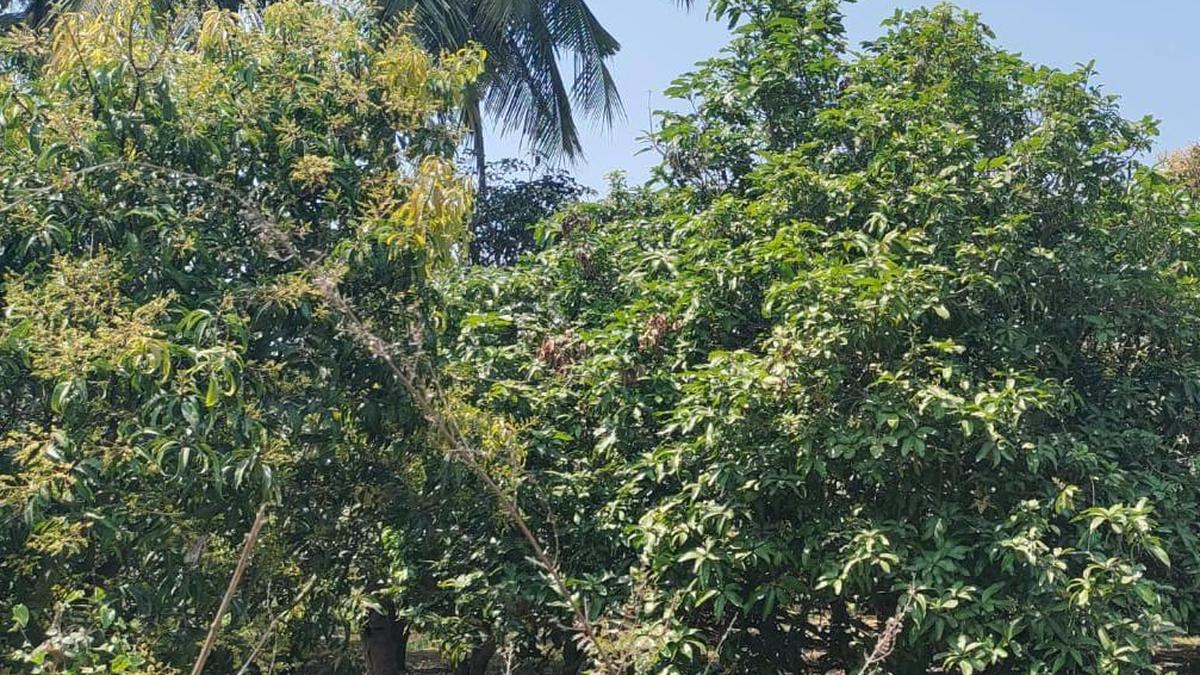
A mango orchard with bleak flowering near Pachikapallam of Vedurukuppam mandal in Chittoor district.
| Photo Credit: HANDOUT
Mango cultivation in the erstwhile Chittoor district is undergoing a deep crisis in 2026, as delayed flowering, shrinking acreage, and the after-effects of last year’s market collapse threaten the crop’s viability. Following the trifurcation of the district into Chittoor, Tirupati and Annamayya, the area under mango cultivation has declined sharply, eroding the region’s long-standing dominance in the crop’s production.
For decades, orchards across the undivided district would spring to life from November onwards. Mango cultivated over more than one lakh hectares was regarded as the “King of Commercial Crops” for its ability to withstand climatic stress while ensuring minimum assured returns. That confidence has steadily weakened.
A key concern this season has been the severe delay in flowering, which now lags behind the normal schedule by nearly two months. Raw mangoes usually reach markets by Ugadi, which will be celebrated in March, for the preparation of ‘Mamidi Pachhadi’, a festive staple. Officials claim that early arrivals would be unlikely this year.
Field officials of the Horticulture department attribute the adverse conditions to unseasonal rains in the eastern side of the district, and prolonged winter conditions and erratic temperature fluctuations in the western mandals. This disrupted the flowering cycle. Delayed flowering would generally yield acceptable results, just like in 2025. However, during the pre-COVID-19 season, the district suffered a jolt with crop failures, following weak and uneven flowering, as well as poor fruit retention.
Few mango growers are anxious considering the experience they had in 2025. The year witnessed more than 80 per cent of production, an unusual phenomenon, triggering a severe price crash. Market rates plunged to ₹3 per kg or lower, pushing growers into distress. At the last minute, the State government had to intervene to help stabilise the situation, with prices supported at ₹4 per kg, coupled with a ₹4 per kg subsidy to farmers. However, the growers continue to deplore that the relief was inadequate offset rising input costs.
“With the gradual shrinking of mango cultivation lands and adverse conditions impacting the regular flowering cycle, volume is no longer on our side,” said Chittibabu, a mango grower in GD Nellore near Chittoor. Officials claim that yields in 2026 may fall well below six tonnes per hectare, compared to the earlier projection of eight tonnes.
Published – January 14, 2026 06:53 pm IST



