


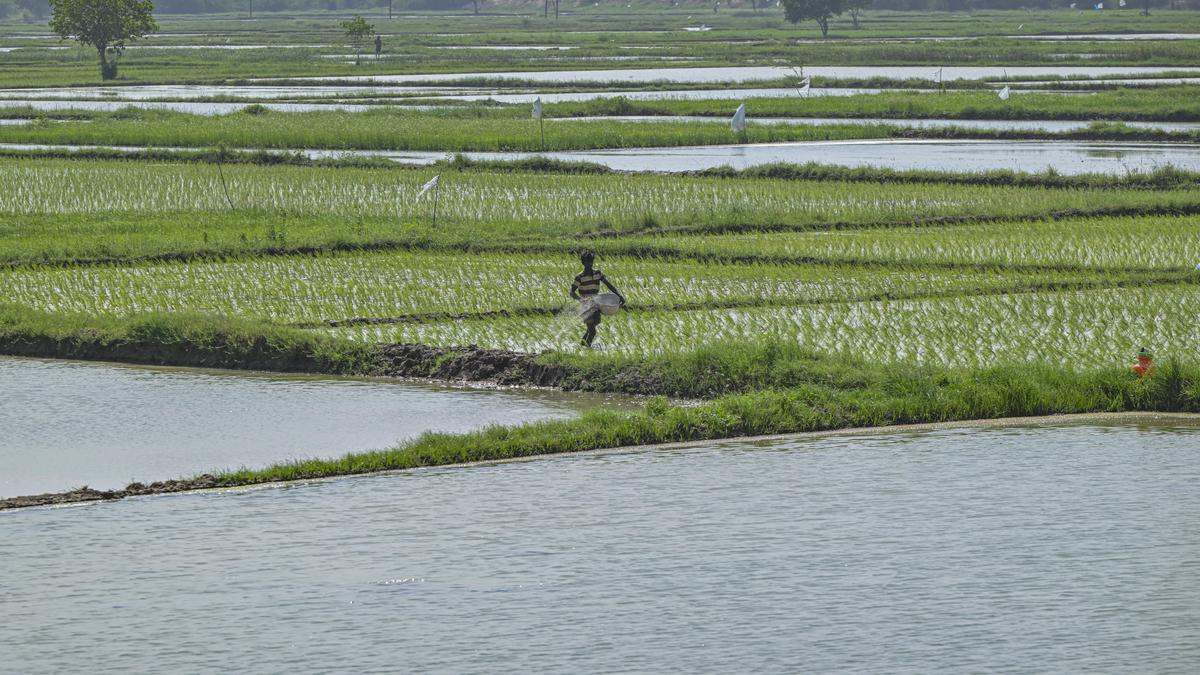
The team of scientists developed an ‘agri-ecological base’ map to assess the impact of cropping systems and the use of fertilisers on organic carbon. They covered 20 agro-ecological regions. File
| Photo Credit: The Hindu
A detailed study conducted by eight scientists of the Indian Council of Agricultural Research (ICAR), including its Director General Mangi Lal Jat, has found that the unscientific use of fertilisers and climate change are contributing to degradation of organic carbon in arable areas of the country.
The study, primarily coordinated by the ICAR’s Indian Institute of Soil Science in Bhopal, has used 254,236 soil samples of 620 districts covering 29 States to reach the conclusions. A research paper based on the six-year-long study started in 2017 has been published now in the England-based international research journal ‘Land Degradation & Development.’
Talking to The Hindu about the research, coordinator of the project Arvind K. Shukla said organic carbon is not only part of the chemistry of the soil, but it covers all the aspects of physics, chemistry and biology of soil. He said a study published by the United Nations’ Food and Agriculture Organisation about 25 years ago flagged this issue, but the samples were very low. “In this study, we have taken samples extensively, and the sample collection was well designed. We have covered both arable and barren land, mostly arable land,” he said.
Effect of altitude on organic carbon
The study has found that if the organic carbon is low, then the deficiency of micronutrients in the soil is high, and if the organic carbon is high, the deficiency is low. The team used an earlier study that said rainfall and temperature determined organic carbon. “We correlated this across the country. We found that organic carbon is highly correlated with the elevation. If the elevation of the land is high, then the organic carbon content is high. But if we move from hills to low land, then the organic carbon content is low,” he added.
Mr. Shukla said organic soil carbon is negatively correlated with temperature. “For example, in Rajasthan and Telangana, the temperature is very high and their organic carbon content is low,” he added. The study noted that irrespective of the crops and cropping patterns, temperature, rainfall and elevation are the three important factors which decide the organic carbon concentration in the soil.
The team of scientists developed an ‘agri-ecological base’ map to assess the impact of cropping systems and the use of fertilisers on organic carbon. They covered 20 agro-ecological regions. “The cropping system is very, very important in deciding the organic carbon content within the regions. Wherever rice-based cropping systems or pulse-based systems are there, the organic carbon content is a bit higher than the areas that followed wheat and coarse-grain cropping systems. For rice, where we have to apply more water, the microbial activities are very high, helping in in sequestering more carbon in soil,” Mr. Shukla added.
The scientists have prepared a map which can help in making policy decisions, particularly for the carbon credit and assessing the land degradation. They have also addressed questions such as rice food system has degraded the land and the extent of its degradation. “We found that wherever imbalanced fertiliser application was there, then the organic carbon contained in the soil had declined. Haryana, Punjab, and parts of Western Uttar Pradesh have intensified the fertiliser application, skewed towards urea and phosphorus, which was mostly scientific application, and it has negatively impacted organic carbon in the soil. But in States like Bihar, where balanced application of fertilisers can be seen, the situation is better,” the scientist added.
Climate change will have an impact on organic carbon, the study noted. Rainfall will not have a significant impact, but with the temperature, it is highly negatively correlated. “If the temperature is rising, then there are chances that soil organic carbon will decline further in future, and that will not only impact soil health, but will also impact the carbon credit and heat emission from soil. If there is more carbon in soil, then there is more heat absorption. If the carbon content is lower, then the heat absorption in the soil will be less, and there will be more heat reflection from the ground creating greenhouse gas effect. That will be dangerous,” Mr. Shukla warned.
The scientists have suggested that the country should cover all the soils with crops and should try to establish a large number of plantations in the country. The first policy measure they have advocated was that wherever soils have very low carbon, less than 0.25%, the governments should promote organic carbon sequestration so that farmers can develop some sort of a cropping system, with increased irrigation facilities. “Second is carbon credit. We should give incentives to these farmers, who are able to trap more carbon dioxide from the soil, and they are converting it into organic carbon. Thirdly, we must find out different crop management options for climate change mitigation,” he added.
Published – November 09, 2025 03:45 am IST



