


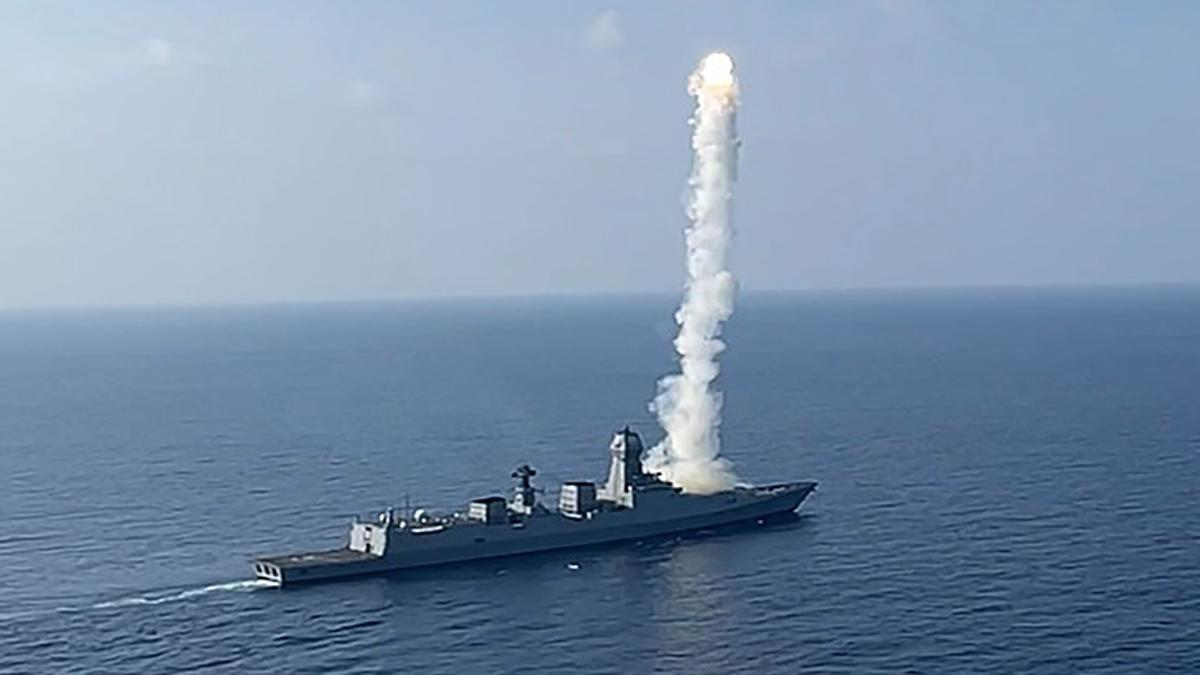
Photo used for representational purpose only. Indian Navy successfully demonstrated the accuracy of an extended-range land attack Brahmos supersonic cruise missile from the stealth destroyer INS Chennai, on 5th March, 2022.
| Photo Credit: PTI
The Indian Navy played a decisive role in Operation Sindoor, establishing maritime dominance and forcing Pakistan into a defensive posture through a calibrated deployment in the Arabian Sea.
Operating as a networked force, the Navy deployed a Carrier Battle Group led by INS Vikrant, equipped with MiG-29K fighter jets and airborne early warning helicopters. This ensured persistent surveillance and real-time threat detection, while maintaining a strong air defence shield that prevented hostile aerial incursions, particularly from the Makran Coast.
According to sources, the Navy positioned around 36 frontline assets, including warships and submarines, near Karachi, marking a significant escalation in capability compared to the Indo-Pakistani War of 1971, when only six warships were deployed. The forward presence effectively bottled up Pakistani naval and air elements along their western seaboard, denying them operational space.
Recently, Chief of Naval Staff Dinesh K. Tripathi said the Navy was “minutes away” from launching maritime strikes during the operation but held back after Pakistan sought cessation of hostilities. The remarks underscore the level of combat readiness maintained by naval forces throughout the crisis.
At a joint briefing shortly after India launched Operation Sindoor on May 7 last year, Vice Admiral A. N. Pramod, Director General of Naval Operations, had informed that the Navy had mobilised into full combat readiness within 96 hours of the Pahalgam terror attack. He noted that forces were prepared to strike targets at sea and on land, including Karachi Port, pending government directives.
The Navy’s deployment in the Arabian Sea ensured that Pakistani naval forces remained confined to harbours or operated close to their coastline under constant surveillance. Multiple weapon drills were conducted to validate combat preparedness and enhance strike precision in a complex threat environment.
On Friday (April 3, 2026), India also commissioned its third nuclear-powered ballistic missile submarine, INS Aridhaman, further strengthening its strategic deterrence during the period. The induction reinforces the credibility of India’s nuclear triad and its ability to maintain a survivable second-strike capability.
Officials emphasised that the Indian response remained measured and calibrated, with all three services operating in close coordination during Operation Sindoor. The Navy’s maritime superiority, combined with joint operational synergy, played a key role in compelling Pakistan to seek a ceasefire.
Despite achieving a dominant position and maintaining the capability to strike, it exercised restraint, halting offensive action when Pakistan sought de-escalation. This demonstrated India’s ability to combine military superiority with strategic prudence. The Indian Navy continues to remain vigilant, maintaining readiness to respond swiftly to any future threats in the region.
Published – April 03, 2026 03:47 pm IST



