


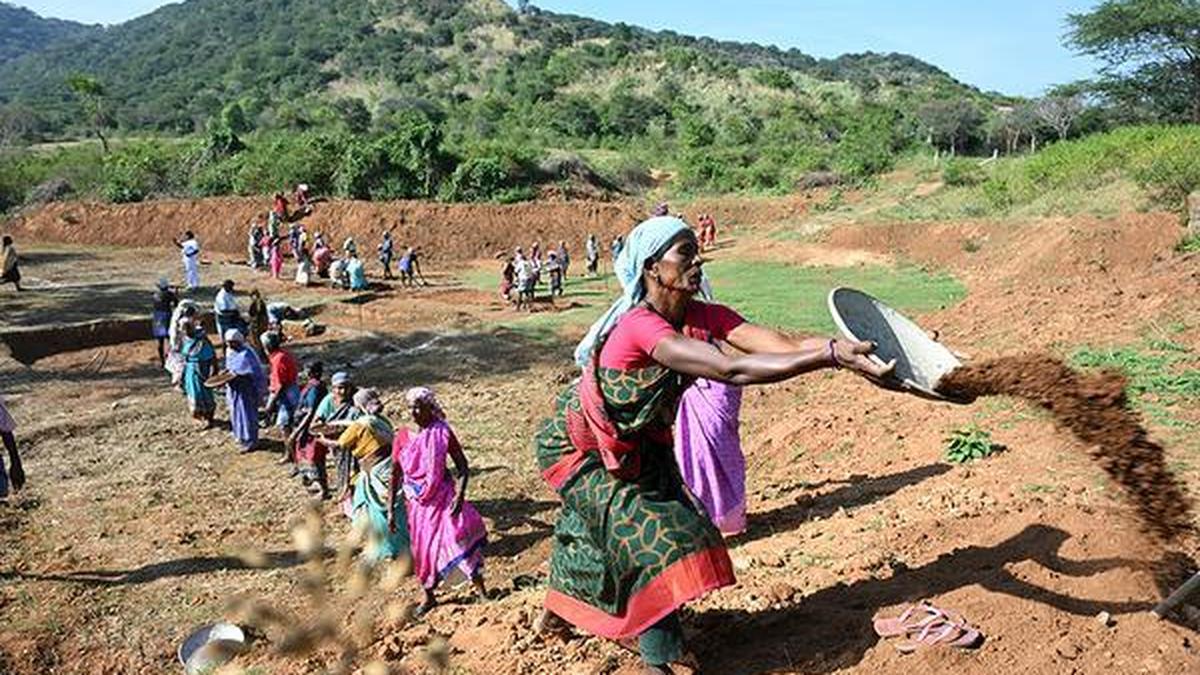
Beneficiary-workers of the Mahatma Gandhi National Rural Employment Guarantee Scheme engaged in the creation of a pond in Dindigul, Tamil Nadu. File
| Photo Credit: Moorthy G.
The Centre on Saturday (May 23, 2026) published draft rules under the Viksit Bharat – Guarantee for Rozgar and Ajeevika Mission (Gramin) Act, 2025 (VB–G RAM G) for public consultation, following the notification of the law’s implementation across all States and Union Territories from July 1.
Framed under Section 33 and other relevant provisions of the Act, the draft rules have been placed in the public domain to facilitate wider stakeholder consultation before they are finalised.
Also read | Change for the worse: On MGNREGA to VB-G RAM G
The proposed rules cover transitional provisions, the National Level Steering Committee, the Central Gramin Rozgar Guarantee Council, administrative expenses, grievance redressal, payment of wages and unemployment allowance, and expenditure incurred in excess of normative allocations, including expenses for Union Territories without legislatures.

Officials in the Ministry of Rural Development said the rules are aimed at establishing the institutional, administrative, financial, and governance framework for implementation of the Act across the country.
They said the consultation process seeks to ensure participatory governance and enable constructive feedback from States, institutions, experts, civil society organisations, and the public.
The draft Transitional Provisions Rules outline the framework for shifting from MGNREGA to VB–G RAM G, the new rural employment guarantee scheme that will replace the existing programme.

These provisions ensure ongoing work, settlement of liabilities, transfer of records, the validity of e-KYC-verified job cards, and the continuation of workers’ rights during the transition period until States notify the new scheme.
On Wednesday (May 20, 2026), a meeting of the Parliamentary Standing Committee on Rural Development and Panchayati Raj, headed by Congress MP Saptagiri Ulaka, saw a detailed briefing on the steps taken for the nationwide implementation of the Viksit Bharat – Guarantee for Rozgar and Ajeevika Mission (Gramin) [VB–G RAM G] Act, 2025, from July 1.
Secretary in the Rural Development Ministry Rohit Kansal is learnt to have conveyed to the members of the committee that 25 States have already allocated funds for VB-G RAM G programme and all administrative and policy actions are being initiated.
All major States have allotted funds required to implement this scheme from July 1.
The VB-G RAM G Act is rural employment law that replaces MGNREGA and raises the guaranteed wage-employment entitlement from 100 days to 125 days per rural household per year. It also reshapes the scheme around village planning, rural assets, and a more digital monitoring systems.
Opposition parties criticise that the Act weakens MGNREGA’s rights-based guarantee by turning it into a more allocation-based scheme, which could make work less enforceable if funds are limited. They argued that the new 60:40 Centre-State funding model could burden poorer States. Civil society groups warned about greater centralisation and possible exclusion of workers with weak digital access.
Published – May 23, 2026 02:29 pm IST



