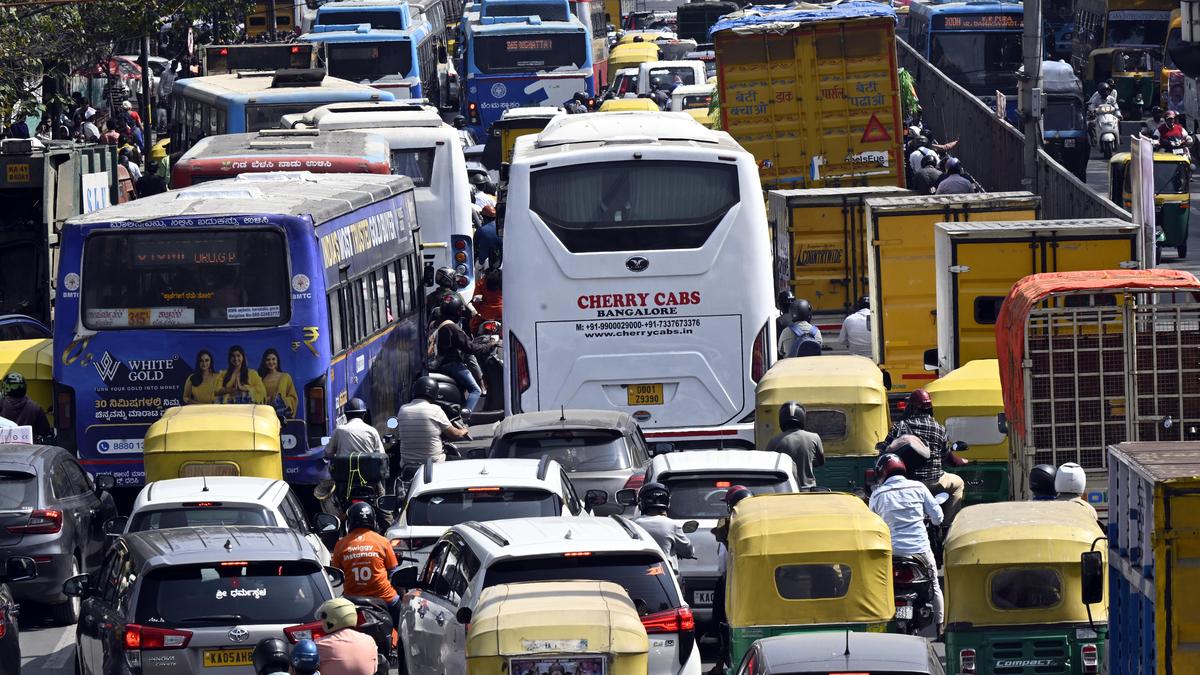
Traffic on Seshadri Road in Bengaluru on January 27, 2026.
| Photo Credit: The Hindu
Bengaluru’s traffic problem has long been a subject of public frustration, with commuters losing an extraordinary number of hours on choked roads. Therefore, the latest TomTom report that ranked Bengaluru as the second-most congested city in the world has come as no surprise. For a city that positions itself as India’s technology and innovation capital, this is an indictment of years of poor mobility planning.
Congestion in Bengaluru is not merely the result of rising population or economic growth. It is the outcome of planning choices that failed to align transport infrastructure with how the city actually functions. Data from Karnataka Transport Department show that the number of registered vehicles in Bengaluru has risen sharply from about one crore in 2020-21 to nearly 1.23 crore in April 2025. This growth has occurred alongside the concentration of employment in a few major clusters, mainly Electronics City, the Whitefield–ITPL corridor, and the 17-km Outer Ring Road (ORR) stretch, that houses lakhs of daily office commuters. These corridors were not initially prioritised in the city’s public transport expansion.
Inadequacy of mass transit
Bengaluru’s commute backbone remains the Bengaluru Metropolitan Transport Corporation (BMTC), operating 7,067 buses, catering to nearly 48 lakh passengers every day, the highest ridership for any city-run public transport system in India. Despite its scale, the BMTC has struggled with a shrinking fleet strength relative to demand, slow average speeds due to mixed traffic, and the absence of dedicated bus priority lanes. The pressure on the BMTC recently prompted former Infosys CFO T.V. Mohandas Pai to suggest that the BMTC should be opened up to private participation, which drew strong opposition from Transport Minister Ramalinga Reddy, who argued that public transport cannot be run for profit. While the Minister’s defence of a public-run bus system is valid, without sustained capital investment, bus priority infrastructure and increase in number of buses, the BMTC cannot solve the traffic issue.
Moreover, the metro network in the city has failed to fill this gap. The construction of Namma Metro began in 2007, and the first stretch opened in 2011, with new corridors added over the years. While these improved city mobility, Bengaluru’s prime employment destinations were again not considered. This planning gap became evident when the metro’s Purple Line was extended to Whitefield in 2023. Data from Bangalore Metro Rail Corporation Limited (BMRCL) showed an immediate increase in ridership of around 2.5 lakh to 3 lakh passengers a day. A similar trend emerged after the Yellow Line to Electronics City opened in August 2025, with daily boardings on the new line alone crossing 60,000 within weeks. Urban transport experts have pointed out that the earliest metro corridors prioritised areas with relatively lower commuter demand, while major employment hubs had to wait over a decade. The result is visible on the ORR stretch. Despite being the city’s largest employment stretch, the ORR will have to wait till 2027 for operational metro connectivity.
Wait for suburban trains
Bengaluru has long needed a high-capacity regional rail system. The Bengaluru Suburban Railway Project was finally sanctioned in October 2020, with an ambitious plan to operate trains across four corridors spanning 148 km and 58 stations. The project was proposed to serve nearly 20 lakh commuters daily. But recently the deadline to open the project was pushed to 2030 from October 2026. Moreover, last- and first-mile connectivity remain notoriously inadequate in the city. Shared auto services are restricted, pedestrian infrastructure is inconsistent, and cycling infrastructure remains fragmented. While cab and auto aggregators have stepped in to fill some gaps, commuters report the unavailability of services during peak hours or sharp fare surges.
The overall fragmentation of the transport network in Bengaluru is compounded by a disempowered Bengaluru Metropolitan Land Transport Authority (BMLTA). Conceived as an apex body to coordinate transport planning across agencies, BMLTA has yet to function as an effective decision-making authority. It seems that without regulatory intervention in the broader mobility framework, aggregators have become unreliable when demand is the highest.
Published – February 05, 2026 01:26 am IST