

By using this site, you agree to the Privacy Policy and Terms of Use.
Accept
India Times NowIndia Times NowIndia Times Now
Notification Show More
Font ResizerAa
  • Bharat Shreshtha Ratna Sanman
  • India News
  • Categories
    • Technology
    • Entertainment
    • The Escapist
    • Insider
    • Finance ₹
    • India News
    • Science
    • Health
Reading: Auroral activity captured at Hanle by IIA’s all-sky camera
Share
India Times NowIndia Times Now
Font ResizerAa
  • Bharat Shreshtha Ratna Sanman
  • India News
  • Categories
Search
  • Bharat Shreshtha Ratna Sanman
  • India News
  • Categories
    • Technology
    • Entertainment
    • The Escapist
    • Insider
    • Finance ₹
    • India News
    • Science
    • Health
Have an existing account? Sign In
Follow US

Home » Auroral activity captured at Hanle by IIA’s all-sky camera

India News

Auroral activity captured at Hanle by IIA’s all-sky camera

India Times Now Desk
Last updated: January 23, 2026 1:30 am
India Times Now Desk
Published: January 23, 2026
Share
SHARE


Contents
  • Interaction with CME
  • Physical mechanism
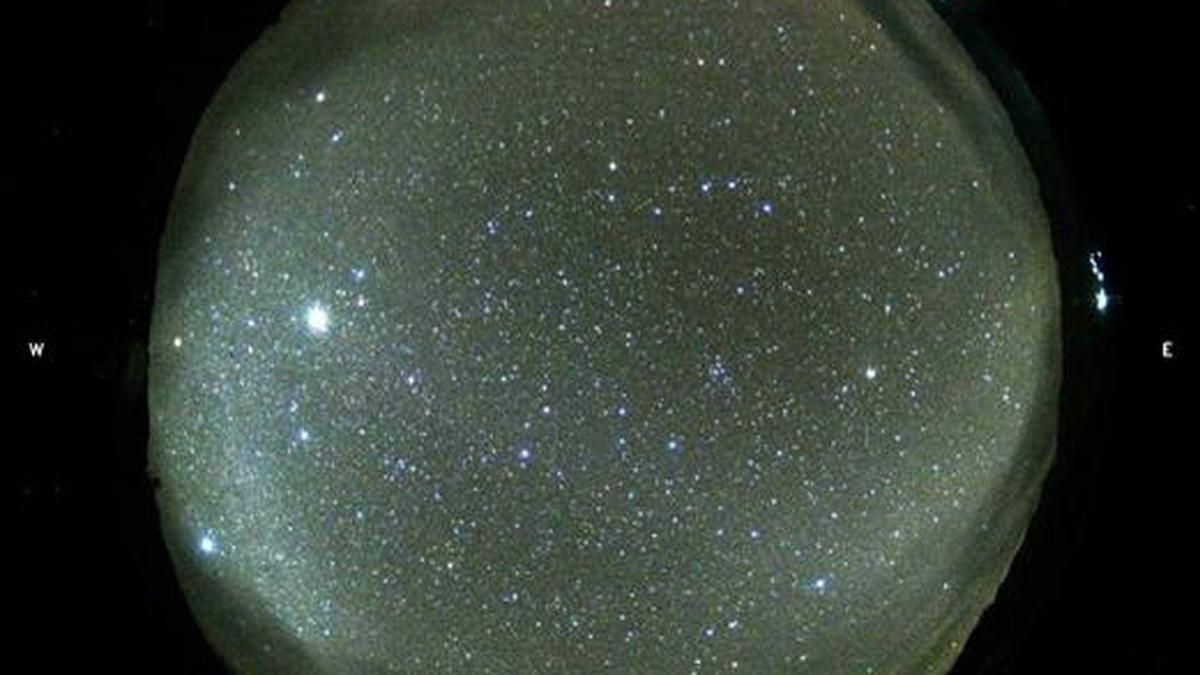
A screenshot of the auroral activity captured by the all-sky camera at the Hanle, Ladakh, by the Indian Institute of Astrophysics.

A screenshot of the auroral activity captured by the all-sky camera at the Hanle, Ladakh, by the Indian Institute of Astrophysics.
| Photo Credit: special arrangement

Auroral activity was captured by the all-sky camera at the Indian Astronomical Observatory in Hanle, Ladakh, on the nights of January 19 and 20. This is the sixth time during the current solar cycle the intense red coloured auroral activity was captured.

The Indian Institute of Astrophysics (IIA), which operates the observatory, said that the aurora seen at Hanle was owing to a strong geomagnetic storm which began at approximately 3.30 a.m. on January 20.

“The storm reached its maximum intensity at 8.30 p.m. on January 20, with a peak disturbance of −218 nano Tesla,” it said.

Interaction with CME

According to NASA’s space-based remote-sensing observations, the storm resulted from the interaction of a coronal mass ejection (CME) that was launched from the sun around 1.30 p.m. on January 18.

The CME originated from Active Region 14341 near the centre of the solar disk and was expelled at a speed of around 1,400 km/s. It was associated with an X1.9 solar flare and accompanied by solar energetic particles. In terms of space-weather severity, the event is classified as a G4-level geomagnetic storm with an S4 radiation level.

“During the ongoing 25th solar cycle, only six geomagnetic storms with intensities exceeding −200 nT have been recorded, which have the potential to cause low latitudinal arorae. A coronal hole was observed over a large area surrounding the active region, which may have facilitated the CME’s rapid propagation toward earth within approximately 28 hours,” said P. Vemareddy, a solar astrophysicist at the Indian Institute of Astrophysics.

Physical mechanism

Using a combination of ground-based and space-based observations, scientists at IIA are actively investigating the physical mechanisms behind these storms to better understand the sun’s influence on earth.

IIA said that CMEs are large expulsions of billions of tonnes of plasma and its associated magnetic fields from the sun into the interplanetary space, some of which can hit the earth and produce geomagnetic storms.

“Extreme geomagnetic storms have the potential to harm space-technology dependent human life on Earth, such as disrupting radio communication, GPS signals, etc. Predicting these storms is an important area of scientific research at IIA and many other institutions in India as well,” IIA said.

Published – January 23, 2026 07:00 am IST


Source link

Fight to protect Chelam Hill gets stronger in northern Andhra Pradesh
Delhi Red Fort Blast: Taxi driver, cosmetics shop owner identified among 13 victims
Tamil Nadu election 2026: Brisk polling, a boycott, and a beachside standoff in Mayiladuthurai and Nagapattinam districts
Ahmedabad Cyber Crime Police bust two networks running NEET scams
Panaiyur fossil assemblage dates back to Holocene period: study
TAGGED:Auroral activityBengaluruIndian Astronomical Observatorykarnatakasspace activities
Share This Article
Facebook Email Print
Leave a Comment

Leave a Reply Cancel reply

Your email address will not be published. Required fields are marked *

Follow US

Find US on Social Medias
FacebookLike
XFollow
YoutubeSubscribe
TelegramFollow

Weekly Newsletter

Subscribe to our newsletter to get our newest articles instantly!
[mc4wp_form]
Popular News

ED searches 13 locations in alleged terror-funding and illegal infiltration case

India Times Now Desk
July 16, 2026
Karnataka rains: Schools closed in parts of Malnad region
Encroachment of years cleared from Durgam Cheruvu
Custodial death case: Sai Krishna’s mother pleads police for his mortal remains
Raghav Juyal plays a ‘delusional actor’ in Bhai Tera Star Hai, teams up with Niharika NM | Watch trailer | Entertainment
- Advertisement -
Ad imageAd image
Global Coronavirus Cases

Confirmed

0

Death

0

More Information:Covid-19 Statistics
© INDIA TIMES NOW 2026 . All Rights Reserved.
Welcome Back!

Sign in to your account

Username or Email Address
Password

Lost your password?

