


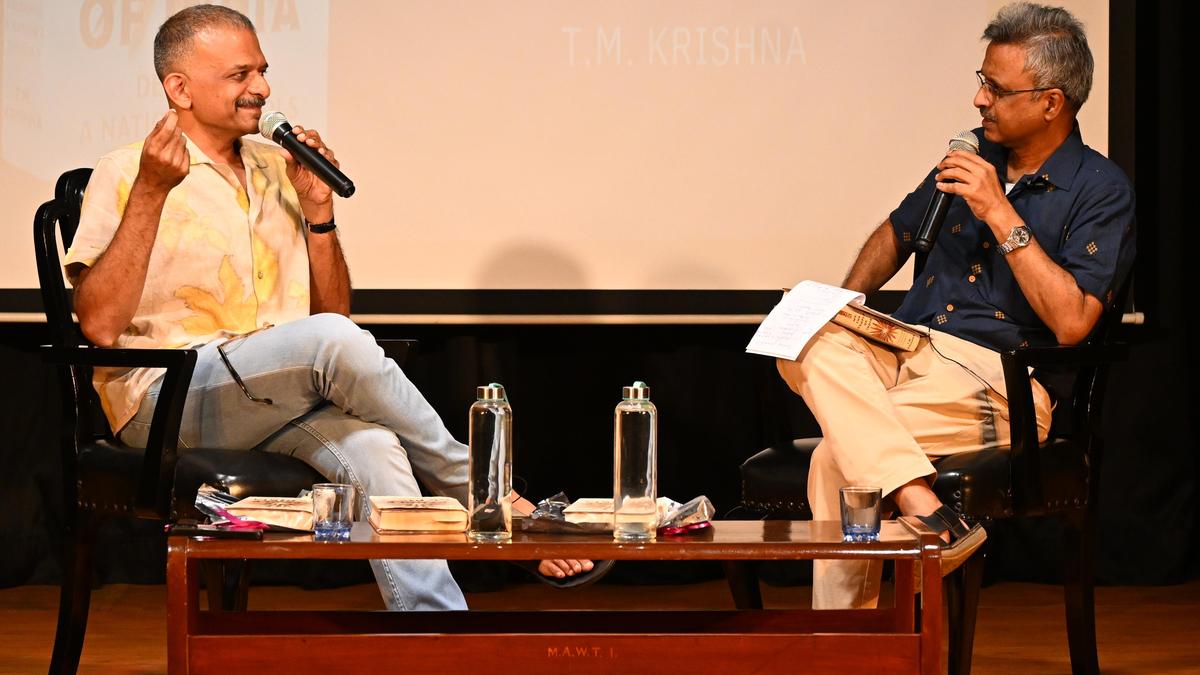
Carnatic vocalist T.M. Krishna in conversation with historian A.R. Venkatachalapathy at the launch event for the former’s book in Chennai on Tuesday.
| Photo Credit: B. JOTHI RAMALINGAM
Can the meaning of national symbols change? Or can one impute new meanings to old symbols? Who actually designed the national flag? These were among the questions that came to the fore at an intellectually rich discussion between musician and author T.M. Krishna and historian A.R. Venkatachalapathy at the release of Mr. Krishna’s latest book, We, the People of India: Decoding a Nation’s Symbols, at The Music Academy in Chennai on Tuesday.
To Mr. Venkatachalapathy’s pointed question on why the meaning of symbols shouldn’t change, Mr. Krishna said he had no objection to it, and new meaning was going to happen anyway. Referring to how the Ashoka Pillar was chosen as a symbol, he said Sarnath was the location of the first sermon of the Buddha, and that’s where the pillar was constructed. “So its meaning there is entirely different. It symbolises the Dharmachakra Pravartanaya. The ruling of the Dharmachakra is what it basically represents.”
Referring to the moment it became an Indian symbol, Mr. Krishna said: “There is a complexity there because you are bringing it to be a State symbol. Now, immediately there is a power shift that we cannot ignore the moment something is given that status, so there is a new meaning. The new meaning is in a new era, in a new sentiment, a new leader, so meanings are going to change.”
When asked about what triggered him to author his latest work, Mr. Krishna said that by 2019, he was quite deeply moved by the national anthem and was wondering about his relationship with the song, not just with the anthem. Recalling what he termed an “accidental statement” made during one of his talks, calling the national anthem a “protest song”, Mr. Krishna said that was the trigger. “I think that was the first time I felt that I must look at symbols, because I think somewhere we failed to look at the power of these symbols, what they mean to us today, and why we have chosen them.”
While examining historical materials, Mr. Krishna said there was not much material on the national emblem and the national motto. Since there was no material on it, the author chose to file RTI applications and the replies were “not good enough”. Sharing his idea of a symbol, Mr. Krishna said: “I think the Citizenship (Amendment) Act protest became a symbol, because it suddenly became a symbol of sovereignty, a symbol of protest, of resistance, of taking ownership, in a way, of the Constitution.”
To Mr. Venkatachalapathy’s query on whether the author came across anything that destabilised existing common perceptions, Mr. Krishna said there was a common belief that late freedom fighter Pingali Venkayya designed the national flag and commented: “I’m going to very confidently say he did not.”
And there were multiple reasons for that, he said. “Gandhi himself says it four times in his life: I created the flag, I invented the flag, when I conceived the flag. He keeps saying that I am the one who created the flag, so it is very clear,” he added.
Published – March 11, 2026 12:16 am IST



