


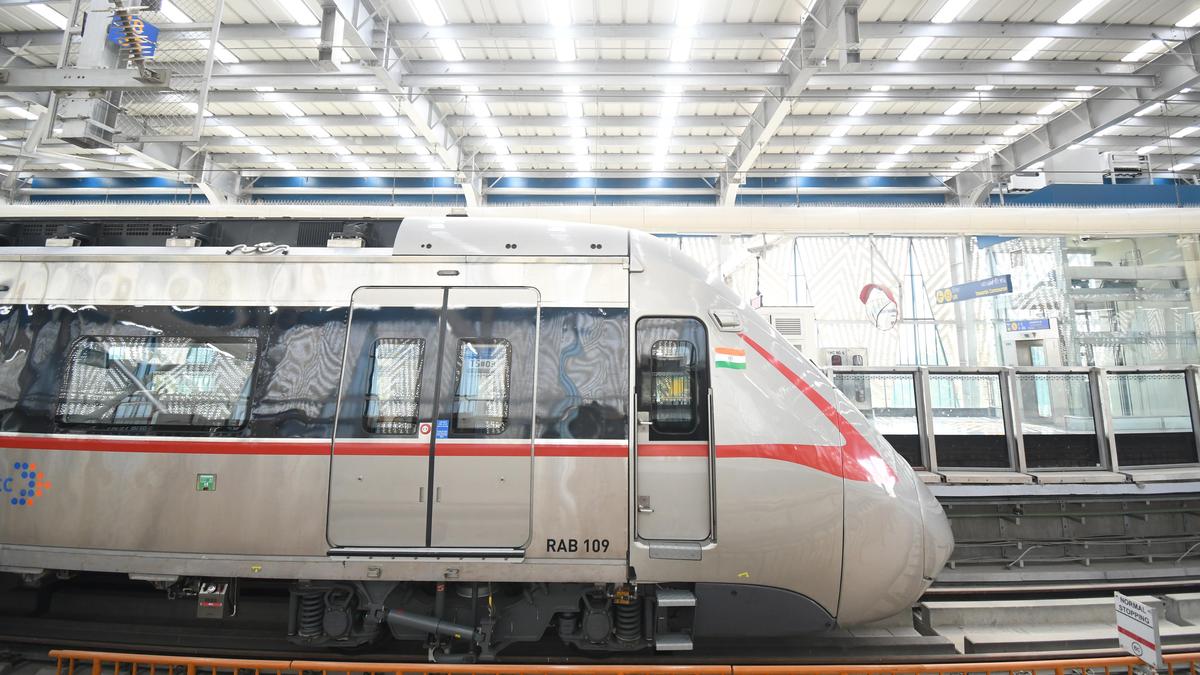
image for representation only
| Photo Credit: SHASHI SHEKHAR KASHYAP
Amid the alleged continued neglect of the Centre towards the demands of Kerala for high-speed travel and claims by technocrat E. Sreedharan that he has started working on a high-speed rail project as suggested by the Centre, the Kerala government recently accorded in-principle approval for the proposed 583 km-long regional rapid transit system (RRTS) project, starting from Thiruvananthapuram to Kasaragod.
Kerala has also decided to take up the first phase of the project, the Travancore line of 284 km from Thiruvananthapuram to Thrissur, to set things in motion. The Kerala Transport department will submit the proposal to the Central government and initiate necessary consultations to obtain mandatory clearances. The project is estimated to cost about ₹1,92,780 crore, and the final cost can only be determined upon completion of the detailed project report (DPR), after finalising alignments, technical models, signalling systems, and transit-oriented development (TOD) models, according to an order.

The 284-km-long phase 1, which includes integration with Thiruvananthapuram and Kochi metros, is slated for execution from 2027 to 2033. This will be followed by the phase 2 Malabar Line (Thrissur to Kozhikode), with integration of Kozhikode Metro, Phase 3 Kannur Line (Kozhikode to Kannur), and Phase 4 Kasaragod Line (Kannur to Kasaragod). Further, the State has plans for the project’s future expansion to Coimbatore via Palakkad, to Kanyakumari from Thiruvananthapuram, and to Mangaluru from Kasaragod through inter-State cooperation, according to the order.
Delhi RRTS funding pattern
Through this “parallel phased execution”, a complete Statewide RRTS network (including Thiruvananthapuram and Kozhikode Metros) can be realised in about 12 years. Taking a cue from the Delhi RRTS, the project could be implemented with a funding pattern of 20% by the State government, 20% by the Central government, and 60% via long-term loans borrowed from international financial institutions. Implementing the project in phases is expected to reduce the financial burden on the State.
The new project has been proposed by the State against the backdrop of the technical objections flagged by the Centre against the previously proposed SilverLine semi-high-speed rail project, along with the public protests against the project in certain areas. As the system can be implemented largely as a grade-separated (elevated on pillars) structure, it can be integrated with the existing and proposed metro rail projects in the State to improve last-mile connectivity and reduce reliance on private vehicles, creating a unified multimodal transit system, the order said.
Adopting the elevated viaduct model (on pillars) instead of an embankment model (at ground level) will significantly reduce land acquisition, prevent the obstruction of natural water flow, and mitigate public opposition observed in certain areas, it added.
Even as the State has been moving ahead with the proposed RRTS, Union Railway Minister Ashwini Vaishnaw on Tuesday reiterated that a high-speed rail would eventually come to Kerala, although the Minister did not provide the details of the Central project.
Published – February 03, 2026 04:16 pm IST



