


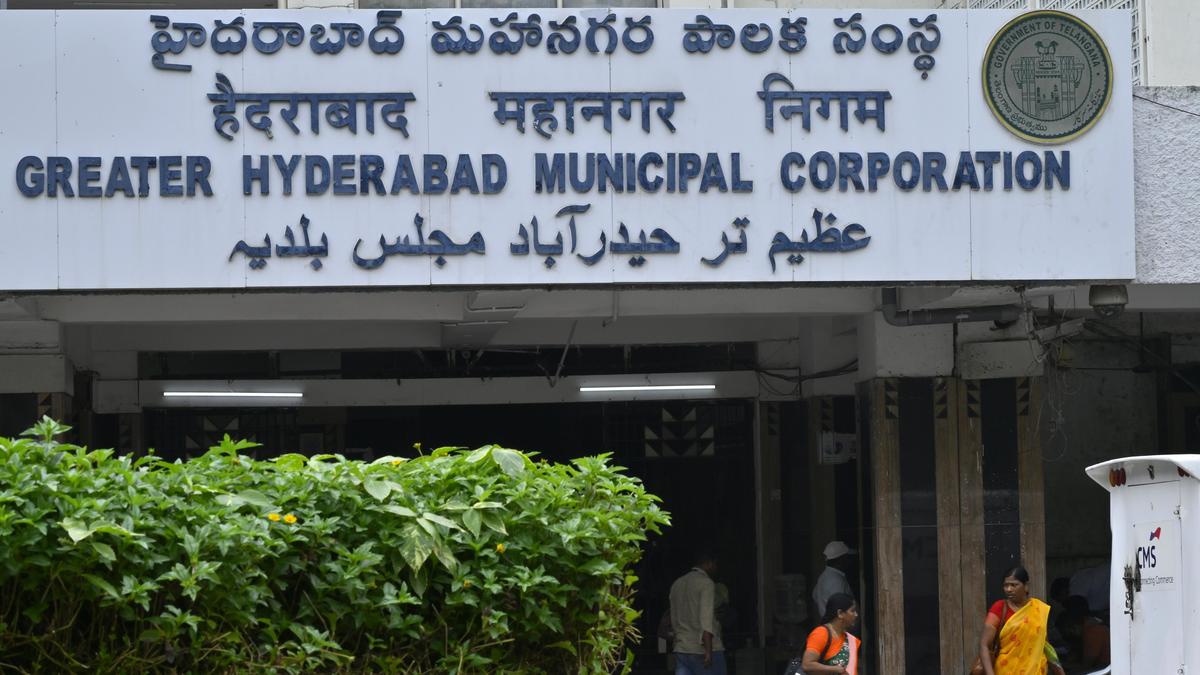
‘The GHMC is now one of India’s largest municipal corporations’
| Photo Credit: The Hindu
The year 2025 was a milestone for the Greater Hyderabad Municipal Corporation (GHMC), with the expansion of the area under its purview from 650 sq km to 2,053 sq km after the subsumption of 27 peripheral urban local bodies (ULB). The GHMC is now one of India’s largest municipal corporations encircled by the 158 km Nehru Outer Ring Road.
Three key ordinances, in late 2025, amending the Telangana Municipalities Act, 2019 and the GHMC Act, 1955, facilitated the GHMC’s expansion and the merger of the ULBs which are either within or through which the ORR passed. The ordinances were passed by the Telangana Legislative Assembly during its winter session. The GHMC has now grown from six zones to 12 zones, 30 circles to 60 circles, and 150 wards/divisions to 300 wards/divisions. With the GHMC Council’s term set to end by February 11, 2026, new council representatives are to be elected for the 300 wards in fresh elections.
While no official announcement has been made yet, there is talk that the civic body could be divided into three different corporations — Hyderabad, Cyberabad and Malkajgiri. There has been a hurried appointment of additional commissioners in the Cyberabad and Malkajgiri regions, a devolution of powers as well as the reorganisation of the town planning and engineering departments.
Also Read | Assembly passes 5 Bills, gives nod to reorganisation of GHMC
Hyderabad is likely to become the largest of all three corporations (150 wards/divisions). Official sources confirm that it would comprise the zones within the core city and the appended regions towards the airport (Rajendra Nagar, Jalpally, Adibatla and Shamshabad). Revenues could be stagnant in the core city with scope for development in the newly added zones remaining limited due to height restrictions around the airport. Cyberabad would encompass all the localities on the western side, which have developed well due to the existence of information-technology and related industries. They include Kokapet, Raidurgam, Serilingampally, Kukatpally, Patancheru, Dundigal, Shamirpet and Medchal. Here, gigantic towers and rising realty prices, rather than road space, water availability and quality of life, seem to attract NRI investments.
Malkajgiri, the ‘third corporation to be’, largely constitutes the eastern part of the city, home to retired government and private employees, middle- and lower-income groups, and migrant populations. This area still faces issues related to semi-urban settings and poor infrastructure. There is also a 350-acre city garbage dump which limits the scope for development in 5-6 kilometre radius.
The demerger of the GHMC into three separate corporations thus negates the goal mentioned in the merger order ‘to tackle uneven growth, service disparities, and fragmented governance in rapidly urbanizing areas…’
Also Read | Merger, demerger, expansion and the birth of the humongous municipality of Hyderabad
The Hyderabad Corporation would in all probability be dominated by the AIMIM, which is poised to increase its tally from 44 to 70-80 seats in a 150-ward council, after the recent ward delimitation exercise. The hard fact is that the AIMIM, with its unrivalled grip on the heritage part of the city for decades, historically displayed no progressive ethos or developmental vision. Its dominance could affect the growth dynamics and cosmopolitan quality of the corporation, with parochial concerns overpowering the larger goals.
The political motive behind all this is undefined, but the Congress party’s voter base could expand. During the 2023 legislative elections, all the city-based Assembly constituencies other than those from the Old City were bagged by the Bharat Rashtra Samithi; the demerger could aid the Congress. There are some who believe that the demerger is to aid Chief Minister A. Revanth Reddy’s pet project, Bharat Future City, about 60 km away from the administrative centre of the State.
The government could learn a lesson or two from the Delhi experiment of 2012 when Delhi was split into three corporations with a stated goal of better civic management. It was hit by financial strain and operational inefficiencies, and the corporations had to be re-unified a decade later. The Telangana government could focus on the deficiencies that plague the GHMC, such as development disparities, woeful staffing, rampant corruption, lack of planning and innovation in urban infrastructure, and unreliable public transport, rather than losing a decade to learn the hard way.
swathi.v@thehindu.co.in
Published – January 19, 2026 12:32 am IST



