
By using this site, you agree to the Privacy Policy and Terms of Use.
Accept
India Times NowIndia Times NowIndia Times Now
Notification Show More
Font ResizerAa
  • India News
    India News
    Politics is the art of looking for trouble, finding it everywhere, diagnosing it incorrectly and applying the wrong remedies.
    Show More
    Top News
    The States Braces for Protests Over New COVID Rules
    August 29, 2021
    Ajaneesh Loknath interview: On ‘Kantara: Chapter 1’ and his hit journey with Rishab Shetty
    October 29, 2025
    N. Ram calls on Chief Minister, presents him The Hindu Year Book 2026
    January 1, 2026
    Latest News
    West Asia crisis: Rajnath Singh calls for swift decisions, long-term readiness
    March 28, 2026
    Government’s failure responsible for supply crunch, panic among people, says Pramod Tiwari
    March 28, 2026
    OBC and EBC voters are not happy with Nitish Kumar moving to Rajya Sabha, says Anand Mohan
    March 28, 2026
    The Tamil connect to a new domestic fuel from CSIR – NCL Pune
    March 28, 2026
  • Technology
    TechnologyShow More
    Strengthening the Team: Thryve PR Onboards Pranjal Patil as PR Executive & Project Manager
    October 1, 2025
    How to Take the Perfect Instagram Selfie: Dos & Don’ts
    October 1, 2021
    Apple iMac M1 Review: the All-In-One for Almost Everyone
    Hands-On With the iPhone 13, Pro, Max, and Mini
    September 4, 2021
    Apple VS Samsung– Can a Good Smartwatch Save Your Life?
    August 30, 2021
  • Posts
    • Post Layouts
      • Standard 1
      • Standard 2
      • Standard 3
      • Standard 4
      • Standard 5
      • Standard 6
      • Standard 7
      • Standard 8
      • No Featured
    • Gallery Layouts
      • Layout 1
      • Layout 2
      • layout 3
    • Video Layouts
      • Layout 1
      • Layout 2
      • Layout 3
      • Layout 4
    • Audio Layouts
      • Layout 1
      • Layout 2
      • Layout 3
      • Layout 4
    • Post Sidebar
      • Right Sidebar
      • Left Sidebar
      • No Sidebar
    • Review
      • Stars
      • Scores
      • User Rating
    • Content Features
      • Inline Mailchimp
      • Highlight Shares
      • Print Post
      • Inline Related
      • Source/Via Tag
      • Reading Indicator
      • Content Size Resizer
    • Break Page Selection
    • Table of Contents
      • Full Width
      • Left Side
    • Reaction Post
  • Pages
    • Blog Index
    • Contact US
    • Search Page
    • 404 Page
    • Customize Interests
    • My Bookmarks
  • Join Us
Reading: A Kodandarama temple that may have inspired Muthuswami Dikshitar’s raganga composition
Share
Font ResizerAa
India Times NowIndia Times Now
  • Finance ₹
  • India News
  • The Escapist
  • Entertainment
  • Science
  • Technology
  • Insider
Search
  • Home
    • India Times Now
    • Home 2
    • Home 3
    • Home 4
    • Home 5
  • Categories
    • Technology
    • Entertainment
    • The Escapist
    • Insider
    • Finance ₹
    • India News
    • Science
    • Health
  • Bookmarks
    • Customize Interests
    • My Bookmarks
  • More Foxiz
    • Blog Index
    • Sitemap
Have an existing account? Sign In
Follow US
Home » Blog » A Kodandarama temple that may have inspired Muthuswami Dikshitar’s raganga composition
India News

A Kodandarama temple that may have inspired Muthuswami Dikshitar’s raganga composition

Times Desk
Last updated: March 27, 2026 7:27 am
Times Desk
Published: March 27, 2026
Share
SHARE


Sometime in the early 19th century, Muthuswami Dikshitar arrived in Thanjavur for an extended stay. Legend suggests he may have visited even earlier, going by his composition ‘Nabhomani chandragni nayanam’ (Nabhomani raga, Triputa tala), which is believed to have been created on the occasion of the Brihadeeswara temple’s consecration during the reign of Serfoji II. The charanam line ‘Sarabhendra samsevita charanam’ seems to indicate this. As per the Thanjavur Saraswathi Mahal Library records, the consecration took place in 1801, evidencing Dikshitar’s presence in the region.

The composer’s more prolonged stay was to teach music to the Thanjavur Quartet. According to Subbarama Dikshitar’s Sangita Sampradaya Pradarsini, only two of the four brothers, Ponniah and Vadivelu, were disciples of Muthuswami Dikshitar. Today, it is accepted that all four trained under him. Since Vadivelu was born in 1810 and would have been around five when he began learning from Dikshitar, we can assume that the composer came to Thanjavur around 1815.

During his stay, Dikshitar embarked on what may be described as raganga raga project. As is well known, he followed the asampurna mela/raganga raga scheme, wherein a raga can be considered a parent scale if it has all seven notes, not necessarily in linear order or in both ascent and descent. It was scholar V. Raghavan who identified most of the compositions in this set, and the temples in and around Thanjavur mentioned in the lyrics. Of the 72 raaganga ragas, 69 have songs, all of them based on Thanjavur temples. Most of them are on the Big Temple and the Bangaru Kamakshi shrine.
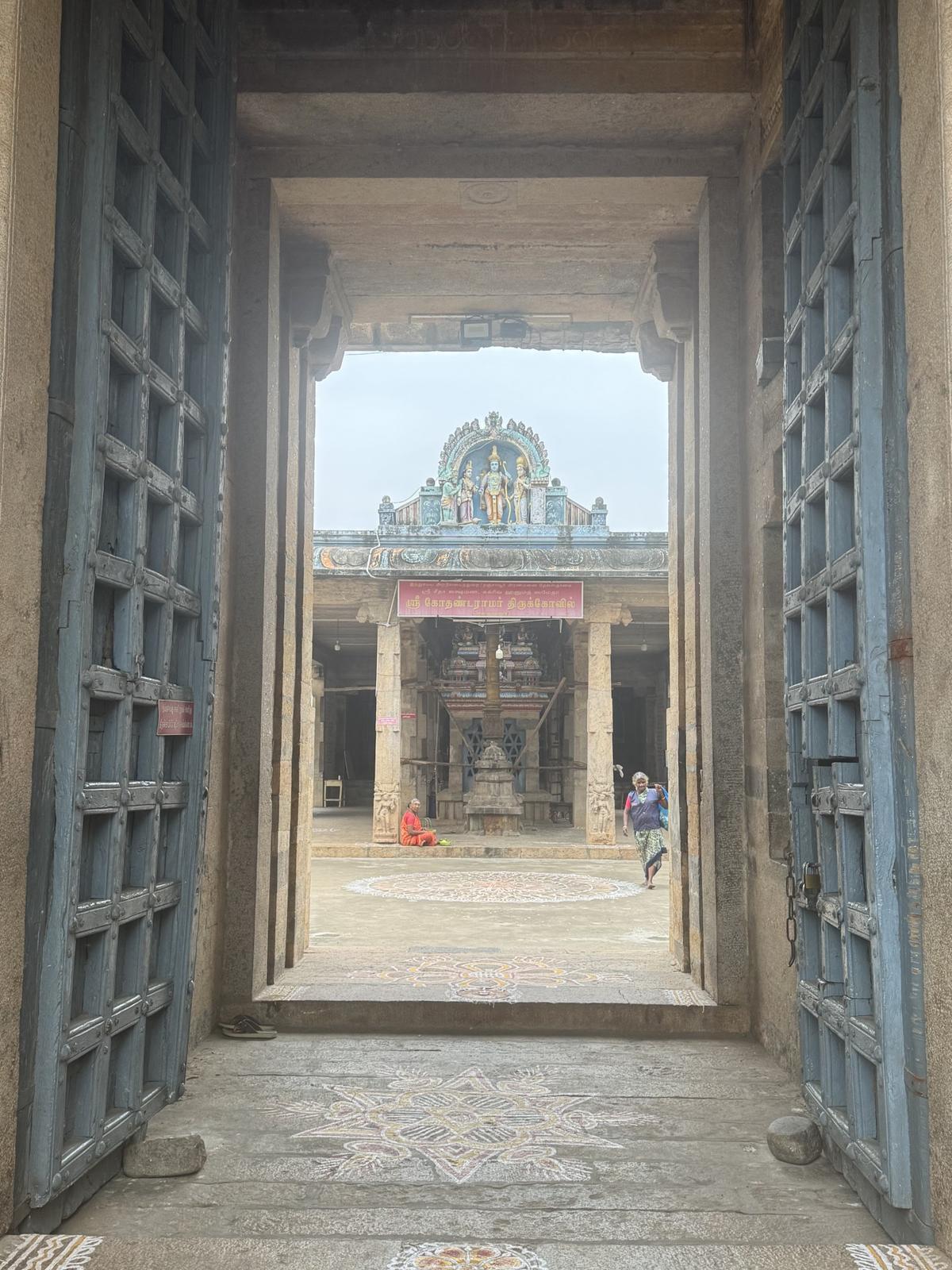
The entrance to the Kodandarama temple on the banks of Vennar in Thanjavur.

The entrance to the Kodandarama temple on the banks of Vennar in Thanjavur.
| Photo Credit:
Special Arrangement

One of the compositions is on Lord Rama — ‘Kodandaramam’ in raga Kokilaravam (the 11th raganga raga in Adi tala). In keeping with most of the raganga compositions, this too is set in the pallavi/anupallavi format, and therefore has no charanam. In recent times, this song has been attributed to the Rama temple at Vaduvur, known for its beautiful utsava deity. But according to V. Raghavan, it was composed on the Kodandarama temple on the banks of the Vennar in Thanjavur.

There is logic in what he says, because the farthest temple to have a composition in the raganga raga scheme is the Dharmasamvardhini shrine in Tiruvarur. All the temples featured in the set come under the administration of the Thanjavur Palace Devasthanam. However, the Vaduvur shrine has never been a part of it, making its association with the song unlikely. Having accepted V. Raghavan’s premise, the task then is to identify the temple he meant.
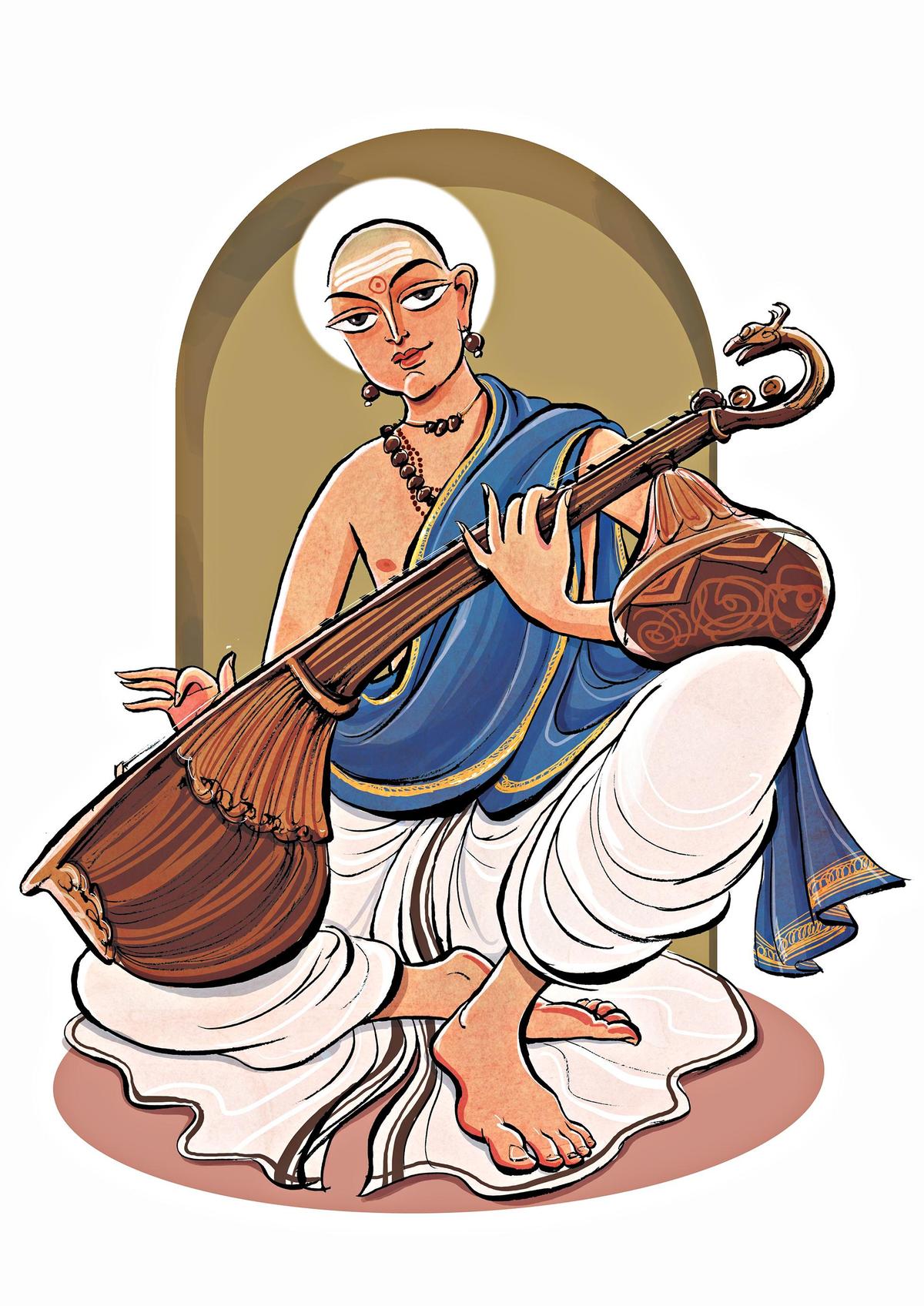
Muthuswami Dikshitar.

Muthuswami Dikshitar.
| Photo Credit:
Illustration by Soumyadip Sinha

The shrine in question is an extremely picturesque one, not far from the famed Punnainallur Mariamman temple. The Vennar flows close by, but the larger water body in the vicinity is the Samuthiram lake. Given Thanjavur’s flat terrain, the temple’s gopuram and that of the Mariamman shrine can be seen from quite a distance. The Kothandarama temple can be reached by a road that runs past the now-ruined Rani Mandapam, once a pleasure pavilion for the Maratha queens.

The Vaduvur temple was built by Pratapasimha (1740-1763). Interestingly, his queen Yamunamba endowed another Rama temple at Needamangalam, whose presiding deity, Santanaramaswami, has been praised by Dikshitar in the kriti ‘Santana ramaswaminam’ in raga Hindola Vasantam. In this composition, Dikshitar refers to the kshetra as Yamunambapuri, indicating the queen’s patronage.

A flight of steps takes you to the entrance arch of the Kodandarama temple in Vaduvur. The rectangular structure of the temple comprises the sanctum, a mukhamandapam and a spacious circumambulatory corridor. A colonnaded verandah with a raised platform runs all along the periphery, allowing devotees to sit and witness temple festivals. It also serves as a vahana mandapam.

Legend has it that the utsava idols of the temple — Rama, Lakshmana, Sita and Anjaneya — were discovered in a field, leading to the construction of the shrine. The moolavar is a magnificent standing Kodandarama, with Lakshmana, Sita and, most unusually, Sugriva. Hanuman, in veera posture, has a south-facing sanctum. There is another Hanuman idol outside this sanctum. A Garuda faces the main Rama. The priests here say that the moola Rama is made of Salagrama stone brought from Nepal, though it is more likely that it is fashioned in stucco, with Salagrama forming the core.

The tranquil ambience of the temple makes you imagine Dikshitar sitting here and composing kritis. That said, the composition does not give any kshetra details, and so the argument that it cannot be on Vaduvur stays. But then, none of the raganga raga compositions provides any local details.

Irrespective of whether the song was composed here, the temple with its exquisite carvings and ornate garbagriha is worth a visit.

Published – March 25, 2026 05:03 pm IST


Source link

UDF convener Adoor Prakash hints at likely action against MLA Rahul Mamkootathil after new sexual assault charges
ED attaches property worth ₹1.52 crore linked to former Bihar DIG under money laundering act
Stalin instructs officials to take steps to drain rainwater from agricultural land
Bomb threats to Maharashtra legislature, four other places
No women journalists at Muttaqi’s press conference
TAGGED:Dikshitar's compositions on RamaKodandaramar temple in VaduvurMuthuswami DikshitarRamanavami festivalVaduvur temple
Share This Article
Facebook Email Print
Leave a Comment

Leave a Reply Cancel reply

Your email address will not be published. Required fields are marked *

Follow US

Find US on Social Medias
FacebookLike
XFollow
YoutubeSubscribe
TelegramFollow

Weekly Newsletter

Subscribe to our newsletter to get our newest articles instantly!
[mc4wp_form]
Popular News
BusinessStartup

Economic Survey 2025-26: From GDP to credit rating upgrade, here are 10 major highlights

Times Desk
Times Desk
January 29, 2026
GBA reviews e-khata issues; staff complaints after letter to Deputy Chief Minister
Odisha proposes changes to English spelling of six districts
BJP names Ritu Tawde as Mumbai Mayor candidate, Shiv Sena picks Sanjay Ghadi for deputy post
Watch: ‘President Trump considers PM Modi a great personal friend’: Sergio Gor, US Ambassador to India
- Advertisement -
Ad imageAd image
Global Coronavirus Cases

Confirmed

0

Death

0

More Information:Covid-19 Statistics
© INDIA TIMES NOW 2026 . All Rights Reserved.
Welcome Back!

Sign in to your account

Username or Email Address
Password

Lost your password?

