


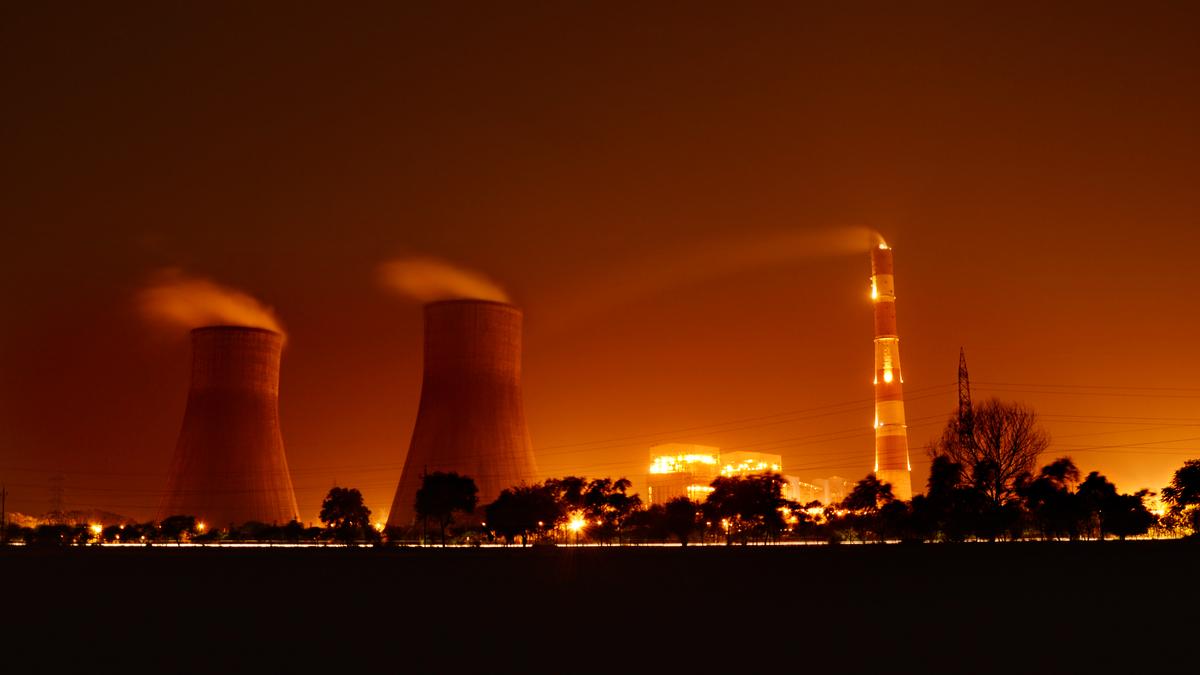
For representative purposes
| Photo Credit: Getty Images
The story so far:
The SHANTI Act, passed in the Winter Session of Parliament, opens the nuclear power sector to private entities and alters the liability framework under the Civil Liability for Nuclear Damage Act (CLNDA). The changes — especially on supplier indemnity and liability caps — have raised concerns about safety and accountability.
What are the key features of the SHANTI Act?
The Act has three main features.
First, it allows private entities to operate nuclear plants, ending the Union government’s exclusive control over the sector. Second, the Act indemnifies nuclear suppliers by channelling liability for any accident to the operator. It omits the “right of recourse” that allowed operators to sue suppliers for accidents caused by defective equipment. The operator’s liability is capped between ₹100 crore for small plants and ₹3,000 crore for the largest plants. The total liability for an accident, including that of the Centre, is capped at 300 million Special Drawing Rights, which is about ₹3,900 crore. The Act also omits Clause 46 of the CLNDA, which allowed victims to invoke other laws, including criminal laws, to seek remedies.
Finally, it provides a legislative framework for the Atomic Energy Regulatory Board but limits the Board’s independence by stipulating that its members will be selected by a committee “constituted by the Atomic Energy Commission.”
Why does the Act indemnify suppliers?
Design defects have played a role in all major accidents.
Safety experts had warned of a weakness in the Mark-1 containment of the GE reactors at Fukushima that exacerbated the disaster in 2011. The report of the International Nuclear Safety Advisory Group identified the reactor’s “positive power coefficient” and its “deficient system for emergency shutdown” as two of the primary causes of the Chernobyl accident in 1986. The U.S. Presidential Commission on the Three Mile Island accident in 1979 noted serious flaws in the control room’s design and criticised the supplier’s failure to communicate known vulnerabilities to the operator. So the indemnity given to suppliers under the SHANTI Act lacks a scientific basis.
However, multinational suppliers, especially from the U.S., had complained vociferously about potential liability in India.
The 2026 U.S. National Defense Authorization Act explicitly seeks that “India … align domestic nuclear liability rules with international norms”, which are favourable to suppliers.
The SHANTI Act ensures that suppliers will not face civil or criminal consequences in India, even if accidents arise from defects in the equipment they supply.
How does the liability cap compare with potential damage?
The Japan Centre for Economic Research has estimated that costs associated with the Fukushima accident could reach 80 trillion yen or ₹46 lakh crore. A joint UN agencies report on the Chernobyl disaster noted that Belarus alone estimated its losses at $235 billion or ₹21 lakh crore. In addition, an area comparable in size to Goa, called the “Chernobyl Exclusion Zone,” has been out of bounds for human settlement for 40 years.
The total cap on liability under the SHANTI Act is about one thousand times smaller than these figures. Even if India avails funds from the international Convention on Supplementary Compensation, the total available compensation is unlikely to reach 1% of the potential damage caused by major accidents. Victims in India would have no legal right to compensation beyond this amount and may have to bear the consequences of loss to life and property on their own. Private nuclear operators might have faced adverse financial consequences in the absence of such a cap, and the SHANTI Act ensures that their interests are protected in the event of a nuclear accident.
What are the potential safety consequences?
Protecting agents from the consequences of their actions creates a “moral hazard” and encourages them to take greater risks. In addition to the liability cap, the Act indemnifies operators for accidents caused by “a grave natural disaster”, reversing India’s “absolute liability” framework for hazardous industries and despite the fact that the Fukushima disaster was caused by a tsunami. This reduces the industry’s incentive to establish resilient plants.
How significant is nuclear energy in India?
Nuclear energy has accounted for only about 3% of India’s electricity generation for decades. In the 1980s, the government announced a programme to reach 10 GW by the year 2000 and, in 2006, it set a target of 20 GW by 2020. However, actual capacity was only 2.86 GW in 2000 and 6.78 GW in 2020. These failures were due to systemic reasons, including the high capital costs of nuclear energy and safety concerns. The “small modular reactors” advertised by the government refer to an untested technology with even higher estimated capital costs per unit of power. So, the government’s new figure of 100 GW by 2047 seems unviable.
What is the economic significance of the Act?
Despite their limited capacity, nuclear reactors open up significant commercial opportunities. For instance, two Westinghouse AP1000 reactors were recently completed in the U.S. state of Georgia at a cost of about 18 billion dollars apiece. The SHANTI Act ensures that private corporations in India and multinational suppliers can profit from these opportunities without being constrained by regulatory bodies or having to face consequences for an accident.
(Suvrat Raju is a physicist associated with Coalition for Nuclear Disarmament and Peace)
Published – February 12, 2026 10:52 pm IST




