


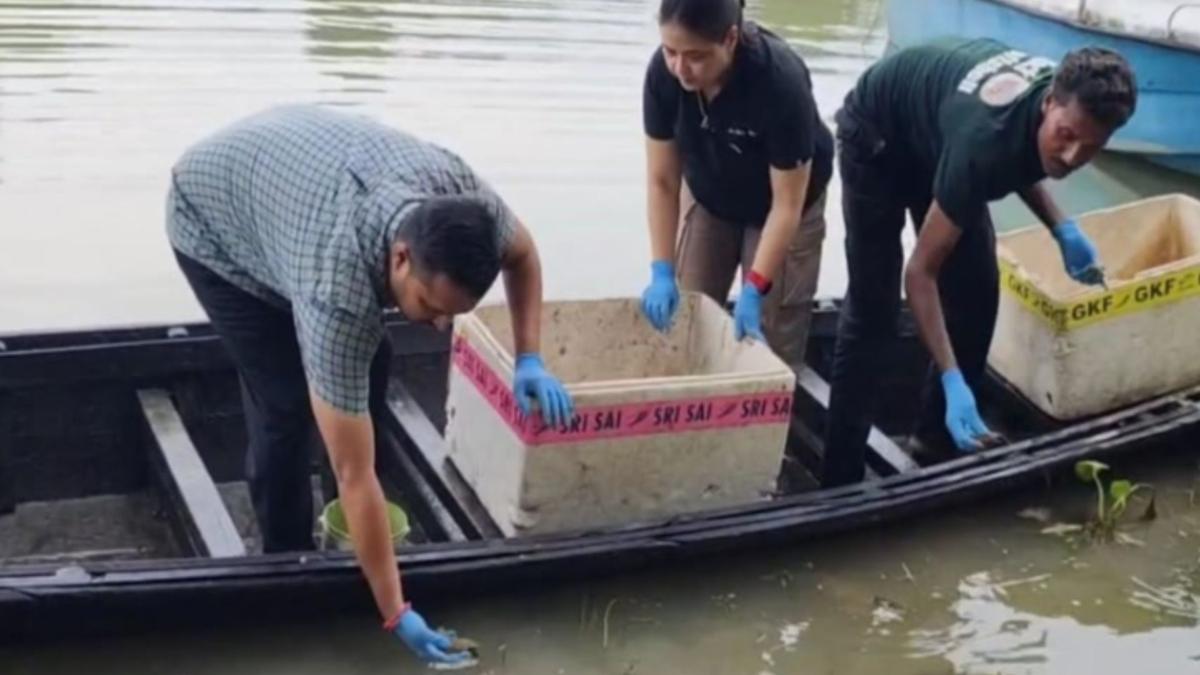
Reptile experts said the release of the 104 hatchlings at the Hadug Beel in Pobitora Wildlife Sanctuary, about 55 km east of Guwahati, marked a significant step in Assam’s turtle conservation efforts.
| Photo Credit: (X/ANI)
Guwahati
A total of 104 hatchlings of three rare turtle species were on Saturday (September 27, 2025) transported from a temple pond and released in a rhino habitat 85 km away.
The three species are the black softshell turtle (Nilssonia nigricans), Indian tent turtle (Pangshura tentoria), and Ganges softshell turtle (Nilssonia gangetica). The black softshell is the rarest of the 28 turtle species found in India.
These turtles were raised at the pond of a temple in Hajo, 30 km west of Guwahati, built in 1583. The temple is dedicated to Hayagriva Madhab, an embodiment of Lord Vishnu, one of whose 10 avatars is a turtle.
Reptile experts said the release of the 104 hatchlings at the Hadug Beel in Pobitora Wildlife Sanctuary, about 55 km east of Guwahati, marked a significant step in Assam’s turtle conservation efforts. The sanctuary is referred to as ‘Mini Kaziranga’ for its similar landscape and sizable rhino population.
“Assam is India’s most turtle-diverse state with 21 recorded species, many threatened with extinction. Temple ponds, particularly the one at Hayagriva Madhab that supports 14 species, play a crucial role in their survival,” said Jayaditya Purkayastha of Help Earth, a Guwahati-based biodiversity conservation group specialising in reptiles.
Wildlife officials stated that the hatchlings were nurtured at the temple in accordance with a long-standing conservation practice and quarantined under veterinary care at the Assam State Zoo before being released into the wild.
“This approach has been vital for the recovery of the black softshell turtle, once declared extinct in the wild by the International Union for Conservation of Nature and now listed as critically endangered,” an official said.
According to herpetologists, such temple pond-based rewilding initiatives, pioneered by the Hayagriva Madhab Temple Committee and the Assam State Zoo, demonstrate the power of combining faith-based traditions, community participation, and scientific management.
Hadug Beel, the chosen release site, is a perennial wetland that is linked to the Brahmaputra River during floods, providing an ideal and sustainable habitat for turtles, fish, and other aquatic wildlife.
With enhanced protection in recent years, Hadug Beel is believed to have become a haven for aquatic biodiversity.
Published – September 28, 2025 10:36 am IST



