


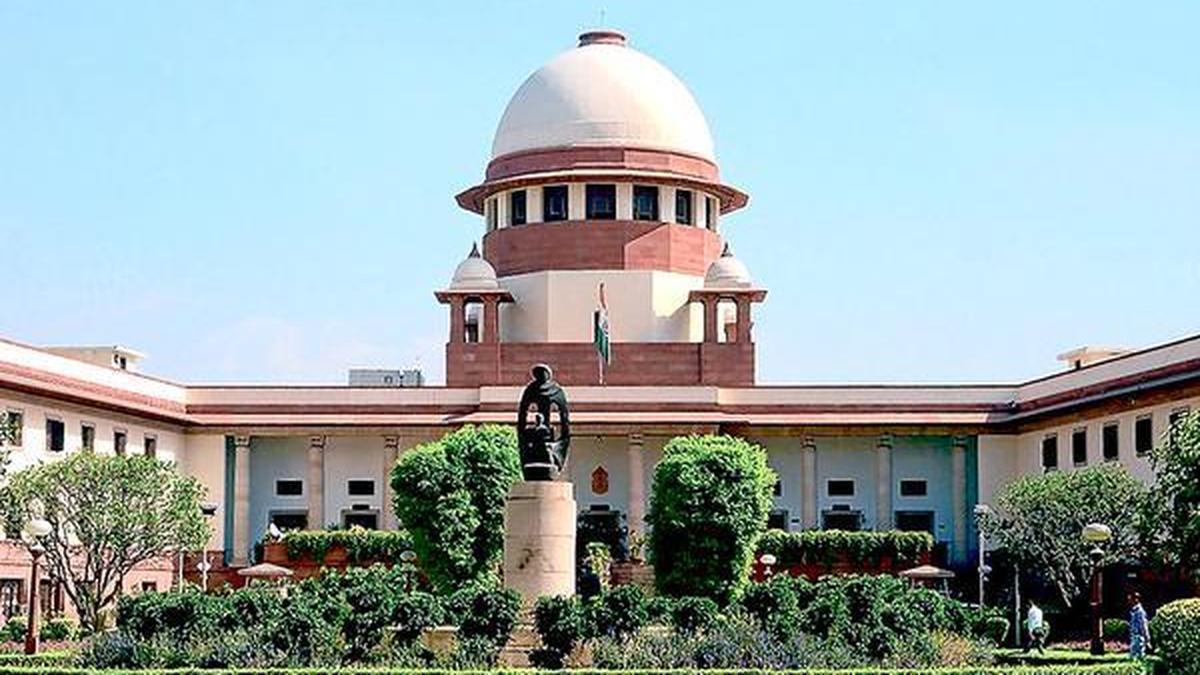
Supreme Court to review plea against CBSE’s mandatory three-language policy for Class 9 students. File
| Photo Credit: S. Subramanium
The Supreme Court on Wednesday (May 27, 2026) agreed to examine if the Central Board of Secondary Education’s (CBSE) three-language rule, set to be effective from July 1 for Class 9 students, has placed unreasonable pressure on resources and children.
A three-judge Bench headed by the Chief Justice of India Surya Kant said the court was more concerned about the logistical and factual challenges of implementing this policy in the face of a dearth of teachers and books.
When senior advocate Kapil Sibal said the policy violated principles of federalism and the right of choice, the Bench said the argument could be turned on its head to submit that learning more languages would work to benefit the spirit of federalism.
Also read | Why is the three-language policy controversial? | Explained
“Somebody can say learning three languages strengthens the federal structure,” Chief Justice Kant addressed Mr. Sibal.
Justice Joymalya Bagchi, on the Bench, said the focus of the petition was “that the implementation was unreasonable… That books are not there, adequate teachers are not there”.
The court issued notice to the Central Government, the CBSE, and the National Council of Educational Research and Training (NCERT) on a petition challenging the mandatory three-language rule.
The Chief Justice asked if the policy warranted any exam in Class 10. Senior advocate Mukul Rohatgi, also for the petitioners, submitted there would be an “internal assessment”.
“Your final-year certificate would reflect it… you have to show you have passed it. You won’t get Class 10 certificate unless you pass it,” Mr. Rohatgi submitted.
The court initially listed the case on June 15. However, Additional Solicitor General Aishwarya Bhati successfully urged the court to list the case in July. The Bench, while asking the authorities to file a comprehensive affidavit, decided to keep it on the opening day in July, after the court’s summer vacation.
Some of the petitioners sought an interim stay on the implementation of the three-language policy. There was clear distress among students who were already saddled with academic load and peer pressure, Mr. Rohatgi said.
The three-language rule was declared in a circular issued by the CBSE on May 15. The circular had said that at least two of the three languages must be native Indian languages, and that the rule was part of the National Education Policy 2020 and the National Curriculum Framework for School Education 2023.

The CBSE had clarified that there would be no Board examination for the third language in Class 10.
“All assessments for R3 (third language) shall be entirely school-based and internal. The performance of students in R3 will be duly reflected in the CBSE certificate,” the Board had said in the circular.
The CBSE had clarified that schools could offer any language, but at least two of them had to be Indian languages. Foreign languages could be taken only as the third or an optional fourth language.
Published – May 27, 2026 05:18 pm IST



