


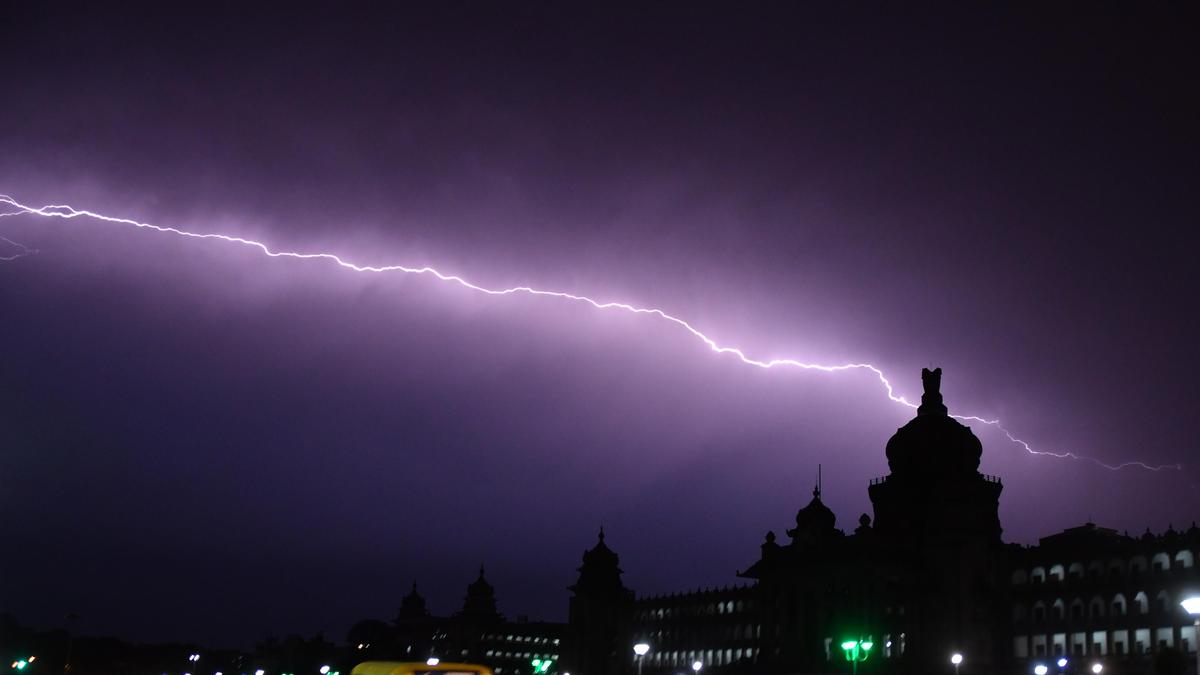
The study reveals that both thunderstorms and lightning events in Bengaluru exhibited a significant increasing trend, rising annually by 3.41% and 3.3%, respectively.
| Photo Credit: File photo
On April 29 Bengaluru received heavy downpour coupled with thunderstorms and hailstorms. The intensity was so heavy that the Bengaluru city station recorded 78 mm rainfall within a duration of about 30 minutes.
A study conducted by the scientists and researchers from the India Meteorological Department (IMD), Bangalore University, and Andhra University, published in the Current World Environment Journal, has found that the heavy rainfall and thunderstorms like the one which occurred on April 29 was not a one off incident but a recurring one.
The study, “Thunderstorms and their Influence on Meteorology and Atmospheric Composition over Southern Peninsular”, has revealed that Bengaluru is experiencing a significant, statistically verified increase in both thunderstorm and lightning activities.
Scientists led by IMD Scientist C.S. Patil, who is the lead author of the study, using a 13-year dataset spanning from 2011 to 2023, have found that Bengaluru records an average of 41 thunderstorm days and 157 lightning strikes each year.
Increasing trend
The study revealed that both thunderstorms and lightning events in Bengaluru exhibited a significant increasing trend, rising annually by 3.41% and 3.3%, respectivelyd.
It further said that Bengaluru’s localised data reveals a unique regional microclimate trajectory as over the 13-year window the city has experienced a steady increase in cumulative rainfall (rising by 1.44 mm per year), relative humidity (up 0.74% per year), while the local surface temperatures showed a slight decline of 0.06°C per year.
According to the study, the amalgamation of high local heat during daytime hours and an abundant moisture supply from moving monsoonal systems creates a perfect thermodynamic recipe to trigger severe storm convection.
“Because heat and humidity are foundational building blocks for storm development, the probability of more severe localised thunderstorms is expected to rise in the coming years,” the scientists said.
When they strike
They also mapped exactly when the thunderstorm and lightning activities strike the city. “Diurnally, thunderstorms follow a sharp unimodal curve : they are incredibly rare during morning and forenoon hours, begin escalating rapidly after 3 p.m. due to daytime solar heating of the land surface, and reach their absolute peak in the late evening between 7 p.m. and 9 p.m.,” they said.
The study further revealed that on an annual scale, the city experiences a dual-peak pattern. “The first and largest spike occurs during the pre-monsoon month of May, averaging 12 thunderstorm days, driven by intense thermal instability and oceanic depressions. A secondary, weaker peak manifests during the post-monsoon transition in September and October as the monsoon trough retreats southward,” the scientists said.
Published – May 21, 2026 09:58 pm IST



