


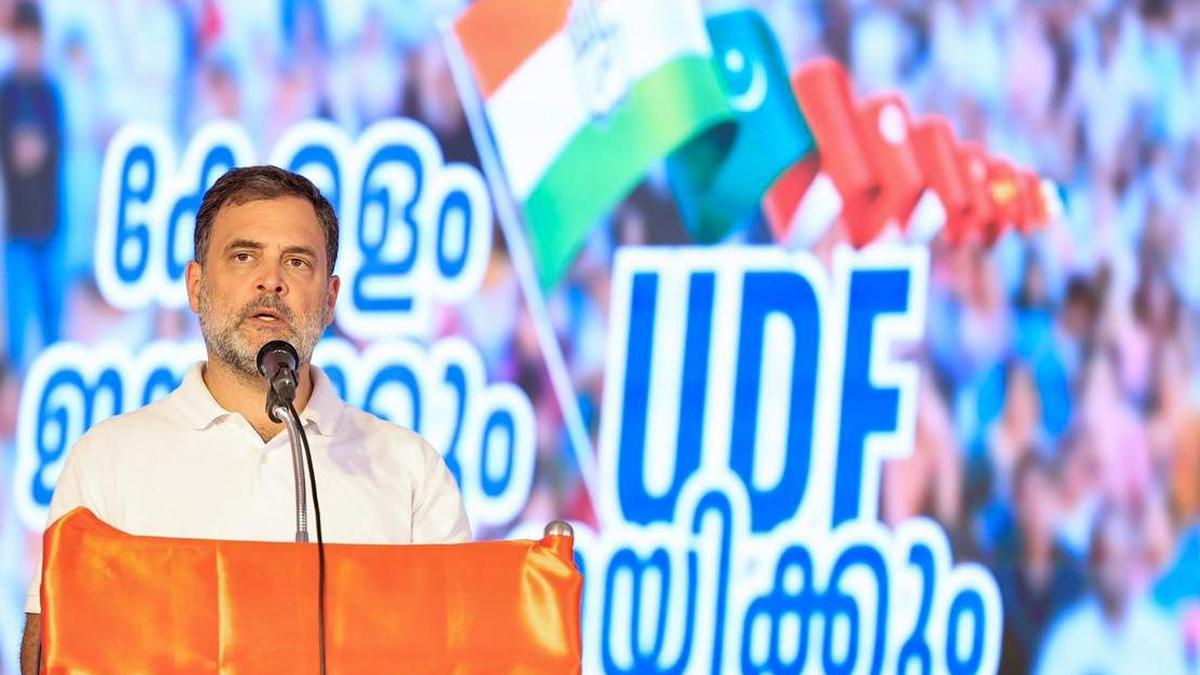
Congress leader Rahul Gandhi
| Photo Credit: ANI
Congress leader Rahul Gandhi on Tuesday (March 31, 2026) launched a sharp attack on both the Bharatiya Janata Party (BJP) and the Communist Party of India [CPI(M)], alleging a “tacit partnership” between the two, while positioning the Congress-led United Democratic Front (UDF) as “the only alternative capable of protecting Kerala’s socio-economic fabric.”
Addressing an election rally in Kannur, the Leader of the Opposition in Lok Sabha said the ongoing polls were “a contest of ideologies” between the Congress and the Left, but claimed that “for the first time, an understanding between the BJP and the CPI(M) has emerged”, describing it as “a convergence between the extreme right and the extreme left”.

Mr. Gandhi pointed to the presence of veteran CPI(M) leaders V. Kunhikrishnan and T.K. Govindan in the UDF camp as indicative of dissent within the Left. “Those who truly represent the people have moved away”, he said, alleging that both the BJP and the CPI(M) had evolved into “corporate-driven parties detached from grassroot-roots concerns.”
Attacks Modi
Targeting Prime Minister Narendra Modi, Mr. Gandhi accused him of selectively raising religious issues across the country, while remaining silent on controversies in Kerala, including allegations linked to Sabarimala gold. He questioned why the Prime Minister, “who projects himself as a defender of Hindu interests”, had not addressed such matters in the State.

The Congress leader alleged political favouritism in the handling of investigations, claiming that while he faced Central agencies’ scrutiny, Kerala Chief Minister Pinarayi Vijayan had not been subjected to similar action.
“If there is no understanding, why is there no comparable pressure?” he asked, alleging that the BJP preferred the CPI(M) in power in Kerala as it was “easier to control” than the Congress.
Slams economic, foreign policies
On national issues, Mr. Gandhi criticised the Centre’s economic and foreign policies, claiming that recent agreements with the United States under Mr. Modi would adversely impact Indian agriculture, energy security and small businesses. He said increased imports and trade commitments would weaken domestic sectors, particularly affecting farmers cultivating crops such as rubber corn, soya and fruits.
He also referred to global geopolitical tensions, including the conflict in West Asia, warning that policy decisions taken now would have long-term consequences for India’s economy and energy access.

Shifting focus to Kerala, Mr. Gandhi outlined a series of welfare measures promised by the UDF, terming these as “guarantees” aimed at addressing unemployment and social security concerns.
Key promises include free bus travel for women, a monthly stipend of ₹1,000 for female college students and interest-free loans up to ₹5 lakh for young entrepreneurs. He also announced a proposal to raise social welfare pension for senior citizens to ₹3,000 and to establish a dedicated ministry for their welfare.
In the healthcare sector, the UDF pledged a comprehensive scheme offering coverage of up to ₹25 lakh per family aimed at strengthening public health infrastructure and reducing financial burden during medical emergencies.
Framing the election as “a choice of values”, Mr. Gandhi said Kerala’s tradition of social harmony inclusiveness and non-violence was under threat. “This is a fight between divisions and unity, anger and compassion,” he said, adding that the UDF stood for “love, brotherhood and economic opportunity.”
He said the Congress was “best positioned” to address unemployment and revive economic growth in the State, while urging voters to back the UDF in the upcoming polls.
Published – March 31, 2026 02:28 pm IST



