


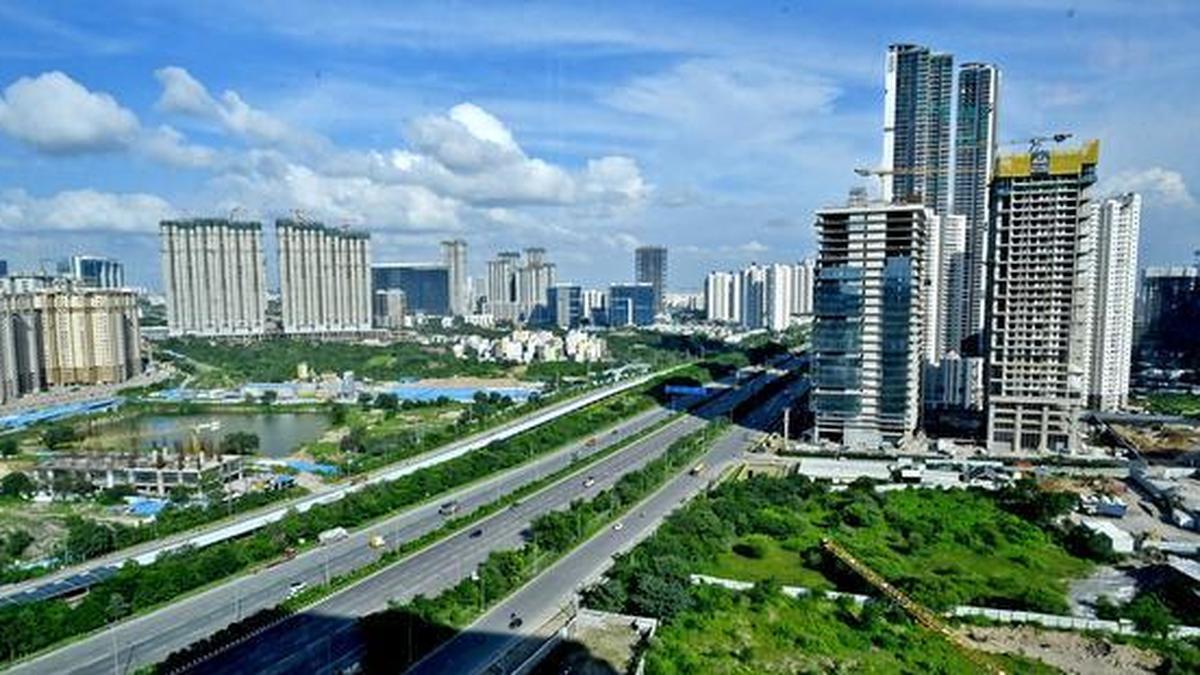
The government has announced amendments to the Telangana Building Rules 2012 aimed at expanding the score of Transferable Development Rights (TDR), easing height restrictions and offering greater flexibility to developers in both high-rise and non-high-rise buildings. Image used for representation purpose only.
| Photo Credit: The Hindu
The government has announced amendments to the Telangana Building Rules, 2012, aimed at expanding the scope of Transferable Development Rights (TDR), easing height restrictions, and offering greater flexibility to developers in both high-rise and non-high-rise buildings.
The new norms were issued on Sunday (March 22, 2026) by the Municipal Administration and Urban Development (MA&UD) Department.
One of the most significant changes is the redefinition of a high-rise building as any structure measuring 21 metres or above, excluding non-working components such as chimneys, cooling towers, lift machine rooms and water tanks.
Further, buildings rising between 18m and 21m on plots ranging from 750 sq.m to 2000 sq.m will now be permitted only through TDR, provided mandatory parking and other rules are met.
The government has allowed the use of TDR for setback relaxations in different categories. Non-high-rise buildings may now obtain setback relaxations via TDR while still adhering to the minimum norms applicable for road-widening situations. High-rises may avail up to 10% relaxation in setbacks through TDR, with a mandatory minimum 7-metre all-round setback.
In instances where Master Plan roads are reduced or modified, applicants are now given a choice to either pay applicable development/conversion charges or furnish equivalent TDR in lieu of payment, offering builders a financially flexible alternative.
To facilitate vertical development, the government has revised the norms for additional floors using TDR in large plots (over 2000 sq.m). This is 3 additional floors on 40-ft roads, up to 4 additional floors on 60-ft roads and up to 5 additional floors on 80-ft roads. All such permissions, however, are subject to fire safety, airport clearances and other regulatory checks.
In a significant tweak to earlier provisions, the government also revised TDR loading requirements for high-rises. Buildings above 10 floors and up to 20 floors must load 3% of the built-up area above the 10th floor with TDR. For structures above 20 floors, 5% of the built-up area beyond the 20th floor must be supported by TDR. To streamline approvals, developers must submit 50% of the required TDR at the building permission stage, and the remaining before issuance of the Occupancy Certificate.
The order follows multiple stakeholder representations seeking rationalisation of TDR usage and more adaptable construction parameters. The new rules are expected to accelerate real estate activity in Hyderabad and other urban regions while providing builders with greater flexibility in project design.
Published – March 22, 2026 11:07 am IST



