


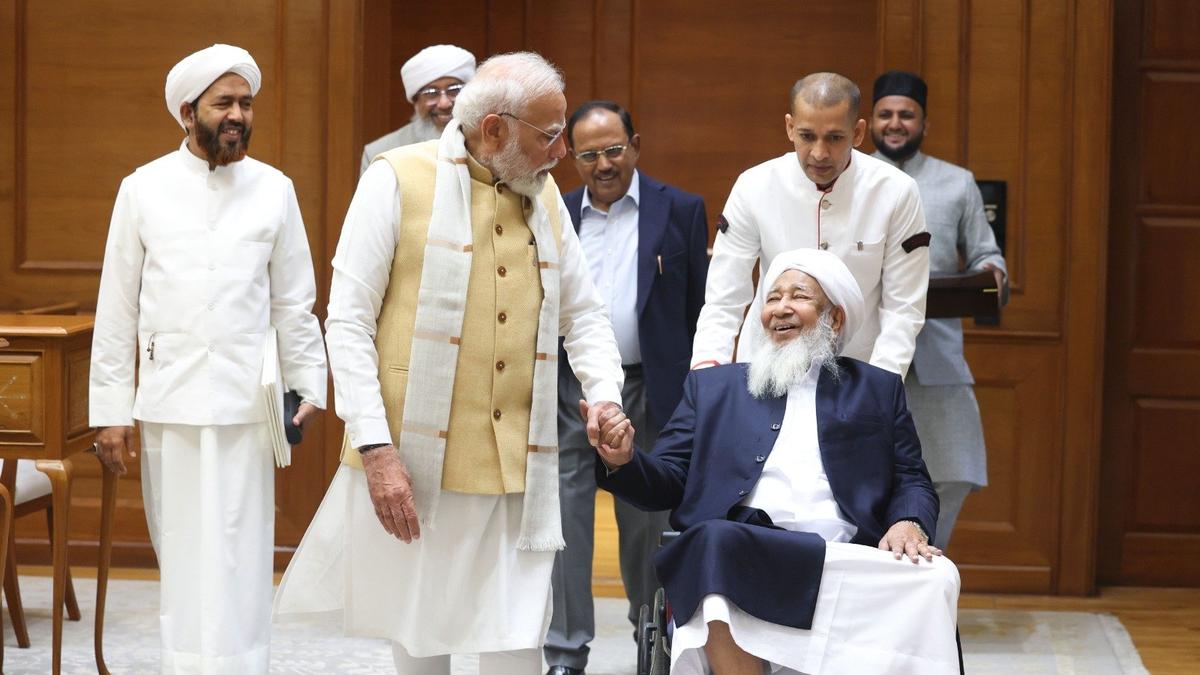
The meeting between Prime Minister Narendra Modi and Kanthapuram A.P. Aboobacker Musliar came just ahead of the Kerala Assembly elections and during the centenary year of the Samastha Kerala Jamiyyathul Ulama, the State’s largest body of traditional Islamic scholars. Photo: X/@narendramodi
The recent meeting between Kanthapuram A.P. Aboobacker Musliar, Kerala’s prominent Sunni leader and general secretary of the All India Jamiyyathul Ulama, and Prime Minister Narendra Modi in New Delhi was no routine courtesy call.
The timing was significant: held ahead of Ramzan, the meeting also came just ahead of the Kerala Assembly elections and during the centenary year of the Samastha Kerala Jamiyyathul Ulama, the State’s largest body of traditional Islamic scholars. In this context, it appeared less about the “Grand Mufti of India” asserting his religious stature or extracting concrete assurances from the Bharatiya Janata Party (BJP)-led government and more about carefully calibrated optics.
The meeting reinforced Mr. Aboobacker Musliar’s standing as a powerful socio-political force within the Muslim community. In a State crowded with leaders claiming influence, his stature remains distinctive — not only within Kerala but also beyond it, where he is known as Sheikh Abubakr Ahmad.
The public relations exercise mattered for Mr. Modi too. Both the leaders shared multiple photographs and exchanged warm words on social media.
Mr. Aboobacker Musliar suggested that the meeting marked the capstone of his 16-day Kerala Yatra under the slogan “with humanity,” during which he interacted with people across social and political divides. He indicated that he shared the concerns and experiences gathered during that tour, including issues affecting minorities, with Mr. Modi. Yet little is known about the Prime Minister’s response to these concerns or any substantive outcomes. The half-hour interaction, by all accounts, was cordial.
In Kerala, reactions to the meeting were predictably divided. The 87-year-old Sunni scholar has been lauded for reaching out to the Prime Minister and for highlighting the concerns of minority communities, essential during a time of growing polarisation. But he has also been widely condemned for his remarks to the Urdu media, saying Muslims in India have been experiencing no major problems under the BJP government. This has been seen by many as a way of softening criticism of the government’s policies, widely viewed as unsettling to minorities. Among his critics were proponents of “political Islam,” a group he recently described in a resolution as a major threat to communal harmony in Kerala. His supporters were quick to defend him, however, arguing that leaders like him must exercise caution and strategic restraint, particularly in statements to the media.
Mr. Aboobacker Musliar is known for his diplomacy in socio-political circles. Though he has often drawn sharp criticism for statements upholding orthodoxy, he has never made his political stance explicit. During elections, his prime-time messages frequently convey the sentiment, “we will help those who help us.”
Even his recent call for a reunification of the Samastha Kerala Jamiyyathul Ulama — popularly known as Samastha — fits this pattern. The call — less a suggestion and more a moral imperative — is unlikely to make any major impact in Kerala’s socio-political firmament, despite being welcomed by the rival Samastha faction and the Indian Union Muslim League thanks to the respect he has earned through decades of restraint. The rival Samastha faction commands greater numerical strength and operates with its own political calculations.
Publicly, Mr. Aboobacker Musliar has maintained equal distance from all parties and fronts, but the Samastha faction he leads is widely recognised for supporting the Left Democratic Front in Kerala. The participation of Chief Minister Pinarayi Vijayan and Opposition Leader V.D. Satheesan in the grand finale of his Yatra in Thiruvananthapuram on January 16 testified how much the religious leader is sought after by the two major fronts in Kerala. Both fronts have been vying to get the support of Mr. Aboobacker Musliar and his Sunni group, but he has mastered the art of remaining non-committal.
Ultimately, the Delhi meeting was less about immediate political gain and more about reaffirming position. By engaging Mr. Modi without surrendering his posture of equidistance, Mr. Aboobacker Musliar has reminded both allies and adversaries that neither his leadership nor his Sunni faction can be ignored in Kerala.
Published – February 18, 2026 12:11 am IST



