


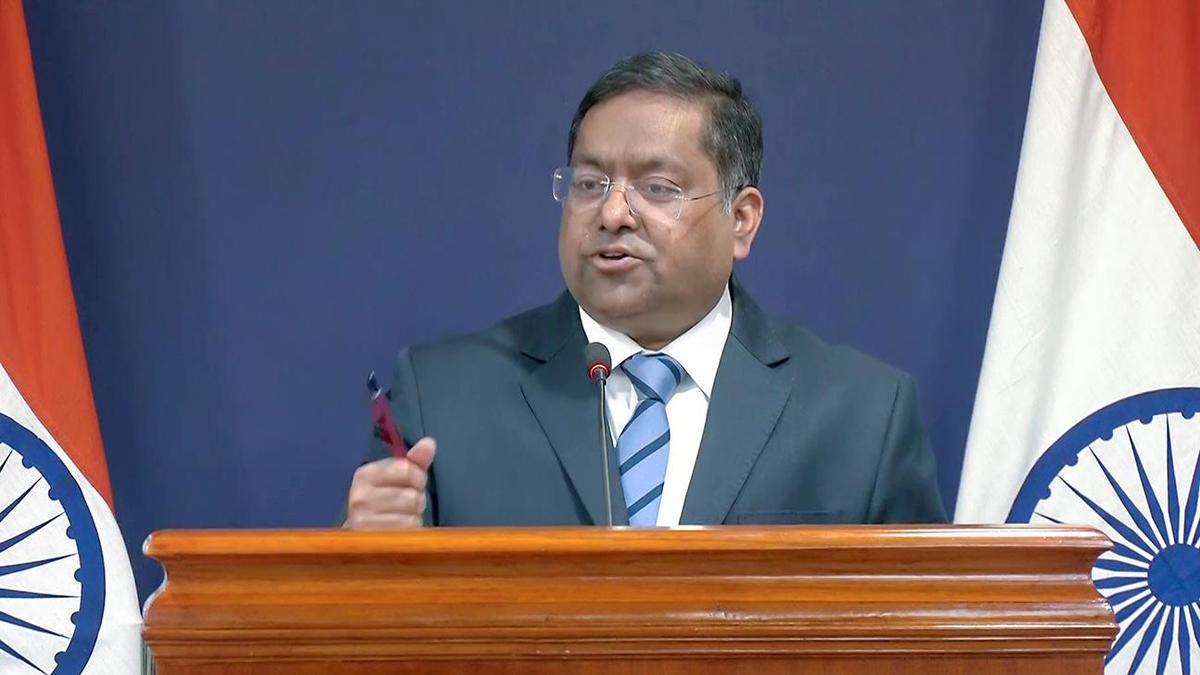
Ministry of External Affairs (MEA) Spokesperson Randhir Jaiswal addresses a weekly media briefing in New Delhi on February 12, 2026.. Credit:X/@MEAIndia.
The Ministry of External Affairs (MEA) has once again refused to directly deny claims by the United States government on Russian oil imports on Thursday (February 12, 2026). This comes after a senior U.S. official said that India had reduced its purchases of Russian crude, as the U.S. “wanted [India] to.”
The government expressed satisfaction at the amendments made by the U.S. administration to its “fact sheet” on the India-U.S. trade deal. The fact sheet, available on the White House website, has now dropped contentious references to pulses and agriculture, saying it reflects the “shared understanding” between India and the U.S. on trade. However, it continues to state that India has committed to stop buying Russian oil.
“The Joint Statement is the framework and remains the basis of our mutual understanding in the matter. Both sides will now work towards implementing this framework and finalising the Interim Agreement,” MEA spokesperson Randhir Jaiswal said. “The amendments in the U.S. fact sheet reflect the shared understandings contained in the Joint Statement.” The joint statement does not contain any mention of Russian oil purchases.

Avoiding questions
As the Opposition continued to raise questions about the agreement in Parliament, U.S. Ambassador to India Sergio Gor met with Foreign Secretary Vikram Misri on Thursday (February 12, 2026). “”So many opportunities ahead now that the trade deal has been finalized,” Mr. Gor wrote in a post on social media.
Mr. Jaiswal refused to comment further on the U.S.’s contentions about Russian oil, a thorny issue that has also been discussed in Parliament and was raised repeatedly by members of the Parliamentary Committee on External Affairs who were briefed by Mr. Misri.
At other briefings, both Commerce Minister Piyush Goyal and Energy Minister Hardeep Puri have refused to answer questions on India’s response to the U.S. claims, directing them to the MEA. In a public statement, Mr. Misri said earlier this week that India’s energy sourcing is guided by pricing, availability, and risks, but did not respond to questions about the sharp month-on-month decline in India’s imports of Russian oil.

‘India acting as U.S. wanted’
On Wednesday (February 11, 2026), at a hearing of the U.S. House Sub-Committee on Foreign Affairs on U.S. ties with South Asia, the U.S. Assistant Secretary of State S. Paul Kapur repeated statements by U.S. President Donald Trump and U.S. Trade Representative Jamieson Greer asserting that India’s actions had been part of the larger trade deal with the U.S.
“The Indians have been reducing their purchases of Russian oil and diversifying away [from it], which is what we [the U.S.] wanted them [India] to do,” Mr. Kapur told the committee. “They’ve actually been buying more U.S. energy and that’s, I think, a promising possibility is to substitute some U.S. energy for the Russian energy and buying from other parts of the world,” he added.
When asked about the repeated statements, Mr. Jaiswal said that Mr. Misri had responded to the “kind of commentary and conversations” being heard, including in the US.
“Exactly to clarify matters, our Foreign Secretary has made a detailed statement… highlighting the various aspects of where [India’s] approach to energy sourcing remains,” he said. However, he refused to answer a question from The Hindu on whether the government’s response to the persistent U.S. claims was a “yes or no”.
According to the White House fact sheet still available online, Mr. Trump had discussed the issue with Prime Minister Narendra Modi during their call on February 2, and had “agreed to remove the additional 25% tariff on imports from India in recognition of India’s commitment to stop purchasing Russian Federation oil.”
Published – February 12, 2026 09:46 pm IST



