


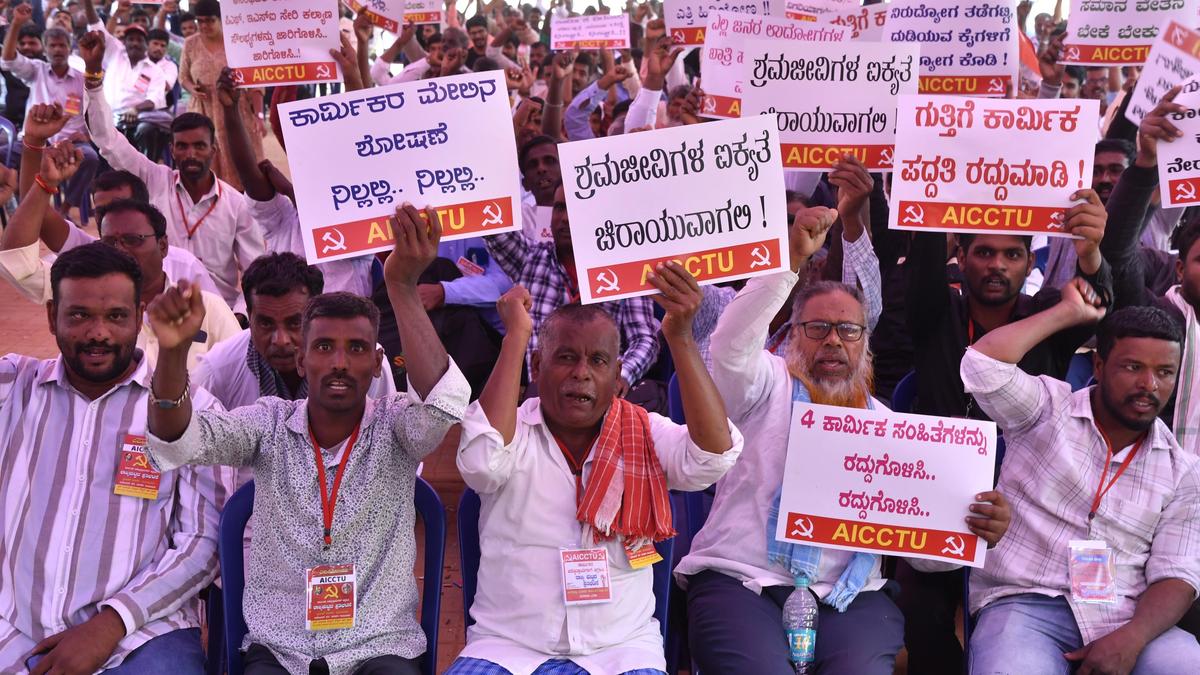
Released on January 27, the draft Code on Wages (Karnataka) Rules lay down procedures for fixing and enforcing minimum wages in the State.
| Photo Credit: ALLEN EGENUSE J.
Projected as a step towards universal wage protection, the Karnataka’s draft Code on Wages Rules largely mirror the Centre’s framework, one that labour union members argued establishes low wages, weakens enforcement and leaves most workers outside its effective coverage.
The draft, they argued, reflects the limited scope States have to correct structural flaws embedded in a centrally-designed law and may end up depressing wages rather than protecting them.
Released on January 27, the draft Code on Wages (Karnataka) Rules lay down procedures for fixing and enforcing minimum wages in the State. However, unions said they retain key features of the central Code, including discretionary floor wage fixation, a narrowed definition of wages and diluted enforcement mechanisms.
Informal workers left out
The Code on Wages, 2019, subsumed four labour laws- relating to minimum wages, payment of wages, bonuses and equal remuneration- into a single legislation. The Union government has pitched it as a reform to simplify compliance, ensure uniformity across States and extend wage protection to all workers, with the Karnataka’s draft rules meant to operationalise the law.
However, Satyanand Mukund, State secretary of the All India Trade Union Congress, said the Code effectively excludes over 90% of India’s workforce, particularly informal, women and domestic workers. He argued that digital compliance systems and employer self-reporting disadvantage workers who lack documentation, bargaining power and access to grievance redressal.
The Karnataka draft details the classification of workers by skill level and zones- metropolitan, non-metropolitan and rural- and bases wage calculations on the needs of a standard working-class family, including food, clothing, housing, education and medical expenses. It also mandates annual dearness allowance (DA) revision linked to inflation.
The labour unions, however, said the draft has left little room for the State to address long-standing concerns. Maitreyi Krishnan of the All India Central Council of Trade Unions (AICCTU) termed the codes “fundamentally anti-worker” and argued that the State should have resisted implementing them, especially since even the Congress has publicly criticised the codes.
She also flagged the treatment of housing costs, arguing that the assumptions used bear little resemblance to real rental or housing expenses.
Floor wage issues
A key concern remains the floor wage fixed by the Union government, below which States cannot go. While consultation is required, the Code does not prescribe a clear methodology or mandate periodic revision, unlike minimum wages. The DA revision is also not required for the floor wage, raising concerns that it may not keep pace with inflation, Mr. Mukund said, warning that the floor wage often becomes the default benchmark, particularly in fiscally stressed States, pushing wages downward.
The union members further pointed out that the Code also removes the earlier system of scheduled employment, under which wages were fixed occupation-wise based on sector-specific risks and conditions. Under the new framework, wages are largely determined by skill and geography.
Definition of ‘wages’
Further, the uniform definition of “wages” excludes components such as house rent allowance, bonuses, overtime and employer provident fund contributions, subject to a 50% cap. Mr. Mukund said this enables employers to restructure pay to keep statutory wages low, reducing linked benefits such as social security and maternity entitlements.
The subsuming of the Equal Remuneration Act, 1976, into the Wage Code has raised concerns around gender justice. While the Code uses gender-neutral language, the union members argued it removes a standalone law that explicitly addressed gender-based wage discrimination.
Published – January 29, 2026 01:01 am IST



