

By using this site, you agree to the Privacy Policy and Terms of Use.
Accept
India Times NowIndia Times NowIndia Times Now
Notification Show More
Font ResizerAa
  • Bharat Shreshtha Ratna Sanman
  • India News
  • Categories
    • Technology
    • Entertainment
    • The Escapist
    • Insider
    • Finance ₹
    • India News
    • Science
    • Health
Reading: OnBoard technology helps visually impaired passengers identify KSRTC buses in Mysuru
Share
India Times NowIndia Times Now
Font ResizerAa
  • Bharat Shreshtha Ratna Sanman
  • India News
  • Categories
Search
  • Bharat Shreshtha Ratna Sanman
  • India News
  • Categories
    • Technology
    • Entertainment
    • The Escapist
    • Insider
    • Finance ₹
    • India News
    • Science
    • Health
Have an existing account? Sign In
Follow US

Home » OnBoard technology helps visually impaired passengers identify KSRTC buses in Mysuru

India News

OnBoard technology helps visually impaired passengers identify KSRTC buses in Mysuru

Times Desk
Last updated: January 11, 2026 11:35 am
Times Desk
Published: January 11, 2026
Share
SHARE


Contents
  • How the technology works
  • Impact and usage patterns
  • Training process
The OnBoard technology is aimed at helping visually impaired individuals identify and board buses.

The OnBoard technology is aimed at helping visually impaired individuals identify and board buses.
| Photo Credit: Special arrangement

The adoption of OnBoard technology among visually impaired passengers has been steadily growing in Mysuru, since its introduction under the Dhwani Spandana project in July 2025. The system enables users to identify KSRTC bus route numbers, making public transportation more accessible.

OnBoard is a patented radio-frequency (RF) based technology developed at IIT Delhi specifically to help visually impaired individuals identify and board buses. The system has been installed in approximately 200 KSRTC buses operating in Mysuru City.

The Swami Vivekananda Youth Movement (SVYM), a Mysuru-based voluntary organization, has trained more than 470 visually impaired persons to use the technology. Of these, 307 individuals have collected their user modules by December 2025, according to Mr. Ramprasad, Officer for Research and Documentation at SVYM.

How the technology works

The OnBoard system consists of a user module—a handheld device that communicates with bus modules through radio frequency. When users press a query button on their device, it connects with the bus module and announces the route number through audio feedback.

Impact and usage patterns

Based on feedback from 30 participants surveyed before and after using OnBoard, the system achieved a 24% reduction in dependence on fellow passengers and bus crew for route identification within nine weeks, SVYM reported.

Students and employees have emerged as the most active users, with the majority falling in the 18-30 age group. Notably, female participants showed higher adoption rates, with 39% of trained women using the system compared to 30% of their male counterparts.
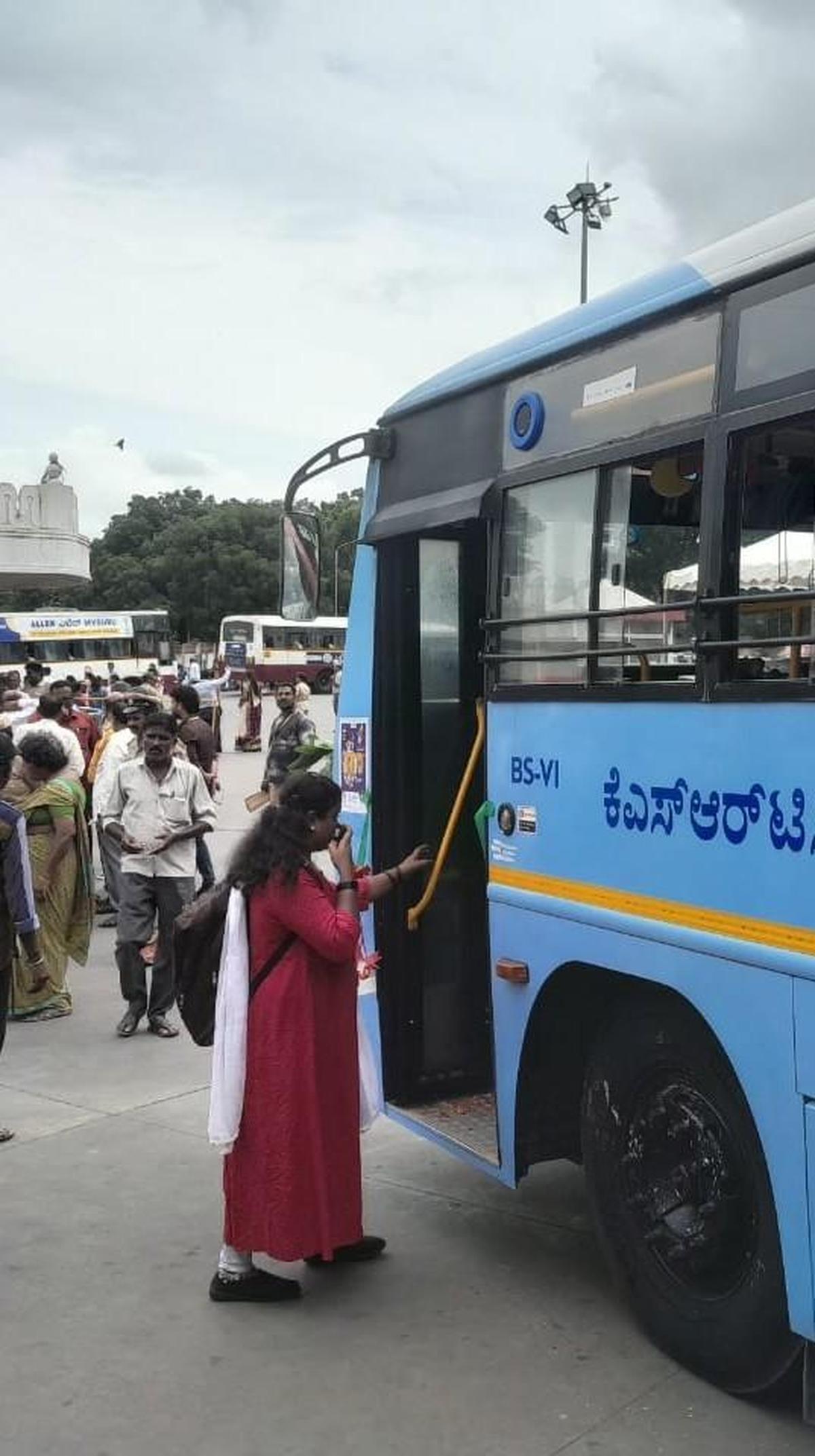
The OnBoard technology has been installed in approximately 200 KSRTC buses operating in Mysuru City.

The OnBoard technology has been installed in approximately 200 KSRTC buses operating in Mysuru City.
| Photo Credit:
Special arrangement

The five most frequently used routes are 303, 116, 119, 266, and 307, which serve areas near colleges and hostels.

“All users who shared feedback reported reduced dependence and increased confidence in traveling, indicating that OnBoard has significant potential to enhance accessibility for persons with visual impairment using bus services,” SVYM stated.

Training process

The training programme is a day-long course combining theory and practical sessions. Theoretical instruction covers device operation, including switches, battery management, and language selection. The practical component uses a private vehicle equipped with a bus module, allowing trainees to practice querying from approximately 30 meters away before boarding.

The OnBoard project is funded by Deutsche Gesellschaft für Internationale Zusammenarbeit (GIZ) and implemented through collaboration among KSRTC, Raised Lines Foundation (RLF), Swami Vivekananda Youth Movement (SVYM), IIT Delhi, KritiKal Solutions, and the visually impaired community.

Published – January 11, 2026 05:05 pm IST


Source link

Hard work, honesty, empathy embedded in State’s social fabric, says Rahul Gandhi while hailing Kerala nurses
Chess player R. Vaishali and other sportspersons get postings in government establishments
Education: Why India needs to radically think its doctoral education programmes
Special trains between Visakhapatnam-Parvathipuram – The Hindu
Bronze statue of Maharishi Sushruta made in Swamimalai unveiled at Royal College of Surgeons of Edinburgh
TAGGED:Dhwani Spandana projectIIT Delhimysuru newsOnBoard technology ksrtcOnBoard technology mysuru
Share This Article
Facebook Email Print
Leave a Comment

Leave a Reply Cancel reply

Your email address will not be published. Required fields are marked *

Follow US

Find US on Social Medias
FacebookLike
XFollow
YoutubeSubscribe
TelegramFollow

Weekly Newsletter

Subscribe to our newsletter to get our newest articles instantly!
[mc4wp_form]
Popular News

Wangchuk returns to Ladakh after NSA revocation, calls for relief to detainees

Times Desk
Times Desk
March 22, 2026
Environment Ministry endorses names of 10-member expert committee set up to define Aravalli hills
The 50: How Divyaa Agarwal’s ‘My husband is…’ comment led to Bhavya Singh’s ‘gold digger’ allegation
At least four killed, 20 injured as bus, truck collide in Odisha
Watch: Deve Gowda expressed love for us, but married PM Modi’s party: Mallikarjun Kharge
- Advertisement -
Ad imageAd image
Global Coronavirus Cases

Confirmed

0

Death

0

More Information:Covid-19 Statistics
© INDIA TIMES NOW 2026 . All Rights Reserved.
Welcome Back!

Sign in to your account

Username or Email Address
Password

Lost your password?

