



The OnBoard technology is aimed at helping visually impaired individuals identify and board buses.
| Photo Credit: Special arrangement
The adoption of OnBoard technology among visually impaired passengers has been steadily growing in Mysuru, since its introduction under the Dhwani Spandana project in July 2025. The system enables users to identify KSRTC bus route numbers, making public transportation more accessible.
OnBoard is a patented radio-frequency (RF) based technology developed at IIT Delhi specifically to help visually impaired individuals identify and board buses. The system has been installed in approximately 200 KSRTC buses operating in Mysuru City.
The Swami Vivekananda Youth Movement (SVYM), a Mysuru-based voluntary organization, has trained more than 470 visually impaired persons to use the technology. Of these, 307 individuals have collected their user modules by December 2025, according to Mr. Ramprasad, Officer for Research and Documentation at SVYM.
How the technology works
The OnBoard system consists of a user module—a handheld device that communicates with bus modules through radio frequency. When users press a query button on their device, it connects with the bus module and announces the route number through audio feedback.
Impact and usage patterns
Based on feedback from 30 participants surveyed before and after using OnBoard, the system achieved a 24% reduction in dependence on fellow passengers and bus crew for route identification within nine weeks, SVYM reported.
Students and employees have emerged as the most active users, with the majority falling in the 18-30 age group. Notably, female participants showed higher adoption rates, with 39% of trained women using the system compared to 30% of their male counterparts.
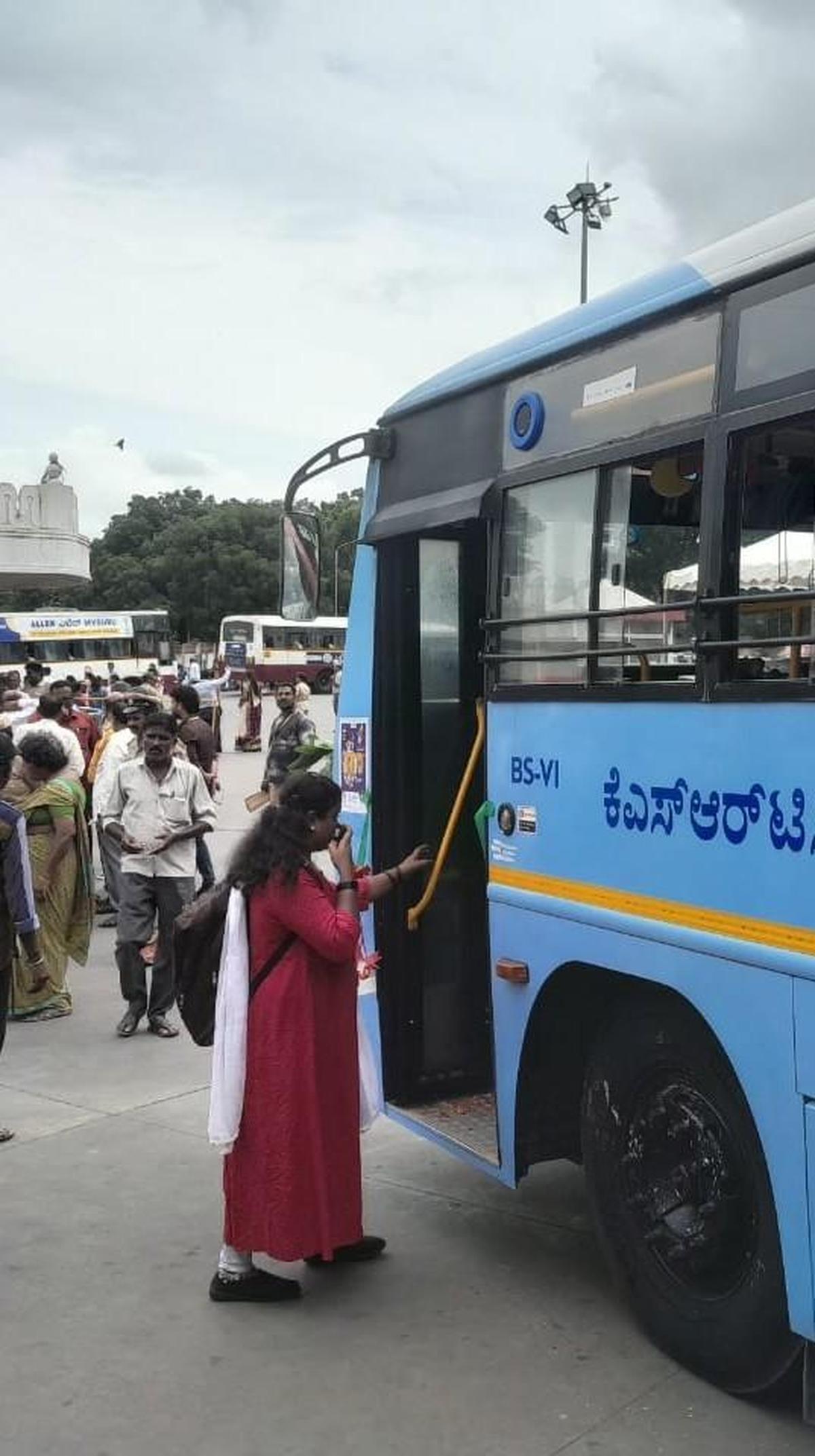
The OnBoard technology has been installed in approximately 200 KSRTC buses operating in Mysuru City.
| Photo Credit:
Special arrangement
The five most frequently used routes are 303, 116, 119, 266, and 307, which serve areas near colleges and hostels.
“All users who shared feedback reported reduced dependence and increased confidence in traveling, indicating that OnBoard has significant potential to enhance accessibility for persons with visual impairment using bus services,” SVYM stated.
Training process
The training programme is a day-long course combining theory and practical sessions. Theoretical instruction covers device operation, including switches, battery management, and language selection. The practical component uses a private vehicle equipped with a bus module, allowing trainees to practice querying from approximately 30 meters away before boarding.
The OnBoard project is funded by Deutsche Gesellschaft für Internationale Zusammenarbeit (GIZ) and implemented through collaboration among KSRTC, Raised Lines Foundation (RLF), Swami Vivekananda Youth Movement (SVYM), IIT Delhi, KritiKal Solutions, and the visually impaired community.
Published – January 11, 2026 05:05 pm IST



