


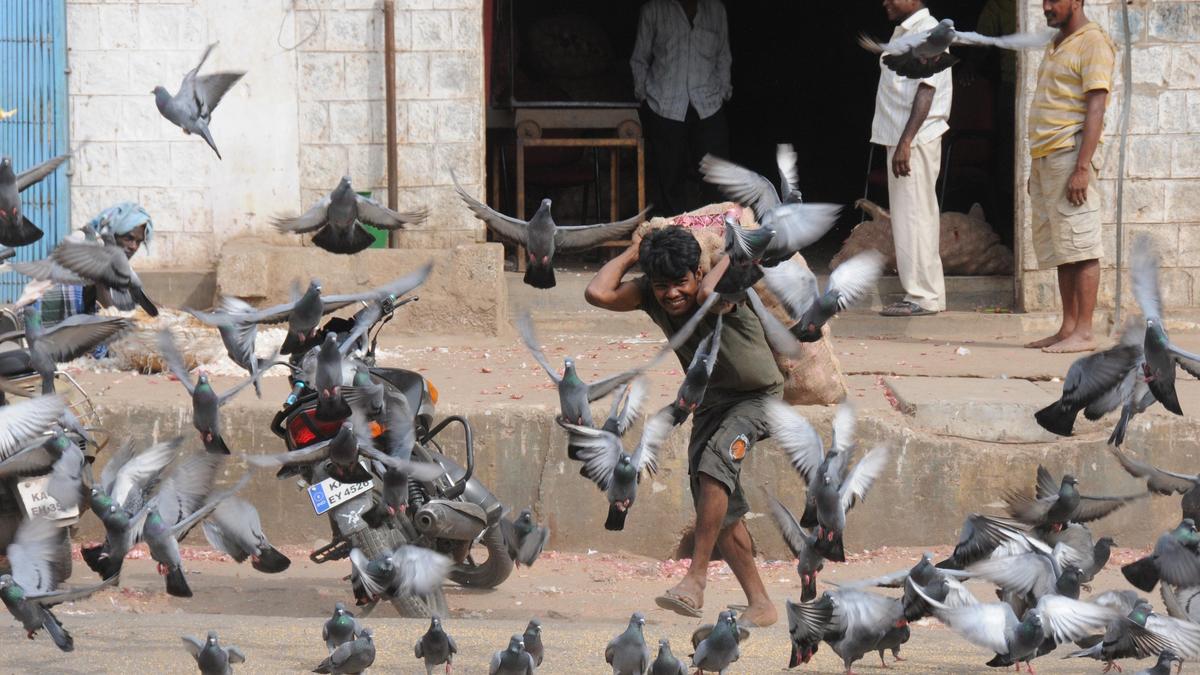
The Health Department has requested the Urban Development Department to issue directions to the Greater Bengaluru Authority and all municipal corporations to enforce specific guidelines on the feeding of pigeons in public places..
| Photo Credit: file photo
The Deputy Secretary of the Health and Family Welfare Department, V. Lakshminath, has written to the Urban Development Department (UDD) to initiate steps to regulate and prohibit the feeding of pigeons in public places.
The Health Department has requested the UDD to issue directions to the Greater Bengaluru Authority and all municipal corporations to enforce specific guidelines.
These include a blanket prohibition on feeding pigeons in areas that cause nuisance or health hazards. Feeding may be permitted only in designated areas. The feeding should be under controlled conditions, for limited hours, and with maintenance responsibilities assigned to charitable organisations or NGOs.
Local authority officers have been authorised to issue on-the-spot warnings, impose fines, or initiate prosecution for violations. The note also directs corporations to conduct public awareness campaigns to educate citizens about health risks, regulatory provisions, penalties, and alternative “humane” methods of bird conservation.
The letter dated December 16 highlights the growing risks posed by excessive pigeon droppings and feathers in densely populated areas as the reason behind the move. The letter highlights medical experts’ caution that prolonged exposure to pigeon droppings and feathers can lead to respiratory illnesses such as hypersensitivity pneumonitis and other lung diseases.
The department cautioned that such conditions may cause severe and sometimes irreversible lung damage, particularly among vulnerable groups. It also refers to similar regulatory measures undertaken by the Greater Mumbai Corporation following directions from the Bombay High Court.
The department has outlined the legal provisions that empower the corporation to curb the “issue”. These include Sections 270, 271 and 272 of the Bharatiya Nyaya Sanhita, 2023, which deal with public nuisance and acts likely to spread diseases dangerous to life.
In addition, powers under the Greater Bengaluru Authority Act, 2025, and the Karnataka Municipal Corporations Act, 1976, enable civic bodies to take measures to prevent the spread of dangerous diseases and ensure public sanitation, according to the letter.
Published – December 16, 2025 11:22 pm IST



