


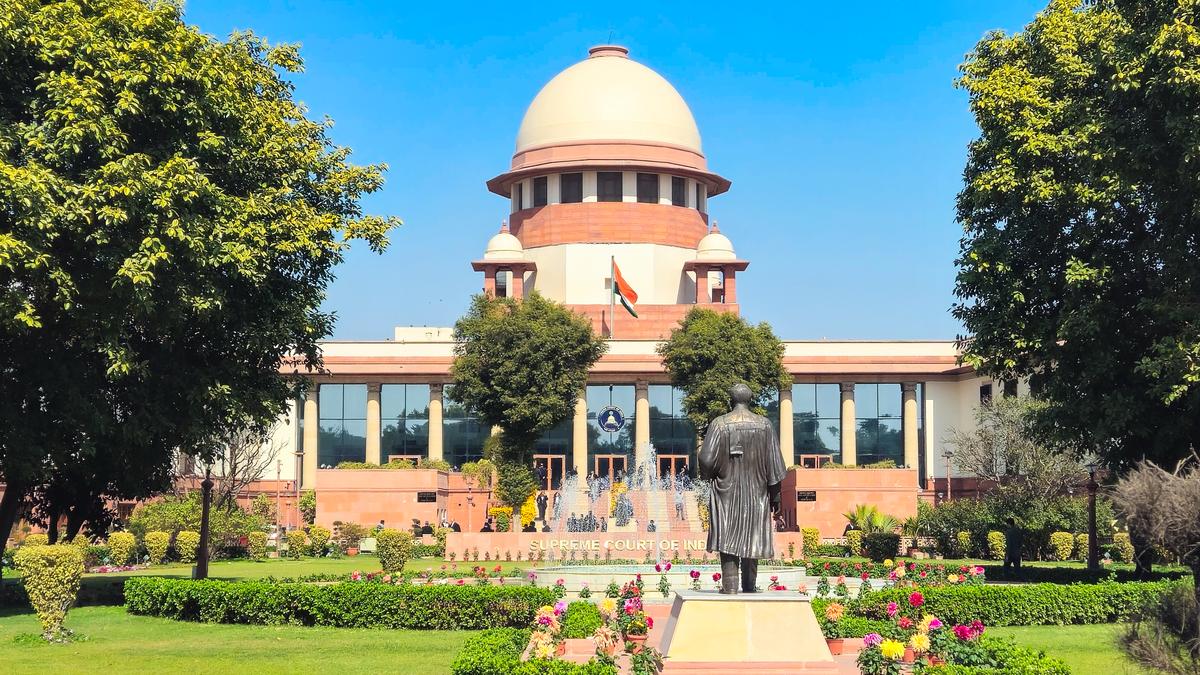
The Supreme Court of India.
| Photo Credit: Getty Images
The story so far:
The Supreme Court has provided its opinion on a Presidential reference made under Article 143. In its opinion, it has largely negated the decision of a two-judge Bench that was delivered in April 2025.
What was the Presidential reference?
The current reference is the result of a two-judge Bench judgment in State of Tamil Nadu versus Governor of Tamil Nadu in April 2025, that had specified a timeline of three months for Governors and the President to act on Bills passed by State legislatures. The court held that decisions by Governors and the President on such Bills are subject to judicial review. It had exercised its extraordinary power under Article 142 and granted ‘deemed assent’ to Bills passed by Tamil Nadu assembly that were not assented to by the Governor.
The present reference had raised 14 questions, primarily surrounding the interpretation of Articles 200 and 201, for the court’s opinion. These questions deal with the authority of the courts to prescribe timelines when they are not specified in the Constitution. The government had questioned whether the actions of Governors and the President can be made justiciable at a stage prior to the enactment of a Bill into a law. The reference also sought an opinion on the extent of powers that can be exercised by the Supreme Court under Article 142.
What is the current opinion?
A five-judge Bench of the top Court delivered its opinion on the questions raised. It stated that this reference was a ‘functional reference’, that strikes at the root of day-to-day functioning of constitutional functionaries and the interplay between State legislature, Governor and the President. Key points of the opinion are summarised below.
First, the Governor has three constitutional options under Article 200 when a Bill passed by State legislature is presented for his/her assent, namely to assent, or reserve the Bill for consideration of the President, or withhold assent and return the Bill to legislature with comments. Second, the Governor enjoys discretion in choosing from these three options and is not bound by the aid and advice of the Council of Ministers. Third, the discharge of functions by the Governor under Article 200 is not justiciable but in case of glaring circumstances of prolonged and unexplained inaction, the court can issue a limited mandamus for the Governor to discharge his/her function on Bills presented. Fourth, in the absence of constitutionally prescribed time limits, the court cannot judicially prescribe timelines for action by the President or Governor. Fifth, the decisions of the President and Governor under Articles 201 and 200 respectively are not justiciable before a Bill is enacted into a law. Finally, the powers of the Supreme Court under Article 142 cannot substitute the powers vested on the President/Governor under the Constitution. Hence, there is no allowance for the concept of ‘deemed assent’ of Bills.
What are the issues?
The Sarkaria Commission (1987), had opined that it is only the reservation of Bills for consideration of the President, that too under rare cases of patent unconstitutionality, that can be implied as a discretionary power of the Governor. The Supreme Court in various cases including in Shamsher Singh (1974) and Nabam Rebia (2016), had held that the Governors should act on the aid and advice of the Council of Ministers. However, in the present opinion, the court has interpreted these cases to conclude that actions under Article 200, with respect to a Bill presented for assent, fall under the discretionary powers of the Governor. This has the potential to derail the legislative intent of popularly elected State governments.
With respect to time limits, the Punchhi Commission (2010), had recommended that the Governor should take a decision with respect to a Bill presented for his/her assent within a period of six months. The court in its own judgment in the K. M. Singh case (2020), had stipulated a time limit of three months for Speakers to decide on disqualification petitions though no time limit has been prescribed in the Constitution. The verdict of the division bench in the State of Tamil Nadu case to provide time limits to Governors and the President was a purposive and progressive interpretation of the Constitution. The current opinion has negated this position.
What can be the way forward?
The underlying disease that has plagued our federal set up has been the politicisation of the gubernatorial post. The Governor acts as an appointee of the Centre for maintaining unity and integrity of the nation. However, federalism is also a basic feature of our Constitution. This opinion should not become an alibi for the Governor’s office to thwart the policies of popularly elected houses in the States. The Governors should display responsible urgency in providing assent to Bills passed by State legislatures.
Rangarajan. R is a former IAS officer and author of ‘Courseware on Polity Simplified’. He currently trains at ‘Officers IAS Academy’. Views expressed are personal.
Published – November 25, 2025 08:30 am IST



