


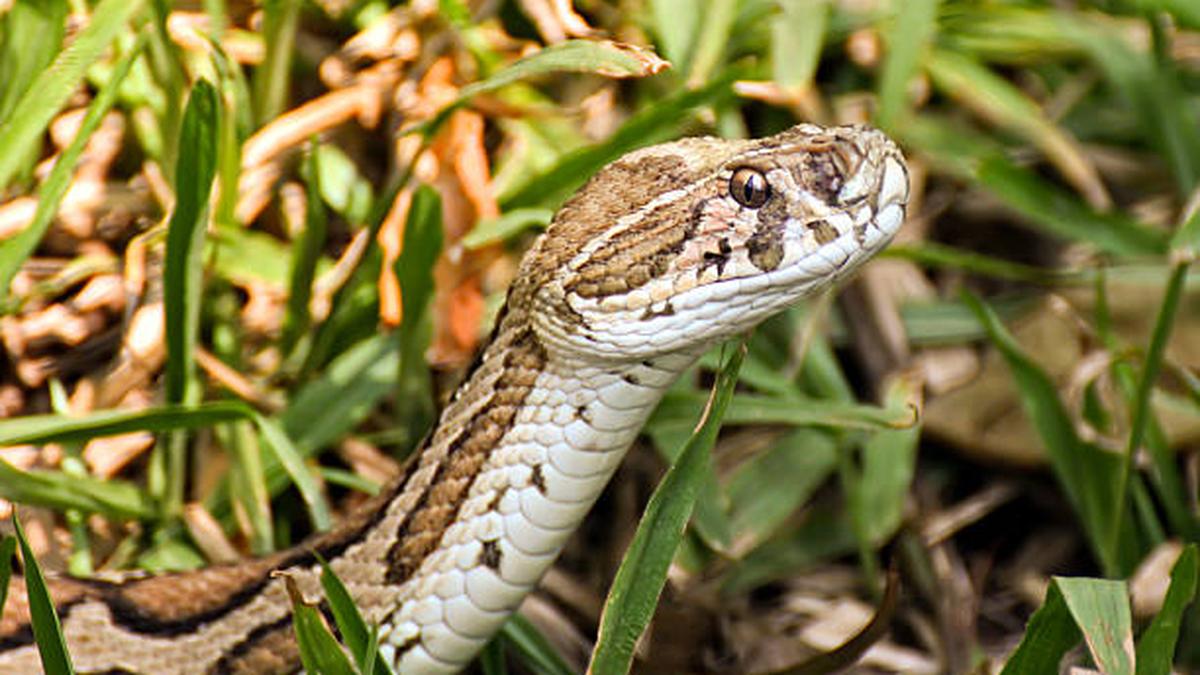
The Russell’s viper is responsible for the majority of bites among the “big four” venomous snake species in India.
| Photo Credit: Getty Images/iStockphoto
The World Health Organisation recognises snakebite envenomation as a “neglected tropical disease”. It causes between 81,000 to 138,000 deaths globally every year, and four-times the number are left with physical disabilities. And “India bears the largest burden of snakebite envenomation globally, accounting for nearly half of the world’s snakebite deaths,” per a new study in Nature Communications.
Nearly half the victims of snakebites die outside hospitals in India. Without prompt antivenom, death or permanent maiming is inevitable, especially by the fangs of the country’s “big four” species of snakes: the Indian cobra, common krait, Russell’s viper (responsible for the majority of bites), and the saw-scaled viper.
“India’s official statistics have long under-reported the true number of cases and deaths,” the paper continued, adding that recent estimates suggest 45,000-58,000 people die every year due to snakebites in India. Many of those that survive have to deal with the long-term effects of snakebites, with neurological sequelae being the most frequent, followed by skin lesions at the bite site, psychological effects, renal and cardiac complications, and sometimes amputations or disabilities.
However, there is an abysmal lack of comprehensive data, particularly in remote regions, “and most available data are hospital-based and fail to capture the public health aspects related to snakebite,” the paper added. “[M]ore attention needs to be given to rehabilitation and follow-up care for snakebite survivors, as many are left with long-term health complications that hinder their quality-of-life.”
For the study, the researchers surveyed 25 districts in 11 States and found that in a year, 7,094 snakebite cases occurred in just these areas, with a mortality rate of 0.33 per 100,000 people. They found that most victims (86.4%) sought hospital care and 60.2% received antivenom.
However, they also found the average “out-of-pocket expenditure” could be debilitating for the already impoverished. Snakebite treatment can cost Rs 3,900 at public facilities around Rs 27,400 at private ones.
“The long-term consequences [of snakebites and treatment] include physical disability and psychological distress in addition to the socio-economic burdens on the victim and family,” the researchers wrote. They added that quick access to hospitals, better antivenoms, and health insurance are “urgently needed” to prevent deaths. In one case, the researchers found that only 12% of victims had insurance cover “in spite of the fact that each BPL card holder is eligible to the Ayushman Jan Aarogya health card, which provides for free treatment in public sector and select empanelled hospitals in the corporate sector.”
“Healthcare providers are often inadequately trained to handle snakebite envenoming and its complications,” the paper added. Worse, patients also delay their visits to medical facilities when they bank on faith healers, losing precious time.
Published – November 21, 2025 03:00 pm IST



