


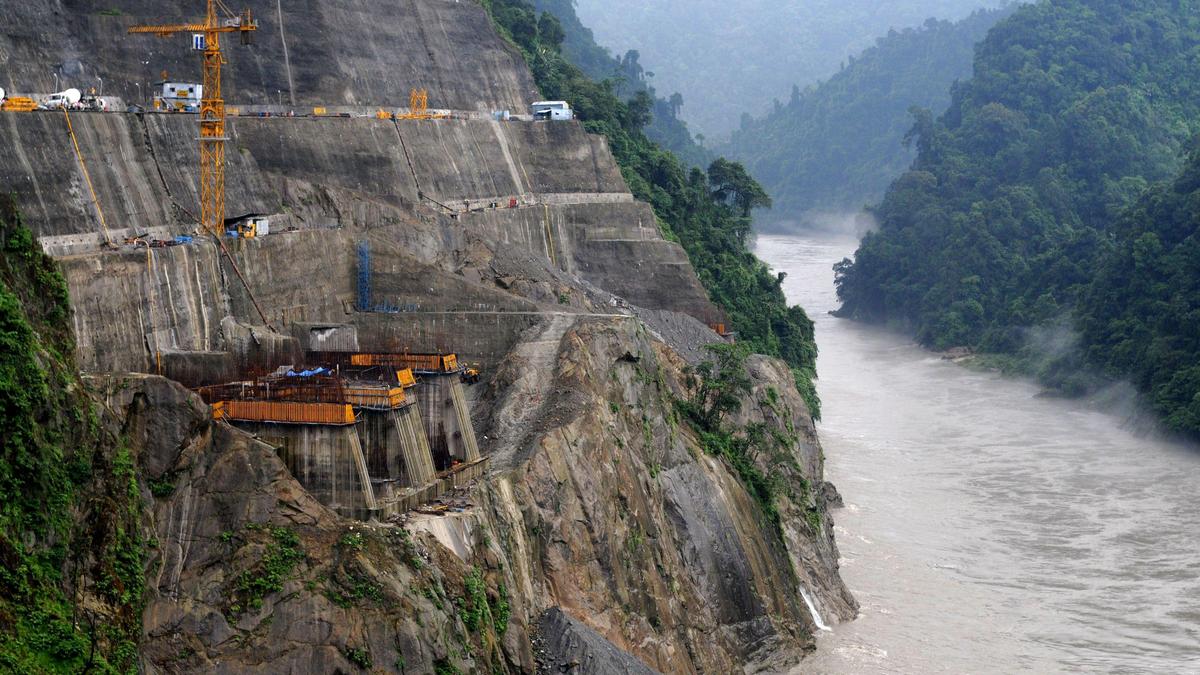
The NHPC’s 2,000 MW Subansiri Lower project in Arunachal Pradesh will be the biggest hydro-electric power project in India and in the entire South East Asia. File
| Photo Credit: The Hindu
GUWAHATI
Arunachal Pradesh has restructured its Department of Hydropower Development (DHPD) to “accelerate hydropower development while safeguarding the State’s ecological wealth”.
Deputy Chief Minister Chowna Mein, who holds the Power portfolio, said the State’s Hydropower Department, rebranded as DHPD 2.0 on November 13, has signalled a renewed push toward clean energy transformation.
“Arunachal Pradesh holds nearly 40% of India’s total hydropower potential, yet only about 2% or 1,227.12 megawatts of our total estimated capacity has been harnessed so far,” he said on Friday (November 14, 2025).
He said that about 31% of the projects are in advanced stages of approval and will soon enter the construction phase, while nearly 57% of the State’s hydropower potential remains to be tapped.
“The State government is committed to unlocking this potential to support Arunachal’s growth and India’s clean energy transition. Our government has declared 2025 to 2035 as the Decade of Hydropower to bring focused attention to the sector and attract major investments,” he said.
Mr. Mein said nearly 19,000 MW of the State’s hydropower capacity is expected to be commissioned in the next decade, involving investments of approximately ₹1.9 lakh crore. “Hydropower is not just an energy source, but a catalyst for building an industrial ecosystem for Arunachal Pradesh and the northeastern region beyond,” he said.
The restructuring of the Department of Hydropower Development involved a redesigned logo featuring the rising sun, flowing rivers, dams, and power lines. Officials said the logo represents the State’s transition toward a cleaner and more sustainable energy future.
The department also has a new catchphrase – ‘Powering Progress, Naturally’.
Anti-dam activists, however, said there was nothing natural about the State’s push for hydropower projects. Tribes and organisations fearing displacement and ecological damage by these projects, some expected to be larger than 10,000 MW, have often clashed with security personnel guarding the proposed sites during pre-feasibility report surveys. The opposition to large dams has been most intense in the Siang and Tawang regions of the State.
Published – November 15, 2025 03:31 am IST



