


Marking 175 years of artistic legacy this year, the Government College of Fine Arts at Egmore in Chennai is one of India’s oldest art institutions and a cradle of modern Indian art. Established in 1850, it has shaped generations of artists who influenced the cultural identity of Tamil Nadu and beyond. From pioneering art education in colonial India to nurturing revolutionary movements in modern art, the institution’s journey mirrors the evolution of art itself.
Archival reports in The Hindu trace the origins of the college to the mid-19th Century. It began as the Madras School of Arts, founded by Alexander Hunter, a military surgeon. It was located on Popham’s Broadway and functioned as a privately run school for two years, with a curriculum designed to train artisans to meet the needs of the British administration. In 1852, an eight-member committee, headed by Hunter, was constituted to overhaul the curriculum after consultations with East India House and the Royal Academy of Arts in London.
The committee recommended that the institution be reorganised as the Government School of Industrial Arts. It also proposed two departments: Artistic and Industrial. The first focused on drawing, engraving, and pottery, while the second dealt with building materials and practical craft training.
The first Superintendent
The school came under the control of the Department of Public Instruction in 1852 and shifted to its present campus on Poonamallee High Road, now known as E.V.R. Periyar Salai. In 1855, Hunter was appointed the first Superintendent of the institution. British experts were invited to teach art and design, and a manufacturing unit was established to support practical training.
Among Hunter’s successors were E.B. Havell, W.S. Hadaway, and R.F. Chisholm. After Hunter retired in 1868, architect Chisholm, known for his Indo-Saracenic architecture buildings, took charge of the school and was officially appointed Superintendent in 1877. The same year, Havell expanded the scope of craft education by introducing wood carving, carpentry, and metalwork.
A major shift in the leadership came in 1929 when Debi Prasad Roy Chowdhury became the first Indian artist to be appointed the Principal. He is remembered for iconic public sculptures, including the Triumph of Labour, known in Tamil as Uzhaipalar Silai, and the Mahatma Gandhi Statue on the Marina. He strengthened the fine arts curriculum and promoted a teaching method based on observation and direct experience. He was only 30 when he took over.
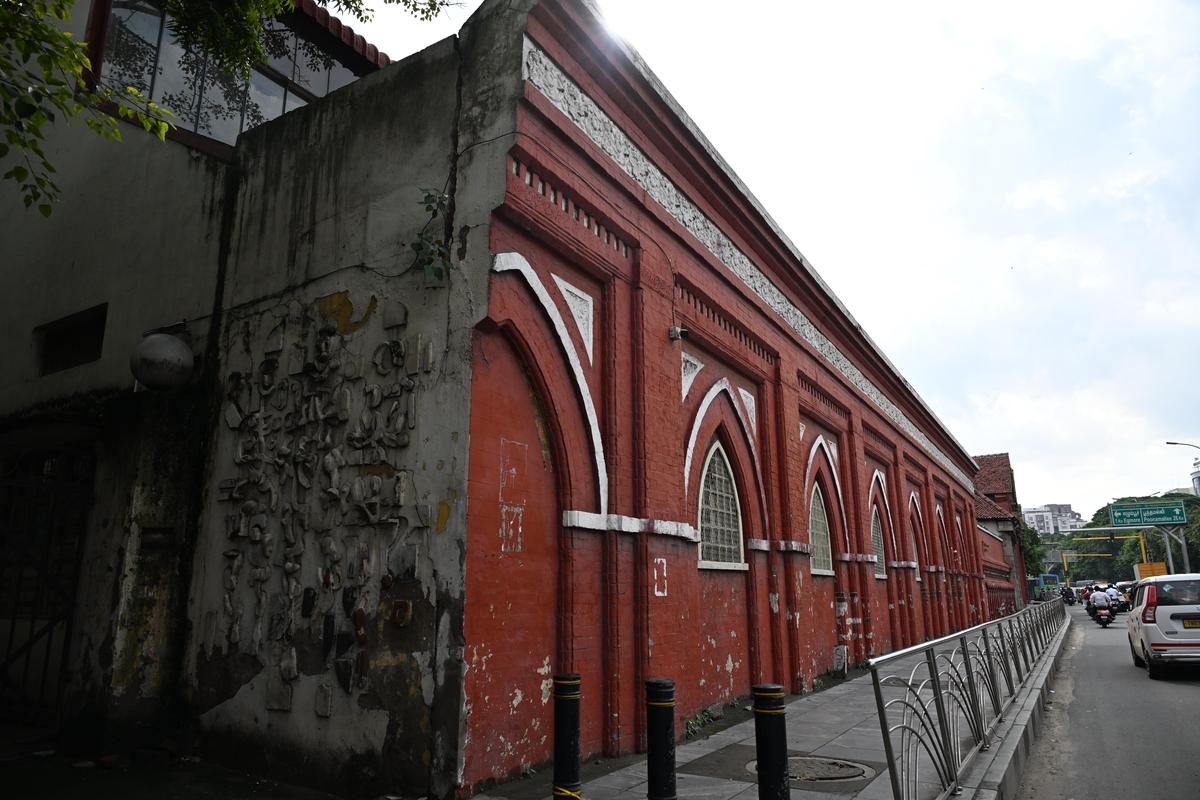
A major shift in the leadership came in 1929 when Debi Prasad Roy Chowdhury became the first Indian artist to be appointed the Principal. He strengthened the fine arts curriculum and promoted a teaching method based on observation and direct experience. He was only 30 when he took over.
| Photo Credit:
B. JOTHI RAMALINGAM
In 1957, Roy Chowdhury was succeeded by noted painter K.C.S. Paniker, who played a key role in bringing together a generation of artists and laid the groundwork for the Madras Art Movement. Paniker introduced a pedagogical approach rooted in the techniques and visual language of the 20th Century European modernism. This opened space for experimentation in both technique and expression and helped to define the direction of contemporary art practice in Madras. He also founded the Cholamandal Artists’ Village near Chennai, which became a landmark in the history of modern Indian art. Over the years, the college’s faculty has included artists such as Ulaganatha Mudaliar, R. Krishna Rao, A.P. Santhanaraj, C.J. Anthony Doss, S. Kanniappan, and P.B. Surendranath. The 4.25-acre campus now houses six departments and a museum that showcases a rare collection of artistic works, including Mughal-era paintings. Since 2013, the college has been affiliated to the Tamil Nadu Dr. J. Jayalalithaa Music and Fine Arts University.
‘A golden period’
Speaking to The Hindu, illustrator and alumnus Trotsky Marudu said the 1960s and 1970s were considered a golden period for the college. He recalled many artists who had trained under Paniker and other distinguished masters, later earned global recognition, and returned to the institution as faculty members. During his student years between 1971 and 1976, the college was headed by veteran sculptor and painter S. Dhanapal. He said animation had emerged as a significant art form and should be included in the curriculum to keep pace with contemporary artistic practices. He welcomed the government’s efforts to improve the infrastructure of the institute, including the renovation of heritage buildings. However, he pointed out that several rare objects and artefacts preserved in the museum required immediate documentation and digitisation to prevent deterioration. These cultural assets would be of immense value to future generations, he said.
Mr. Marudu, who serves as the chairman of the Tamil Nadu Government M.G.R. Film and Television Institute, said the curriculum should adopt a stronger interdisciplinary approach. The students of fine arts should collaborate with peers from film and fashion technology to stay relevant in a rapidly evolving creative landscape. According to him, such collaboration is essential to shape a well-rounded artist. Without this shift, Tamil Nadu risks falling behind culturally in the coming years, he added.
Actor Sivakumar, who studied at the college between 1959 and 1965, shared fond memories of his time there with The Hindu journalists at a recent interaction. He recalled how spot painting gained popularity during his student days. He also displayed some of his spot paintings from the 1960s, including those of the Shore Temple at Mamallapuram, the Arunachaleswarar Temple at Tiruvannamalai, and the Meenakshi Amman Temple in Madurai, featured in his book Paintings of Sivakumar: A Unique Collection.
Published – October 24, 2025 05:30 am IST



