

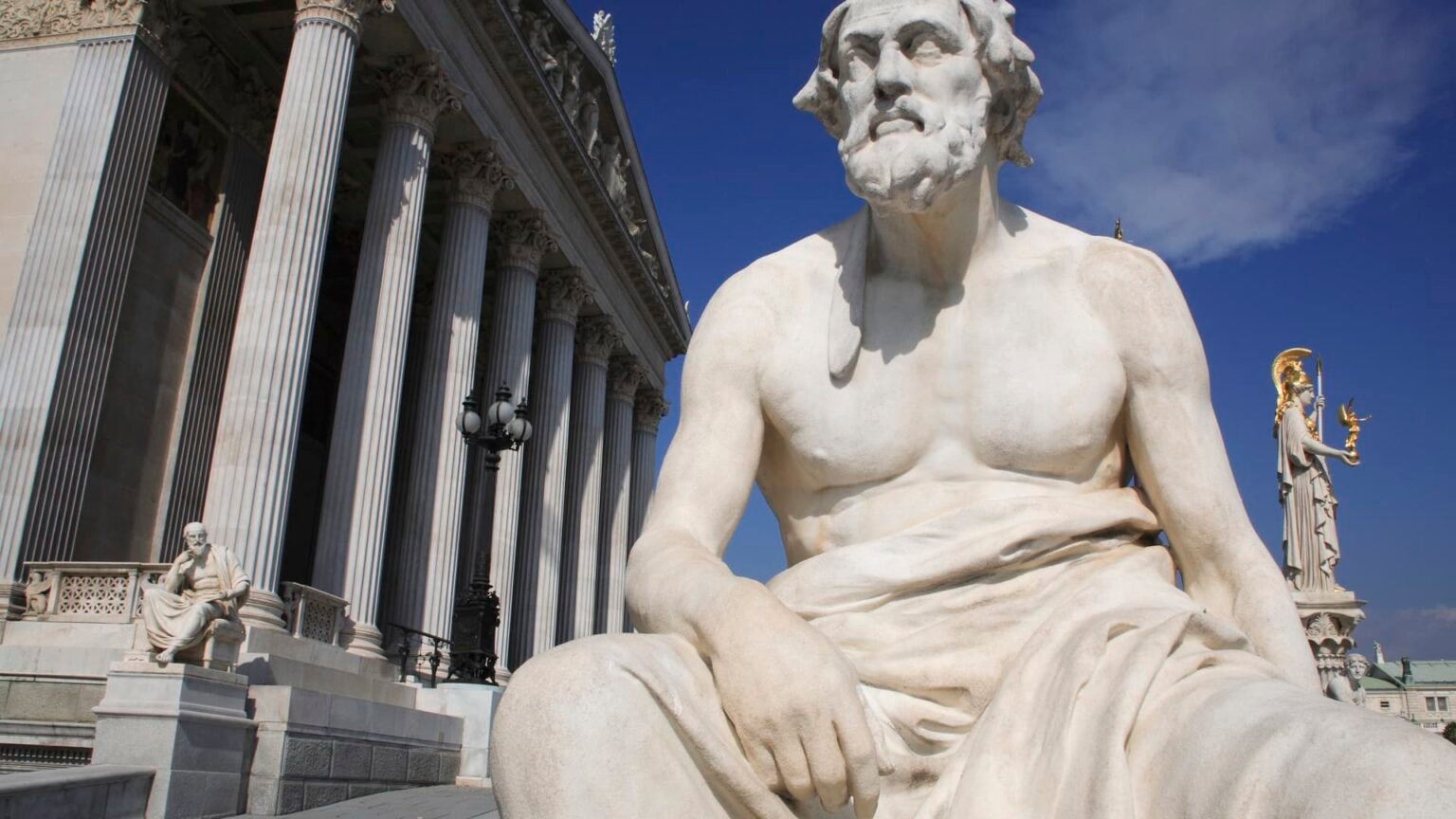

Austria, Vienna, Statue of Thucydides the Greek philosopher in front of Parliament building.
Eye Ubiquitous | Universal Images Group | Getty Images
BEIJING — China is embracing the idea of competition without confrontation, by invoking an academic concept.
“The Thucydides Trap can be overcome,” Chinese President Xi Jinping said on arriving at the White House to meet U.S. President Donald Trump on Thursday, according to the Chinese side’s official readout.
That framing contrasts with the rhetorical question he posed at the May summit of whether the two countries could avoid the Thucydides Trap.
The Thucydides Trap, popularized by Harvard professor Graham Allison in the early 2010s, refers to how tensions between a rising and ruling power have historically often resulted in a war.
Thucydides was an Athenian general in ancient Greece. His historical record of the Peloponnesian War described how Athens’ rapid rise in power alarmed Sparta and made war between the two city-states inevitable.
Allison has met Xi and visited China multiple times, including in June 2026 for a World Economic Forum event. Allison was founding dean of Harvard’s Kennedy School, which for decades trained many of China’s government officials.
The academic previously worked in the U.S. government as Assistant Secretary of Defense under President Bill Clinton in the 1990s and Special Advisor to the Secretary of Defense under President Ronald Reagan in the 1980s.
Xi referred to the Thucydides Trap during a rare interview published by HuffPost in 2014.
“We all need to work together to avoid the Thucydides Trap — destructive tensions between an emerging power and established powers, or between established powers themselves,” Xi said.
A new bottom line?
The Chinese leader’s state visit to the U.S. this week was his first in 11 years. A state media article following his 2015 visit noted Xi’s interest in the Thucydides Trap reflected his view that it’s major powers’ suspicion of each other, rather than any sense of inevitability, that results in the conflict that the term predicted.
Xi’s comment on Thursday about overcoming the Thucydides Trap followed remarks on peaceful coexistence — that the U.S. and China can have “healthy” competition without confrontation.
“It should be a race of catching up with one another, not a wrestle in which one either wins or loses,” Xi said, adding the two countries’ militaries should improve crisis communication and prevention.
This establishment of a bottom line — competing intensely without military conflict — is the “most significant political outcome” of the summit, Cui Shoujun, a professor at Renmin University of China’s School of International Studies, said in Chinese, translated by CNBC. “This injected certainty into the volatile bilateral relationship.”
Trump’s comments on Xi’s arrival at the White House only emphasized general collaboration.
The U.S. president has yet to comment on Taiwan around this summit, despite Xi calling on the U.S. to “oppose ‘Taiwan independence,'” according to Beijing’s readout of the two presidents’ talks on Thursday.
—CNBC’s Anniek Bao contributed to this report.



