


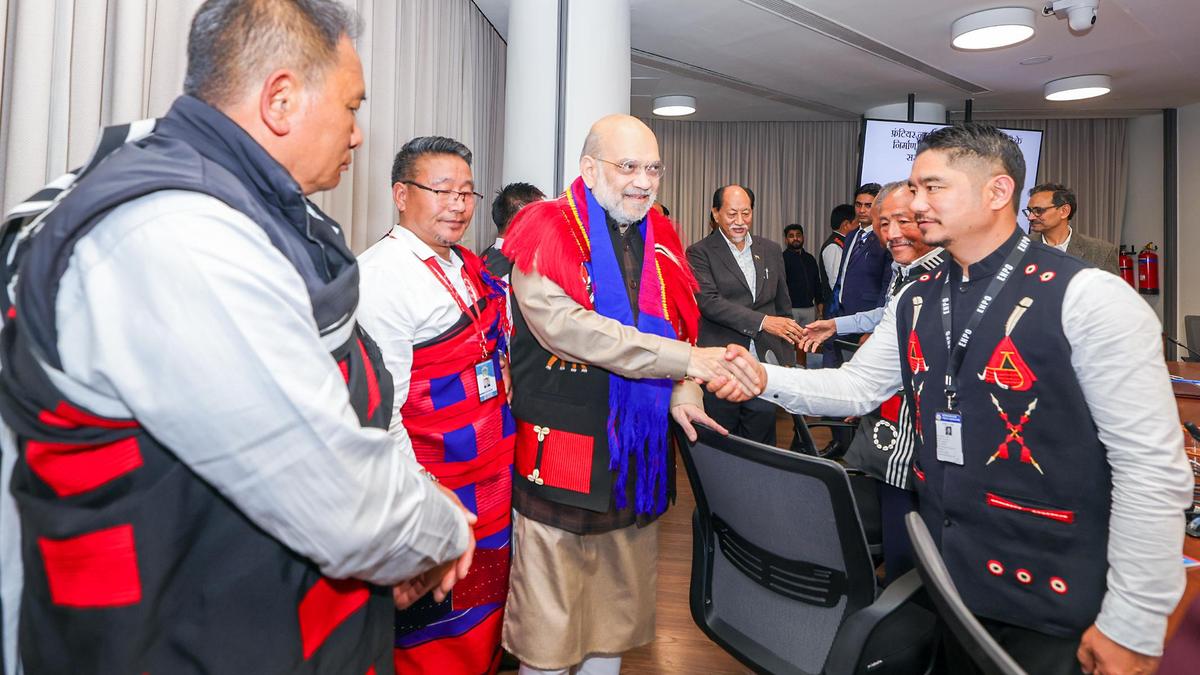
The Nagaland Chief Minister and the Union Home and Cooperation Minister Amit Shah grace the signing of an agreement between the Government of India, the Government of Nagaland and representatives of Eastern Nagaland People’s Organisation (ENPO), in New Delhi. File photo: PIB Photo Gallery via ANI
The story so far: On February 5, the Centre signed a tripartite agreement with the Nagaland Government and the Eastern Nagaland Peoples’ Organisation (ENPO) to form the Frontier Nagaland Territorial Authority (FNTA). An experiment in “devolutionary autonomy”, the FNTA offers a high degree of administration and financial autonomy to six “backward” eastern districts — Kiphire, Longleng, Mon, Noklak, Shamator, and Tuensang.
What was the ENPO’s demand?
The core demand of the ENPO was the creation of a separate State to be carved out of Nagaland. Its demand for a ‘Frontier Nagaland’ was conveyed in 2010 through a memorandum to the Centre, but is rooted in the policy of the pre-1947 British administration to leave the hills as an un-administered frontier. This lack of governance created a “developmental differential” that postcolonial India struggled to bridge. The eight Naga tribes inhabiting the six eastern districts increasingly began feeling ignored, politically and economically, after Nagaland was carved out of Assam as a State in 1963. The resentment snowballed into a movement for independence from the alleged administrative dominance of the western Naga tribes.

Why did the Centre find merit in the demand?
The Centre’s decision to intervene was driven by a mix of strategic compulsion and political obligation. New Delhi and Kohima, Nagaland’s power centre, attempted to satisfy the ENPO with SOPs, including a ₹500-crore package, but these solutions failed to address the underlying political aspirations of the people. In 2024, the situation reached a breaking point when the ENPO leaders called for a total boycott of the Lok Sabha elections, demonstrating their immense collective leverage. That the ENPO region is a critical buffer zone bordering Myanmar also played a role in the Centre’s eagerness to resolve the issue. Leaving a large segment of Nagaland’s population disillusioned in such a region was a major security risk, especially as armed extremist groups are based across the porous border.
The FNTA is seen as a pacifier for a strategic asset to ensure that the frontier remains stable and aligned with national interests.
What does the FNTA offer?
The FTNA offers semi-autonomous governance to six eastern Nagaland districts. A central feature of the agreement is the establishment of a mini-Secretariat within the region, headed by a high-ranking officer to bring state machinery to the doorsteps of the eastern tribes, reducing their dependence on Kohima. According to the blueprint, development outlays will be shared proportionally based on population and area, and the Ministry of Home Affairs has committed to providing initial expenditure for the authority’s establishment. The FNTA will exercise legislative and executive powers over 46 specific subjects. This devolution allows local leaders to make decisions on land use, agriculture, rural development, and infrastructure tailored to the specific needs of their tribes. Crucially, the agreement achieves this without abrogating or altering Article 371(A) of the Constitution, thereby preserving the unique customary laws and social practices central to the Naga identity.

Can the FNTA model be leveraged to resolve the Kuki-Zo demand?
The FNTA model has raised questions about its applicability to the Kuki-Zo demand for a Union Territory-like separate administration in conflict-scarred Manipur. Structurally, the FNTA is similar to the Hill Areas Committee mechanism under Article 371(C) in Manipur, which was provided to protect tribal interests. The Nagaland model suggests that the Centre is willing to create “territorial authorities” as a middle path between total Statehood and standard district administration. This may provide a solution for the Kuki-Zo community, as it demonstrates that New Delhi can innovate constitutionally to grant autonomy without redrawing State maps. However, the differences in context are stark. In Nagaland, Chief Minister Neiphiu Rio was a willing partner in the negotiations, and there was no active, violent conflict between the Nagas. In Manipur, the government based in the Meitei-dominated Imphal Valley remains vehemently opposed to any administrative separation, and the levels of inter-group trust are currently non-existent. Furthermore, the presence of other groups, especially the Tangkhul Naga-heavy National Socialist Council of Nagalim, who also claim parts of the hill districts, makes a clean administrative carve-out much more difficult.
Published – February 22, 2026 05:31 am IST




