


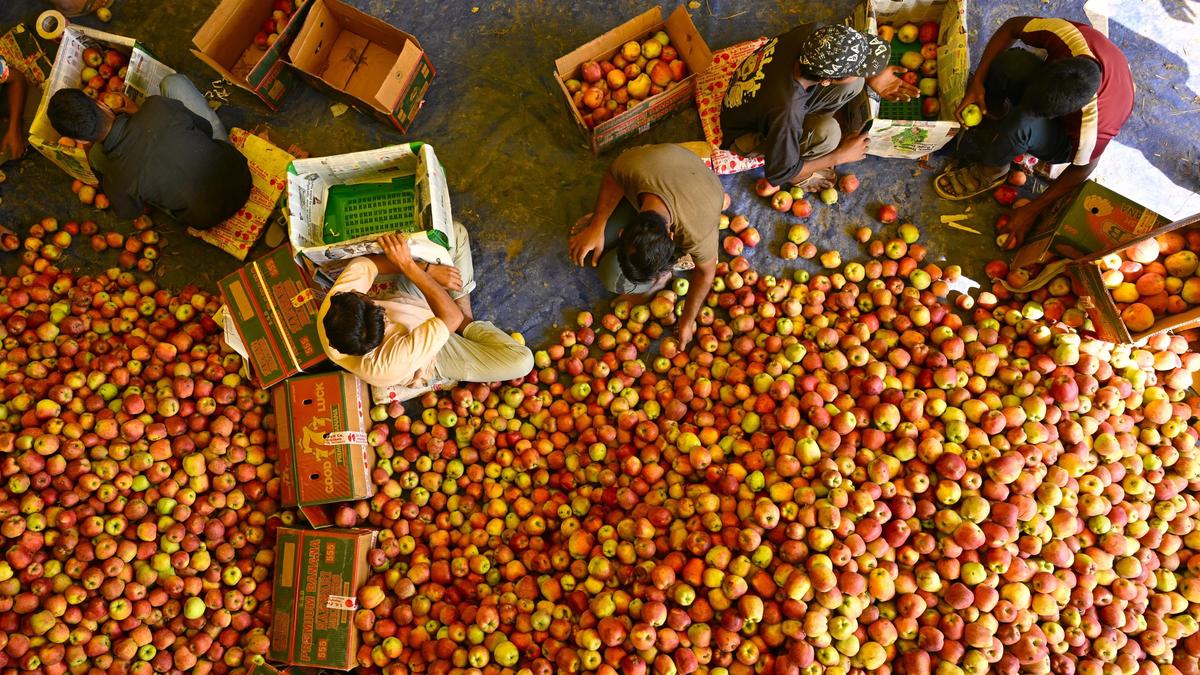
Workers separating rotten apples in Pulwama, near Srinagar in 2025.
| Photo Credit: IMRAN NISSAR
The story so far: Jammu and Kashmir Chief Minister Omar Abdullah and Leader of the Opposition in J&K Mehbooba Mufti have termed the India-U.S. trade deal as a death knell for the horticulture sector, especially for apple production in Kashmir. The criticism has grown shriller in the backdrop of India’s decision to reduce basic customs duty on apples imported from the U.S. from 50% to 25%, even though the Minimum Import Price (MIP) was set at ₹80 per kilogram. Under the new India-European Union trade deal, import duty on fresh fruits was reduced to 20% under a Tariff Rate Quota (TRQ) system. Only 50,000 tonnes per year of apples will be allowed from the EU at this reduced duty, to avoid the sudden flooding of Indian markets. However, the deal agrees to increase the quota to 1,00,000 tonnes over the next 10 years.
How important is apple production?
According to the J&K Economic Survey 2025-26, apple production comprises 50% of the total horticulture production of J&K against pear, apricot, peach, plum, cherry, citrus, mango, walnut, almond etc. The horticulture sector produces roughly ₹10,000 crore in revenue and employs about 35 lakh individuals, either directly or indirectly, thereby supporting approximately seven lakh families, the official survey suggested.
In 2024, apple production in J&K stood at 21 lakh metric tonnes. Over 173.07 lakh hectares of land in J&K are under apple orchards. J&K contributes to over 70% of the total apple production in the country.
The apple is the fourth most important fruit crop in India.
Besides J&K, Tamil Nadu, Himachal Pradesh, Uttarakhand, Nagaland, and Sikkim also produce apples.
Why are there fears?
Kashmir cannot compete with apples produced in Western countries due to their farming practices, favourable government policy and technological intervention. One estimate suggests that orchardists in New Zealand, the U.S., and in the EU on an average operate on 50-plus hectare farms against an average of 0.40 hectares in J&K. Only 7-8 tonnes of apples per hectare can be produced in India, whereas 40-70 tonnes per hectare are produced in countries like the U.S., Iran, New Zealand and China owing to better geography, advanced technology and mechanisation, says Nasir Hamid Khan, former vice-president of the Kashmir Chamber of Commerce and Industries (KCCI), a pan-Valley traders body. Moreover, Western countries have already introduced AI system technologies for pruning, pollination, harvesting, infield-sorting and bagging.
How will it impact off-season pricing?
Nations in the West have also mastered many popular varieties of apples such as gala apples. India introduced the gala variety only very recently and it is yet to reach its optimum production quality in terms of colour, taste, juice, shape as well as yield. Orchardists in Kashmir fear apples from the West will enter India at cheaper prices and in turn hit controlled-atmosphere cold storage prices the most. With reduced import duty, fresh New Zealand apples will enter Indian markets at cheaper prices, directly undercutting Indian apples stored in cold facilities, says Izhan Javed, a senior member of the J&K Fruits and Vegetables Processing and Integrated Cold Chain Association. Kashmir stores 397.08 lakh metric tonnes of apples in 92 cold storages currently. Local orchardists in Kashmir have invested heavily in cold storage infrastructure. “The trade deals threaten to make these investments economically unviable, endangering the entire post-harvest ecosystem built with public and private capital. The trade deal has the potential to destroy off-season price stability and push farmers back into distress sales,” warns Mr. Javed.
What are J&K parties demanding?
J&K parties and traders are urging the Centre to relook the deal and ensure safeguards for apple producers. In J&K, parties are clamouring for a joint strategy to pressure the Centre to exclude apples from the deal. The Peoples Democratic Party (PDP) leader and legislator Waheed-ur-Rehmaan Parra has sought an all-party meeting “to devise a collective strategy”. “Out of 30 lakh kanals of orchard land, only 30,000 kanals are under high-density cultivation. There is a need to have interest-free loans for farmers under Holistic Agriculture Development Programme (HADP) to compete globally,” says Mr. Parra.
The PDP also pitched for the expansion of cold storage and controlled-atmosphere storage infrastructure “to prevent distress sales”. It demanded the activation of dry port projects in J&K for the smooth ferrying of apples from the Valley to the markets outside.
Chief Minister Omar Abdullah has also echoed these concerns. He said the trade deal will “spell disaster for the horticulture sector if left unaddressed”. Mr. Abdullah says time has come to invest in improving productivity and quality before the market is flooded by cheaper apples. We don’t know what the benefits will be in the rest of the country, but we are seeing a loss, Mr. Abdullah warned. He underlined that the deals have paved an “uneven playing field for local orchardists and better-quality imports will dominate the market and the local produce will get devalued”.
Published – February 23, 2026 08:30 am IST



