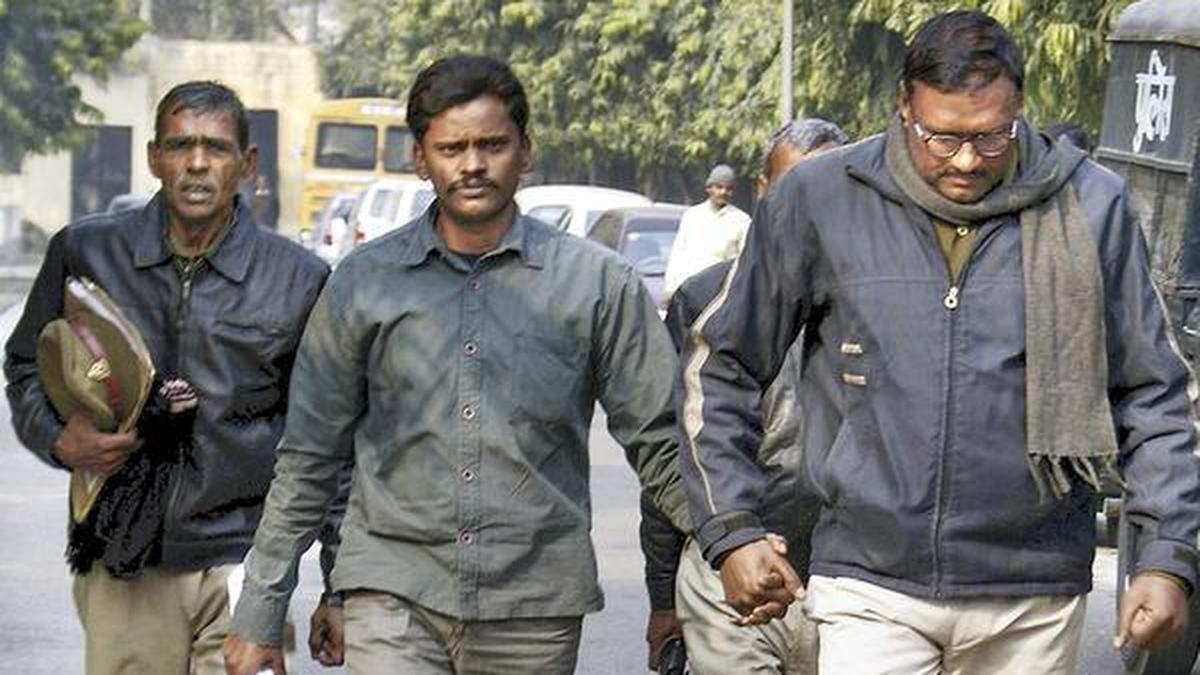
Police take Surinder Koli, accused in the Nithari serial killings, to jail in 2010.
| Photo Credit: PTI
On November 12, Surinder Koli was acquitted by the Supreme Court in the last of the 16 cases linked to the 2006 Nithari killings. On December 29, 2006, skeletal remains of several children were discovered from a drain behind the house of a businessman, Mohinder Singh Pandher, at Nithari in Noida. The silence following his release suggests a deep unease: not because guilt was disproved with precision, but because the evidence was tainted or insufficiently collected.
Double injustice
The problem becomes even more glaring when we recall that Mohinder Singh Pandher, the owner of the house where several of the offences allegedly took place, had already been acquitted years ago after spending 14 years in custody as an undertrial. When both accused in a case of such gravity are set free because the investigation could not withstand legal scrutiny, it is not a clean acquittal. It is a failed prosecution. This is a double injustice — towards the accused and towards the victims.
Wrongful prosecution in Nithari amounts to secondary victimisation of the accused. Koli spent 19 years in jail; Pandher spent 14. These are years erased from their lives. India still lacks a statutory framework to compensate individuals who suffer incarceration and stigma due to investigative failures. Once labelled a serial killer or rapist, acquittal rarely restores one’s honour. Such cases are not isolated. Under stringent special laws like the Unlawful Activities (Prevention) Act (UAPA), where bail becomes nearly impossible, undertrials have spent a decade or more in jail only to be acquitted later on technical grounds. The Law Commission of India’s 277th Report recommended a compensation scheme for those wrongly prosecuted. Yet, the proposal continues to languish without implementation.
The other side of the injustice is even more troubling — the absolute denial of justice to victims. The Nithari families deserved the truth, accountability, and closure. What they received instead was silence. The fact that no direction has been issued for a fresh or independent investigation reflects a disturbing complacency: once the accused walk free, the system believes its job is done.
Consider the parallels. Anokhilal, convicted for rape of a minor, was acquitted after spending 11 years in prison when the DNA protocol used in his case was found flawed. The acquittal was hailed as a victory for procedural correctness, but no one asked the fundamental question: if not him, who committed the assault? Our system’s disproportionate focus on the accused should not blind us to the equally compelling need to discover the actual perpetrator. Justice must strike a balance.
Lack of accountability
Underlying this failure is the absence of accountability. Investigators, forensic experts, and prosecution officers can make grave errors — losing evidence, relying on unscientific methods, building fragile cases — without facing repercussions. There is also a lack of a transparent, data-driven model to evaluate performance in policing, prosecution, and forensic services. Critical statistics on conviction quality, investigative timelines, and decision patterns are either absent or inaccessible. Without data, we cannot diagnose; without accountability, we cannot reform.
The Nithari acquittals reveal a justice system that completes cases, but does not necessarily deliver justice. In the eyes of the law, both accused now walk free. But the children who were killed still have no voice. A nation that prides itself on constitutionalism cannot accept justice that merely rearranges guilt without identifying truth. India deserves a criminal justice system where truth, accountability, and victims’ rights are not afterthoughts. Justice must not only acquit the innocent — it must pursue the guilty with equal resolve.
The author is Vice Chancellor & Sr.Professor of Criminology, National Law University Delhi. Views are personal.
Published – December 08, 2025 08:30 am IST