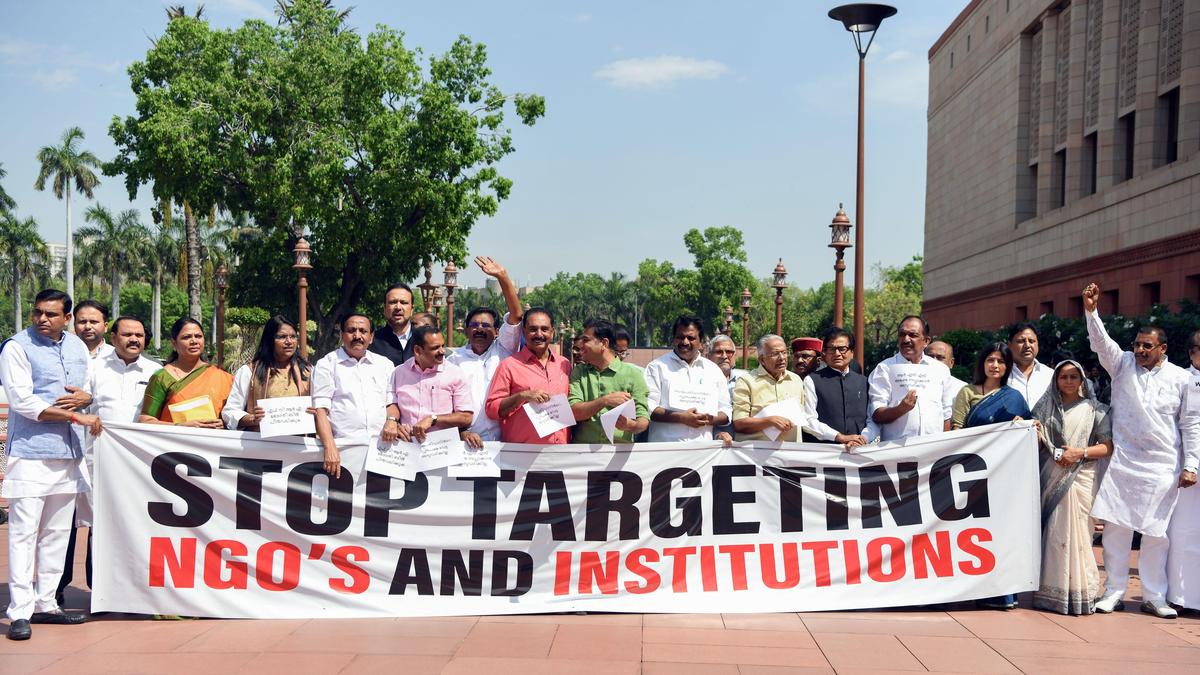
Opposition MPs protest at the Makar Dwar of the Parliament demanding the withdrawal of the Foreign Contribution (Regulation) Amendment Bill 2026, during the ongoing Budget Session, in New Delhi.
| Photo Credit: ANI
The story so far:
The Central government proposed to introduce the Foreign Contribution (Regulation) Amendment Bill, 2026 during the Budget Session of Parliament, which concluded on April 2. The Bill seeks to amend the Foreign Contribution (Regulation) Act, 2010, under which registration is mandatory for non-governmental organisations (NGOs) and associations to receive foreign funds or donations. It was introduced in the Lok Sabha on March 25; however, following an uproar by Opposition parties, its discussion and passage were deferred.
According to the statement of objects and reasons, around 16,000 associations are registered under the FCRA and receive approximately ₹22,000 crore annually. The Act regulates the acceptance and utilisation of foreign contributions to ensure that such inflows do not adversely affect national interest, public order, or national security.
Fear of the foreign: On the FCRA amendments
What are the key changes proposed?
One of the key changes proposed in the Bill is the appointment of a ‘designated authority’ to take over, manage, or dispose of assets created from foreign funds when an NGO’s FCRA registration is suspended, cancelled, or not renewed. This authority will have the powers of a civil court and can order the transfer or sale of assets owned by NGOs to either the government or any other body. The 2010 Act provided for regulation of foreign fund flows, but lacked a statutory framework for managing assets created from such funds. The government said that Section 15 of the Act provides for vesting of assets, but the absence of a comprehensive framework for the supervision, management, and disposal of such assets has led to administrative uncertainty and scope for misuse.
Another proposed amendment broadens the definition of an NGO’s ‘key functionary’ beyond office bearers and directors to include trustees, partners, the Karta of a Hindu undivided family, governing body members, or anyone controlling or managing the organisation, and makes them liable for FCRA offences unless they can prove lack of knowledge or due diligence.

What are the other changes proposed?
The Bill seeks to amend Section 43 of the parent Act to require any law enforcement agency or State government to obtain prior approval from the Central government before initiating investigations into FCRA-related complaints.
It also proposes timelines for the receipt and utilisation of foreign contributions under the ‘prior permission’ category (one-time receipt of funds), and provides for automatic cessation of certificates upon expiry or non-renewal.
The Bill proposes to reduce the maximum imprisonment for FCRA offences from five years to one year. It also proposes fixed timelines for the utilisation of foreign funds received under the ‘prior permission’ category unlike the open-ended provision under the 2010 Act.
How does the Ministry of Home Affairs (MHA) regulate foreign donations in India?
The MHA regulates foreign donations in the country through the FCRA to ensure that such funds do not adversely affect the country’s internal security. The legislation was first enacted in 1976. In 2010, it was repealed and replaced with a new legislation. The 2010 Act came into force on May 1, 2011 and has been amended in 2016, 2018, and 2020.
The FCRA registration is valid for five years, after which the NGO has to apply for a renewal. Since 2015, the FCRA registrations of more than 18,000 NGOs have been cancelled. As on April 3, there are 14,965 FCRA-registered NGOs active in the country. NGOs can receive foreign contributions for social, educational, religious, economic, and cultural programmes.
Why is the Bill being opposed?
The Catholic Bishops’ Conference of India said the Bill amounts to “executive overreach” and raises concerns about “undue interference” in the functioning of minority institutions and civil society groups. The body objected to “clauses that grant sweeping powers to the Central government, allowing it to deny renewal or cancel licenses of organisations” and the powers “to assume control over institutions, including their funds, properties, and other assets.” The Chief Ministers of poll-bound Tamil Nadu and Kerala have opposed the Bill as well.
What is the status of the Bill?
The Bill was deferred following an uproar by the Opposition. In Kerala and Tamil Nadu, there were fears it could be misused to seize assets of minority institutions, such as churches. Meanwhile, the Bharatiya Janata Party has been reaching out to the Christian community in Kerala to build a support base. The legislation remains active.
The Catholic Bishops’ Conference of India said the Bill amounts to executive overreach and that it could unduly interfere with minority institutions and civil society
Published – April 05, 2026 01:30 am IST