


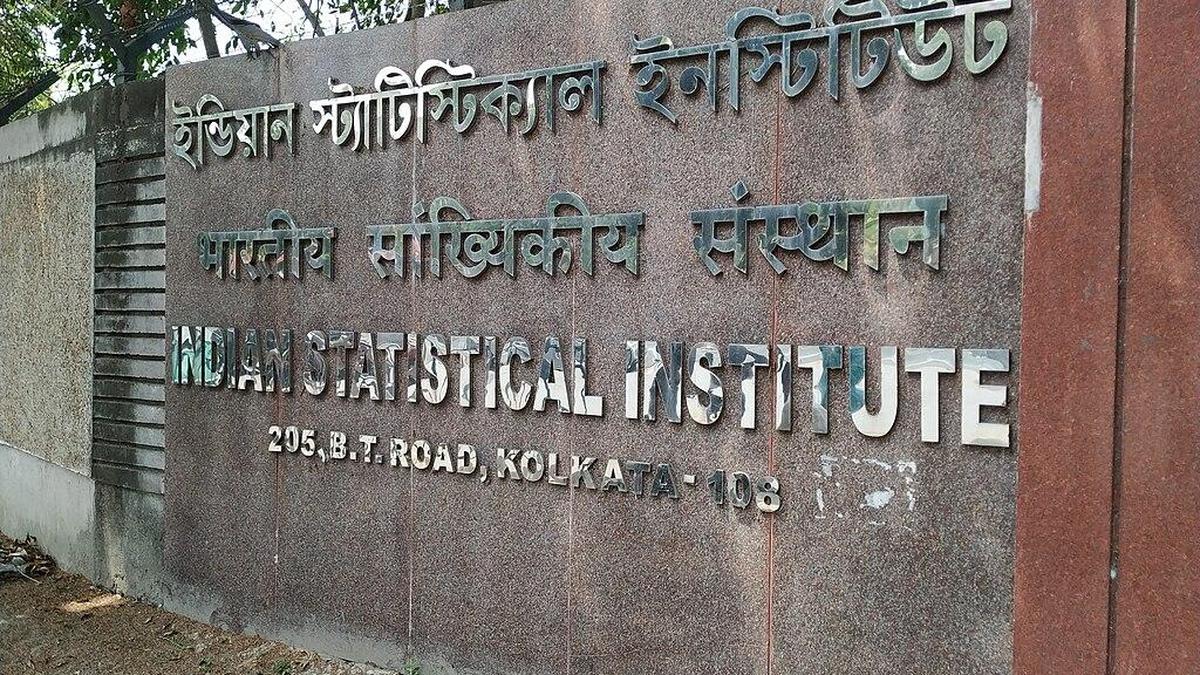
The Kolkata-based Indian Statistical Institute.
| Photo Credit: File Photo
The story so far:
On September 25, the Ministry of Statistics and Programme Implementation (MoSPI) released the draft Indian Statistical Institute Bill, 2025. The Bill has been met with strong protests by academicians as well as students of the Indian Statistical Institute (ISI) who claim that the move is aimed to strip the institute of its academic autonomy by converting it from a “registered society to a statutory body corporate”.
What is the significance of the ISI?
The ISI was founded in December 1931 by P.C. Mahalanobis in Kolkata and has since grown into one of India’s most prestigious academic and research institutions. The institute was originally registered in April 1932, under the Societies Registration Act of 1860, and later re-registered under the West Bengal Societies Registration Act of 1961. Being a society provided the institute its own memorandum of association, bye-laws, and regulations. Parliament enacted the Indian Statistical Institute Act, 1959, declaring ISI as an Institution of National Importance (INI).
Many scholars link the origin of the institute to the Bengal renaissance and credit the institute with shaping India’s planning and policy apparatus. The National Sample Survey Organisation (NSSO) was developed at ISI, establishing the foundation of India’s official statistical system. Other than P.C.Mahalanobis, the institute has produced legendary scholars such as Professor C.R. Rao and S.R.S. Varadhan.
With about 1,200 students and six centres across India, ISI offers undergraduate and postgraduate degrees in Statistics, Mathematics, Quantitative Economics, Computer Science, Library and Information Science, Cryptology and Security, Quality Management Science and Operations Research.
Why are academicians protesting?
The primary concern of those opposing the draft Bill is how the ISI’s institutional status will change, from a “a registered society to a statutory body corporate”.
A recent letter by about 1,500 academicians to Rao Inderjit Singh, Minister of State (Independent Charge) MoSPI, stated that there is no transparent reason that MoSPI should repeal the (1959) Act, abolish the society and introduce a Bill which violates the basic spirit of the agreement between the general body of the society and the government. The letter also states that the move to bypass the society registered under the WB Societies Registration Act to a “statutory body corporate” infringes upon the jurisdiction of the Societies Registration Act and is against the spirit of cooperative federalism. On November 28, hundreds of students and staff of ISI formed a human chain and held a public meeting near the institute’s campus on B.T. Road in North Kolkata.
Those opposing the draft Bill point out that the governance structure, as in the existing 1959 Act, vested authority in a council with academic representation, and procedural safeguards against government overreach. The proposed 2025 Bill, however, gives power to the Board of Governors (BoG), defined under Section 15 of the Act, which is heavily dominated by government nominees sidelining the authority of faculty and academic stakeholders. Former professor of ISI and chairman of West Bengal Infrastructure Development Finance Corporation Abhirup Sarkar said that the ISI is a place of doing basic research which is a long-term process where immediate results may not be visible. Since there is a push for a corporate model of funding in the draft Bill, getting funds for basic research projects could be a problem in the future. Section 29 of the proposed 2025 Act deals with ‘power to generate revenue’ which includes student fees, consultancy services and sponsored research projects among others.
Another critical area raised by those opposing the Bill is that all appointments will be controlled by the Union government, through the BoG. Earlier there were 10 representatives from ISI (eight elected, one worker and one scientific worker) out of the 33 representatives on the council, a little less than one-third. Now there will be none. Professor Sarkar said that after the proposed Bill, there are apprehensions of political interference in the appointments by the Union Government.
What is the government saying?
The government claims that the idea behind the legislation is the vision to make ISI not only one of the best in India but one of the foremost institutes in the world as the institute approaches its centenary in 2031. A press release stated that, over the years, four review committees had examined the functioning of ISI. The most recent, chaired by Dr. R.A. Mashelkar in 2020, recommended major reforms to strengthen governance, expand academic programmes, and make ISI globally competitive.
What lies ahead?
The students and academicians are banking on the support of Opposition parties to oppose the proposed legislation. Villupuram Member of Parliament D. Ravikumar has written to the Union Minister of State (MoPSI) urging him to withdraw the draft Indian Statistical Institute Bill, 2025. Leaders from Trinamool Congress and Communist Party of India (Marxist) have also publicly opposed the draft legislation and vowed to oppose it if it is tabled in Parliament.
Published – December 08, 2025 08:30 am IST



