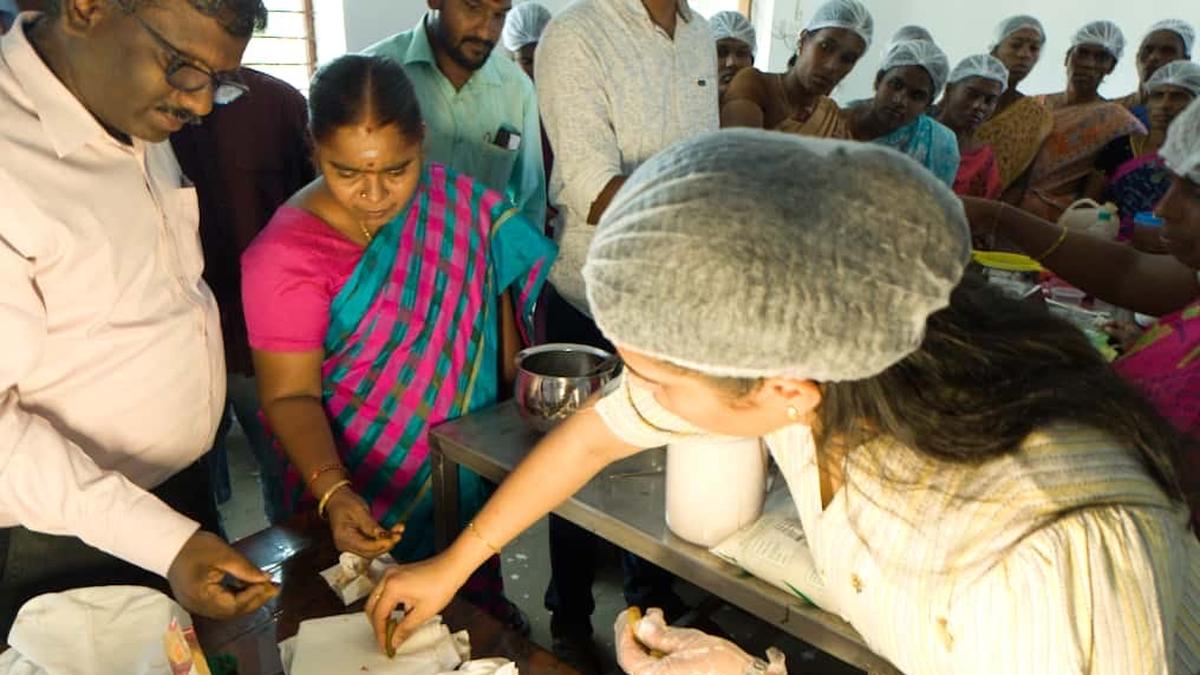
At a dilapidated building that belongs to the Forest Department, cookery skills were imparted to around 100 tribals
| Photo Credit: Special Arrangement
Amid thick forests, a group of tribals, mostly women, at Athipet, a remote hamlet around five kms from Jamunamarathur village atop Jawadhu Hills in Tiruvannamalai, was busy, with cookery items, in learning nuances of making mixed fruit jams, squash and juices, using locally grown red tamarind.
At a dilapidated building that belongs to the Forest Department, cookery skills were imparted to around 100 tribals by a team of staff of Adi Dravidar and Tribal Welfare Department of the State government in collaboration with Coimbatore-based Institute of Forest Genetics and Tree Breeding, and Vivekananda Trust as part of enhancing income capability of tribals, especially women, in the hills.
“Training helps us to make home-made cookery items to earn additional income apart from farming. Free mixers were provided to us to make juices and squash individually in our houses for sale, using tamarind,” said S. Petchiammal, a tribal.
Tribals from at least ten remote hamlets that come under Kovilur and Nammiyampattu village panchayats in the hills attended the day-long training at the centre. They were taught a variety of ingredients that can be used to make these food items to enhance its quality and taste.
Optimum level of quantity of the ingredients to make jams and juices were also imparted. “With help of SHGs, we help tribals to market their home-made cookery items in bazaars of big towns in the plains. We also plan to conduct exhibitions on cookery items made by tribals and promote them online,” S. Kalaiselvi, Project Director, Department of Tribal Welfare (Tiruvannamalai), told The Hindu.
Officials of the Department of Tribal Welfare said that at present, around 39,525 hectares of forest land in the hills were allowed for tribals to do farming, mainly paddy, millets, groundnuts and vegetables for local consumption and sale in markets in the plains.
Besides, tribals were allowed to collect minor forest produce like Indian gooseberry, Haritaki (Kadukkai), soapnut (Pundhikottai), tamarind, and honey within allocated forest land in the hills. As per a study by the department, around 200-300 tonnes of red tamarind is harvested in the hills every year.
Peak season for red tamarind cultivation is between February and May where the entire harvest is done. Tribals, especially women, have been relying on income earned during harvest to meet domestic expenses during off-season. “The training to impart cookery skills using locally grown tamarind is to bridge the income gap during off-season of tamarind cultivation where women earn an income by sale of homemade items,” said D. Balu, chairman, Vivekananda Trust.
Tribal Welfare Department officials said that tribals can process their harvested tamarind at Tamarind Processing Unit in Athipet village free of cost. Large jute mats were also provided to tribals to dry processed tamarind before they were sold to wholesale merchants in the district.
Published – September 21, 2025 11:25 pm IST