


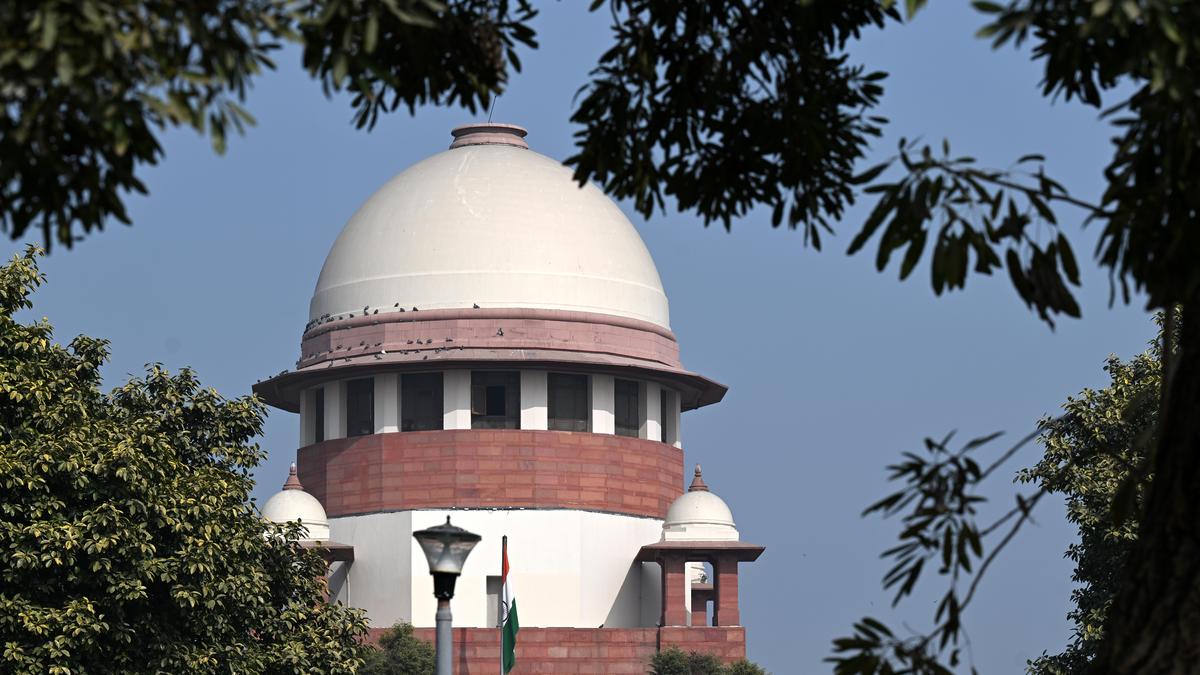
Supreme Court of India. File
| Photo Credit: The Hindu
The Supreme Court on Wednesday (January 21, 2026) drew a clear line between State functionaries splurging public money on irrational freebies and “investing” in welfare schemes for the marginalised sections.
“Distribution of State largesse to individuals at a large scale is different from investing State largesse in public welfare schemes. That distinction should be kept in mind,” Chief Justice Surya Kant observed orally.
The Supreme Court asked why there was no “dedicated diversion of revenue surplus for developmental purposes which would further the constitutional ideal of inclusivity through free medical care and education for the poor and those not in the creamy layer of the society. The State has a commitment towards this end”.
The Chief Justice said launching welfare schemes was an obligation the State had to achieve under the Directive Principles of State Policy in the Constitution.
The oral observations from the Bench, also comprising Justice Joymalya Bagchi, were in response to an oral mention made by advocate Ashwini Kumar Upadhyay for early listing of a batch of petitions seeking a judicial declaration that irrational freebies offered by political parties to lure voters during poll time should be considered a “corrupt practice”.
Mr. Upadhyay said when the petition was filed, the nation was in debt of ₹1.5 lakh crore, which had since increased to ₹2.5 lakh crore. Every Indian was in debt, and yet the State continued to rain freebies before elections, he submitted.
“This is a very, very important matter,” Chief Justice Kant reacted, agreeing to list it early for hearing.
In January last year, an apex court Bench headed by Justice (now retired) B.R. Gavai had asked whether untrammelled freebies lull the poor into a parasitic existence, depriving them of any initiative to find work, join the mainstream and contribute to national development.
The court has, in previous hearings in the case, made its anxiety plain about parties, which form the government riding the wave created by their pre-poll promises of “free gifts”, bleeding the State finances dry by actually trying to fulfil their “wild” promises of largesse using public money.
Amicus curiae, senior advocate Vijay Hansaria, had submitted that the court had to decide whether “giving freebies would be a corrupt practice under Section 123 of the Representation of the People Act, 1951 and become a ground for moving court in an election petition”.
Senior advocate Arvind Datar, for the petitioner side, had submitted that freebies ought to be considered as “expenditure defrayable by the Union or a State out of its revenues” under Article 282 of the Constitution.
Advocate Prashant Bhushan had said legitimate freebies must not be classed with discriminatory gifts.
“Doing away with the debts of willful defaulters is an illegitimate freebie. Giving benefits to a particular religious community would classify as a discriminatory freebie,” he explained.
Consistently, over the years, the court has been shifting away from its 2013 judgment in the S. Subramaniam Balaji versus Tamil Nadu case, which held that making promises in election manifestos did not amount to a “corrupt practice” under Section 123 of the Representation of the People Act.
Published – January 21, 2026 11:09 pm IST



