


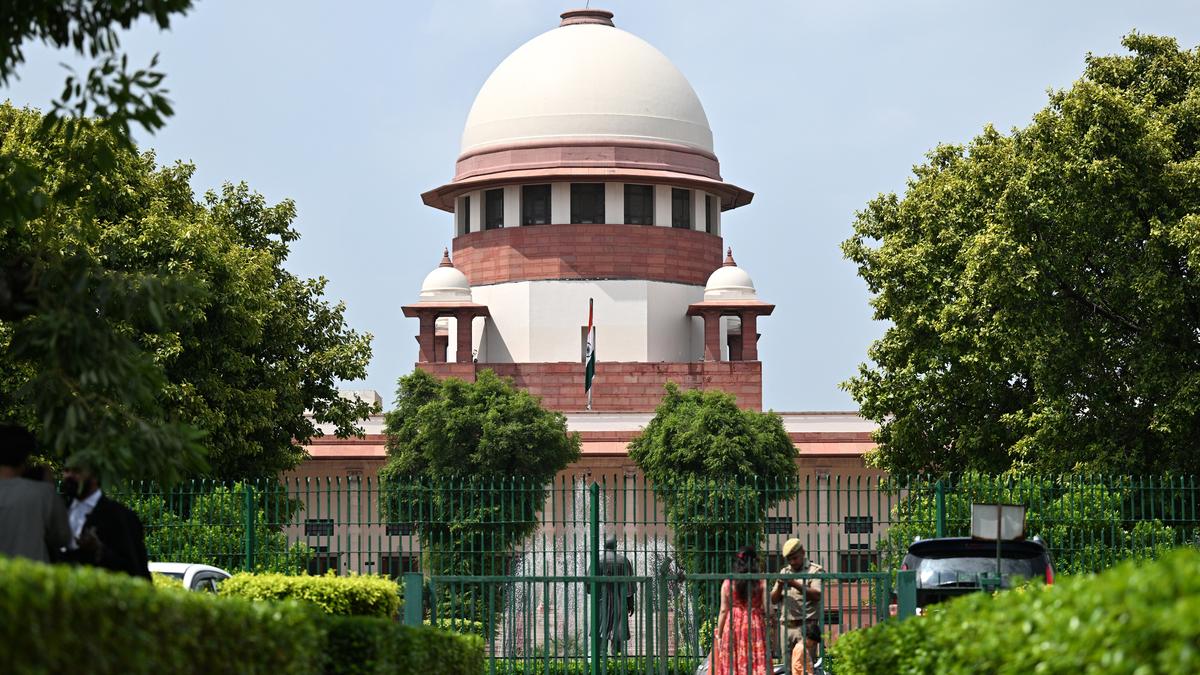
The top court directed the responses to be filed within two weeks. File
| Photo Credit: The Hindu
The Supreme Court on Friday (September 26, 2025) sought a detailed account from the Rajasthan government on the installation and functioning of CCTV cameras across police stations in the State.
A Bench of Justices Vikram Nath and Sandeep Mehta was hearing a suo motu case registered earlier this month, following a newspaper report that had flagged 11 custodial deaths in Rajasthan in the first eight months of 2025, seven of which occurred in Udaipur. The report had further alleged that CCTV footage was frequently withheld by the police on “frivolous grounds” such as malfunctioning equipment, inadequate storage, or confidentiality.
The court stressed that non-functional cameras and the failure to preserve recordings amounted to a breach of its 2020 ruling in Paramvir Singh Saini vs Baljit Singh, which had directed the Centre to ensure CCTV coverage in all police stations as a safeguard against custodial torture. It accordingly asked the State’s Additional Advocate-General to respond to a set of specific queries.

Barrage of questions
The State has been asked to provide data on the number of cameras in each police station and their technical features, such as resolution, night vision, field of view, audio capture, and tamper-detection. It must also explain how video data is stored and how long recordings are preserved.
The Bench further sought details on how frequently cameras are serviced, the process followed when they break down, and whether surprise inspections or forensic checks are carried out to ensure tamper-proofing. The State must also clarify the status of internet connectivity in police stations, whether the systems are linked to a central server or control room, and the software being used.
The court also asked whether standard operating procedures (SOPs) had been drawn up to train officers in handling CCTV footage. “Creation of SOPs for the training of officers regarding access, review and retention of video footage and regarding protocols for usage, escalation and tamper proof protocols. Furthermore, information shall be provided in respect of training of the officers in respect of data protection laws and judicial admissibility of the video footage,” the order said.
“The response to the aforesaid queries shall be filed positively within two weeks, supported by an affidavit of the Director General of Police, State of Rajasthan,” the Bench said and posted the matter for hearing on October 14.

In its 2020 judgment, the apex court had directed all States and Union Territories to ensure that CCTV cameras were installed in every police station at entry and exit points, the main gate, lock-ups, corridors, lobbies, reception areas, and outside lock-up rooms, so that no part of the premises was left uncovered.
“As most of these agencies carry out interrogation in their office(s), CCTVs shall be compulsorily installed in all offices where such interrogation and holding of accused takes place in the same manner as it would in a police station,” Justice Nariman, who authored the judgment, had ordered.
However, senior advocate Siddhartha Dave, who was appointed amicus curiae in the 2020 case, had pointed to a “glaring fact” that the Centre, despite overseeing multiple investigative agencies, had failed to comply with the apex court’s directions.
While hearing the matter on September 15, the court had said it was considering setting up fully automated control rooms to detect non-functional CCTV cameras in police stations. It had pointed out that such a system could prevent instances of police deliberately switching off cameras or erasing recordings.
Published – September 26, 2025 10:59 pm IST



