


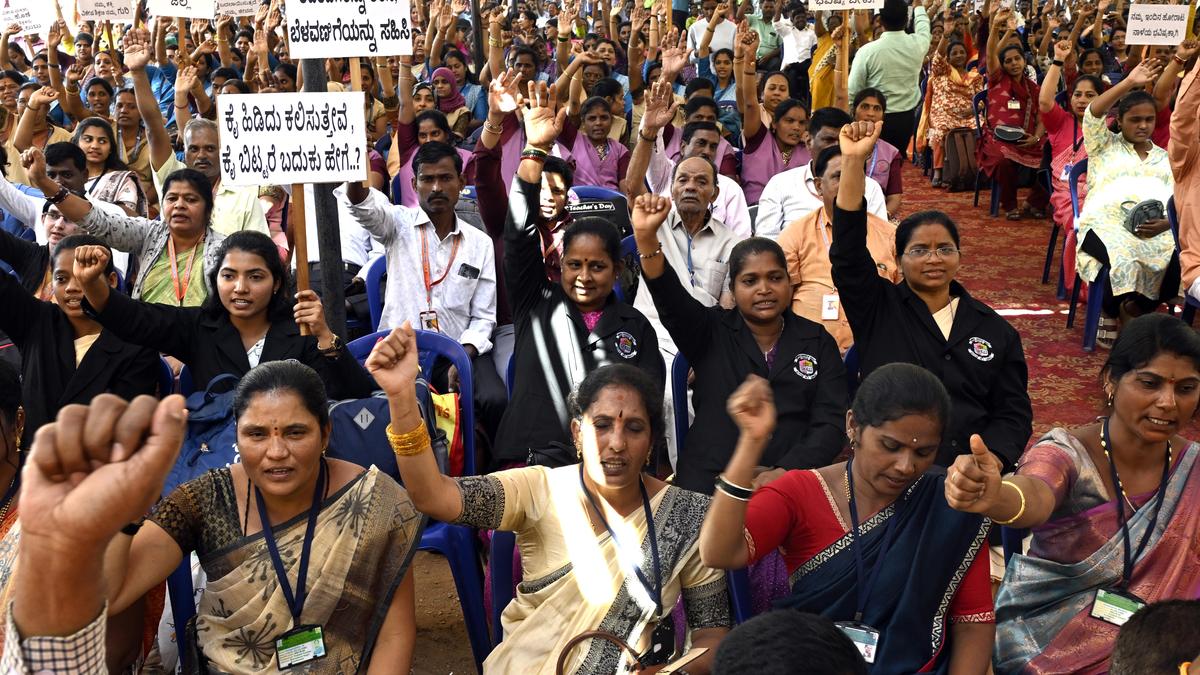
Members of the State Special School Teachers’ and Non-Teaching Staff Association staging protest in Bengaluru on Wednesday.
| Photo Credit: SUDHAKARA JAIN
A large number of special school teachers and non-teaching staff gathered at Freedom Park in the heart of the city on Wednesday to stage a protest against delays in granting funds meant to support the education and care of children with disabilities.
The State government had launched the Child-Centric Scheme for Special Schools to support the education and care of children with disabilities. Under the scheme, the government runs four special schools across the State and funds 180 special schools managed by NGOs, according to the protesters.
“This scheme provides financial assistance of ₹9,000 a child per month for 10 months in a year through these schools to ensure minimum standards in teaching, care, and support services. It also provides grants covering salaries for special school teachers and non-teaching staff, special learning materials, and school operational costs,” said Sanjay Sabarad, manager of Sadbhavana Special School, Bengaluru.
The protesters alleged delays in the release of funds under the scheme and limited revisions in salaries over the years. The salary of special school teachers was ₹13,500 per month in 2014-15, which was raised to ₹20,250 per month from 2022 onwards, the Karnataka State Special School Teachers’ and Non-Teaching Staff Association said in a statement.
The teachers alleged that the revision was not aligned with inflation, while the government staff were paid nearly three times more for similar work. They termed this disparity unfair and demanded fair pay. “It is very difficult to run our households on ₹20,000 a month, and we demand a salary increase based on current inflation,” said Chandrika K.M. of Jnana Vikasa Deaf & Dumb Special Residential School, Mandya.
The protesters demanded an immediate revision of salaries and timely release of funds. Additionally, the NGOs demanded a 40% increase in grants to ensure minimum standards are maintained.
Several NGOs expressed concern over delays in grants and their impact on school operations. “I have been running my school for over six years, and it is difficult to manage when grants are released in four instalments a year. Two instalments would save time. Further, the current grants are insufficient, and teachers are unwilling to work for such low salaries,” said Mr. Sabarad.
Published – January 28, 2026 09:40 pm IST



