

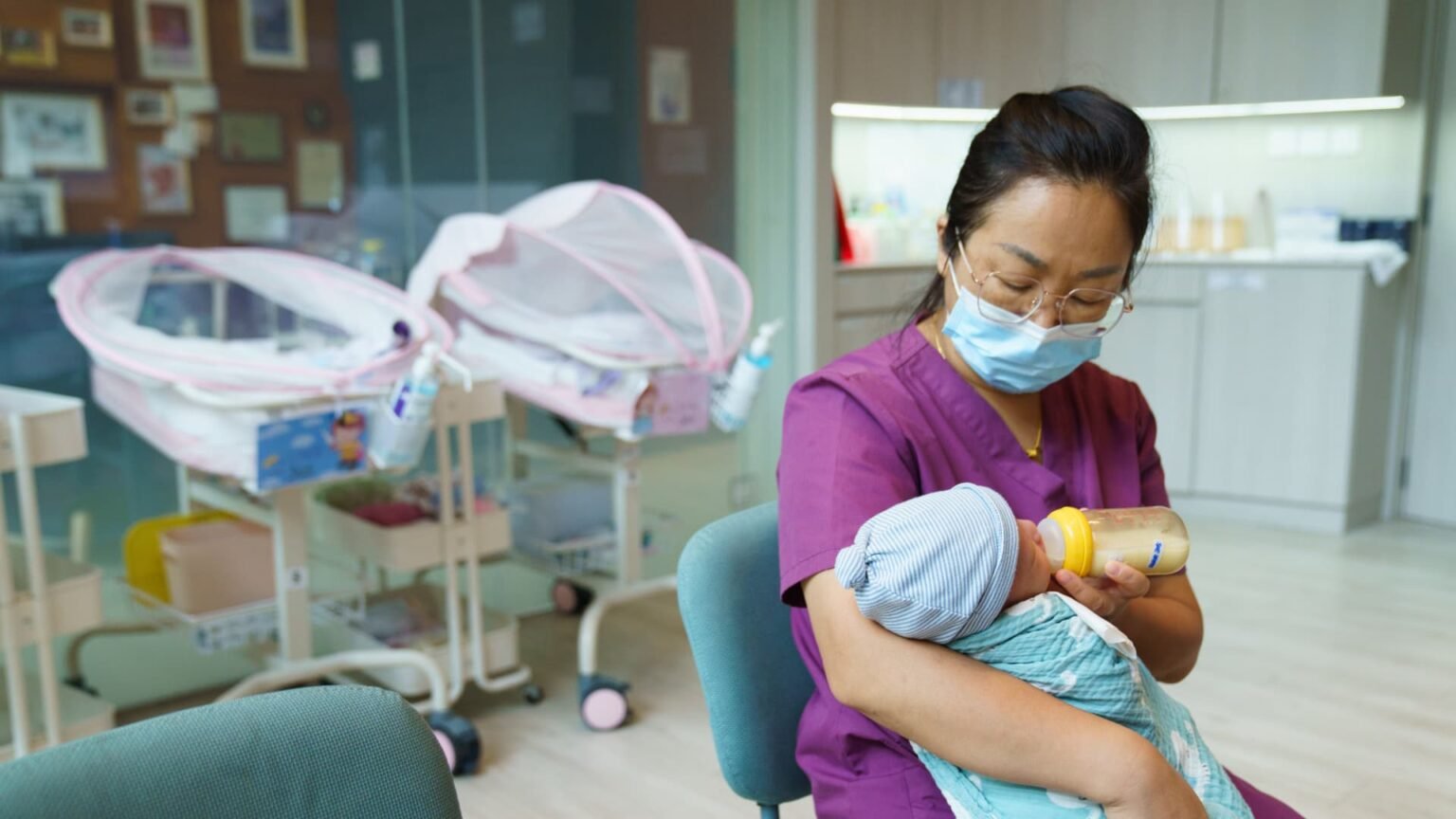

An employer feeds a baby at the My Queen confinement center in Singapore, on Monday, Feb. 19, 2024.
Bloomberg | Bloomberg | Getty Images
Tiny Singapore is throwing cash and incentives at its citizens to avoid a long-term demographic crisis, but it may take many years before the level of success becomes clear.
The city-state recently unveiled a series of new measures aimed at removing obstacles to having children, including a promise of over S$60,000 ($47,100) to support every citizen child from birth to age 17 in what is seen as its largest effort yet to encourage its citizens to have more babies.
Prime Minister Lawrence Wong described the effort as “more than incremental improvements or changes to individual schemes. We want to make a fundamental shift in how we support families.”
One challenge for policy makers, however, is that success on many measures won’t show up immediately.
“It is a very slow, slow iceberg to turn around…It will take time. It’ll take a few decades to see a little bit of change,” Kalapana Vignehsa, senior research fellow at the Institute of Policy Studies, told CNBC.
However, the new measures are “a total departure from what we have had previously,” and “starting to provide the financial support is the easiest of the many difficult things to do,” she said.
During Singapore’s National Day Rally a week ago, commonly seen as the most important policy speech of the year, Wong explained that Singapore’s current measures are concentrated around the birth of a child, but the government, with the new measures, want to support parents more consistently while they raise their children.
The incentive package includes lower childcare fees, more parental leave time and elevated chances to get sought-after public housing.
Singapore saw a sharp decline in its total fertility rate, or TFR, to 0.87 in 2025, from 0.97 the previous year, and it’s now the world’s second lowest after South Korea’s 0.81. A TFR of 2.1 is the average number of children a woman must have in her lifetime to keep a population stable without relying on migration.
A woman pushes a baby stroller past the rain vortex at Jewel Changi Airport in Singapore on June 23, 2021. (Photo by Roslan RAHMAN / AFP) (Photo by ROSLAN RAHMAN/AFP via Getty Images)
Roslan Rahman | Afp | Getty Images
Case studies from around Asia offer a warning about whether Singapore’s measures can succeed. South Korea expanded childcare and family support but still has a fertility rate of just 0.8, despite two years of improvement, and Japan’s rate fell for a 10th straight year to a record low of 1.14 in 2025.
Still, the fact that Singapore is taking these measures shows it’s at least attempting to change things around, according to Chua Yeow Hwee, assistant professor of economics at Nanyang Technological University.
“This new approach recognized that the financial cost and time cost of raising the children continue for many years,” Chua told CNBC. The plan is more promising than a one-off bonus, as it gives parents more certainty that support will be there when a child grows, he added.
However, he noted that the plan has other second-order impacts, such as operational disruption for businesses when workers are on leave, which creates another set of hurdles for policy makers.
“What’s challenging is operational cost,” Chua said. “if someone is absent, the work has to be done by someone else. So who is going to bear the cost?”



