


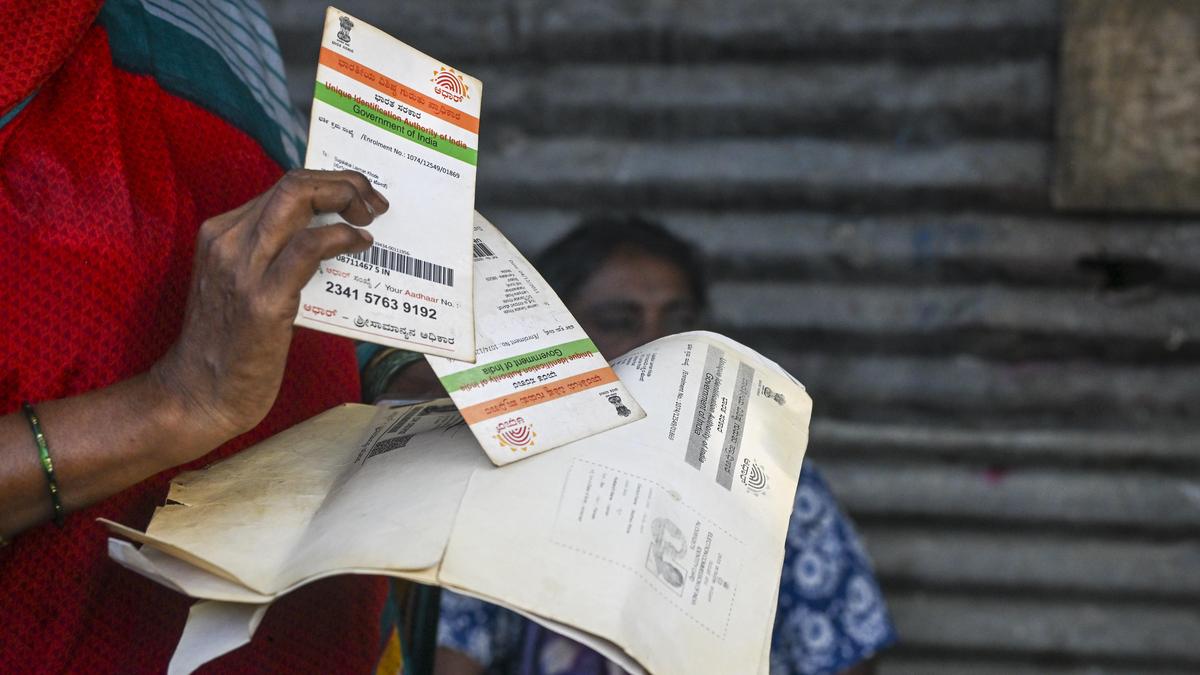
The Union Government has promoted digital identity systems such as Aadhaar around the world as a key plank of digital public infrastructure (DPI). File
| Photo Credit: The Hindu
Fifty-four civil society groups and over 200 individual signatories have put out an open letter pushing back against the expanding use of Aadhaar-like digital identity systems in countries other than India. “We, concerned Indian citizens and organisations, are alarmed to note that efforts are being made to promote biometric identity systems similar to Aadhaar in other countries,” the letter said.
The two-page letter was signed by organisations such as digital rights advocacy group Internet Freedom Foundation, the grassroots right to information movement, Mazdoor Kisan Shakti Sangathan, the JNU Students Union, the Safai Karmachari Andolan, and the People’s Union for Civil Liberties (PUCL). It was also endorsed by individuals such as former Amnesty International India chair Aakar Patel, activist Jean Drèze, and constitutional law scholar Gautam Bhatia.
The Union Government has promoted digital identity systems such as Aadhaar around the world as a key plank of digital public infrastructure (DPI), a concept that India is promoting with both policy support and open source tools, such as those provided by the Modular Open Source Identity Platform (MOSIP).
India has backed MOSIP in various ways. MOSIP, which was largely developed by the IIIT Bengaluru, does not use the same technology as Aadhaar. Some countries engaged with MOSIP to various degrees include Morocco, the Philippines, Sri Lanka, Ethiopia, and Uganda.
‘Tool of social control’
The letter, released on the eve of World Human Rights Day, warns that Aadhaar could “turn into a dangerous tool of social control, especially but not only in the hands of an authoritarian government”. The “linkage of numerous databases with Aadhaar magnifies the danger of it becoming a tool for profiling”. The information is all stored in a central database that could be vulnerable to cyber attacks; the data itself is also prone to errors, the letter says.
A spokesperson for the Unique Identification Authority of India (UIDAI), which issues Aadhaar, was not available for immediate comment on the letter.
The government has vigorously denied data security risks, and regularly insists that Aadhaar has been instrumental in allowing more people to access services. Many of the issues raised in the letter were litigated in the Supreme Court in 2018 and the top court had upheld the constitutionality of the scheme.
The letter charges the government with violating some provisions of the ruling. “At every step, the Aadhaar project has been a law unto itself,” the letter says.
“It began without any legal backing. Later, the Aadhaar Act was passed by bypassing the Upper House of Parliament. The Unique Identification Authority of India (UIDAI) often violates orders of the Supreme Court of India (e.g., protections for children and against use by private entities). It has enormous power and regularly issues rules that make life difficult for millions, without any serious feedback from the affected people. A critical provision for parliamentary oversight of the UIDAI was dropped in the final version of the Aadhaar Act.”
“The promoters of Aadhaar were never able to justify this particular identity model or to explain what ills it is supposed to remedy,” the letter concludes. “Instead, they relied on propaganda to push for it. Many countries have functional identity systems that are less coercive, invasive, exclusionary and unreliable than Aadhaar.”
Published – December 09, 2025 11:48 pm IST




