


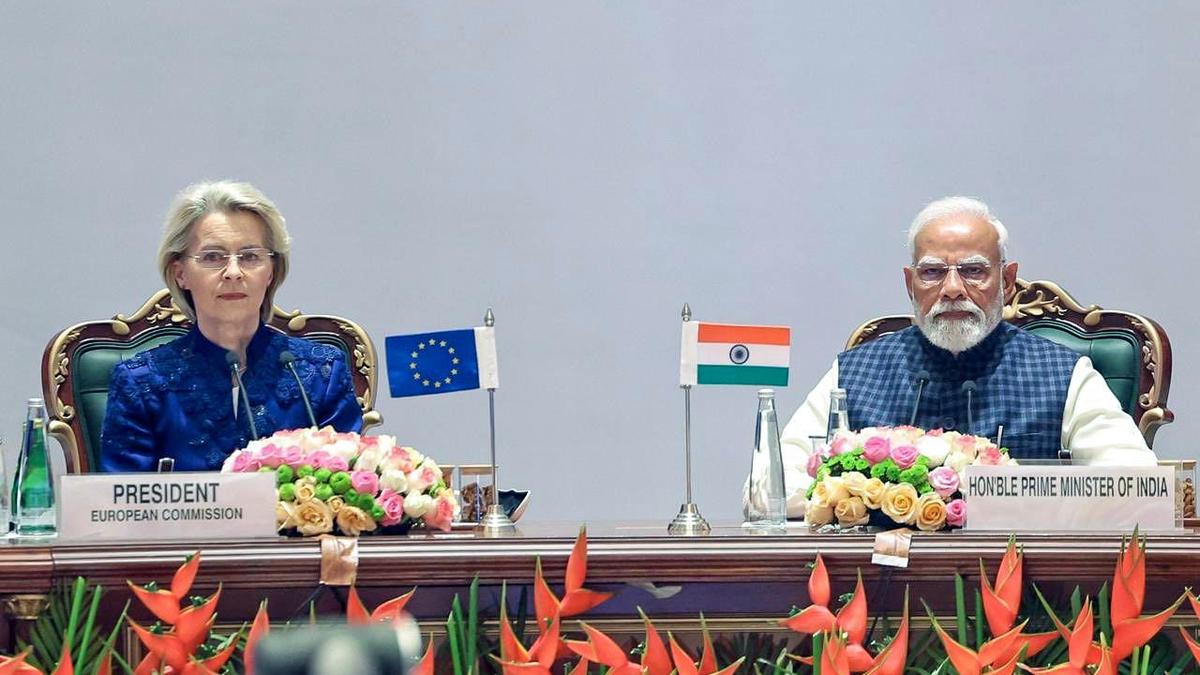
Prime Minister Narendra Modi, with European Commission President Ursula von der Leyen, chairs the India–EU Business Forum, in New Delhi on January 27, 2026. Photo: @MEAIndia X/ANI Photo
India ‘concluded’ a ‘historic’ Free Trade Agreement (FTA) with the European Union, Prime Minister Narendra Modi said on Tuesday (January 27, 2026), announcing the end of negotiations that began nearly two decades ago and were revived in 2022.
Speaking at the end of delegation-level talks with the visiting EU leaders—European Council president Antonio Luis Santos da Costa and European Commission president Ursula Von der Leyen—Mr. Modi said that alongside the ‘ambitious FTA’, India was also entering into a new Security and Defence Partnership and a system of mobility that would allow secure and legal movement of Indians to the EU region.
“Today, India has concluded the largest Free Trade Agreement in its history,” said Prime Minister Modi, announcing the conclusion of the negotiation on the deal. The two sides began discussions on the trade deal in 2007 but suspended the negotiation in 2013, and the talks were relaunched in 2022 as India and the EU began reorienting policies in the post-pandemic scenario. The Prime Minister presented the deal as a boost to investment between the European Union and India that would support “innovation partnerships and strengthen supply chains at the global level”. European Commission president Von der Leyen said the FTA would “cut upto €4 billion in annual tariffs for exporters”. “It brings together Indian skills, services and scale with Europe’s technology, capital and innovation,” said Ms. Von der Leyen.
Union Home Minister Amit Shah welcomed the India-EU FTA and said, the deal “safeguards the related sectors” while “opening a whole new world of opportunities for textiles, apparel, leather footwear, marine products, gems, jewellery, handicrafts, engineering goods, medical instruments and appliances, plastics and automobile sectors.”
Referring to global uncertainties, Prime Minister Modi stated the two sides discussed the conflict in Ukraine, West Asia and the Indo-Pacific theatre, saying, “In this context, the partnership between India and the European Union will strengthen stability within the international system.”
A Joint Statement issued after the meeting said the two sides would “continue to support efforts towards the achievement of a comprehensive, just and lasting peace in Ukraine through dialogue and diplomacy, based on the principles of the UN Charter and international law, including independence, sovereignty and territorial integrity.” That apart, the Joint Statement called for “unhindered humanitarian access” for the victims of Israel-Palestinian conflict in Gaza Strip and called for implementation of the UN Security Council Resolution 2803 of November 17, 2025 that welcomes the ‘Board of Peace’ for Gaza. The document reiterated the call for “implementation of the two-State solution, through dialogue and diplomacy” for the Israel-Palestinian conflict.
At the end of bilateral consultations, the two sides exchanged thirteen documents that included the India-EU FTA, the establishment of a Green Hydrogen Task Force, a mobility agreement and a ‘Security and Defence Partnership’. “This will help us work more closely on counter-terrorism, maritime security, and cybersecurity,” said Mr. Modi, elaborating on the India-EU Security and Defence Partnership. The Joint Statement elaborated on the security and defence partnership and said the new document would deepen ties in areas like “maritime security, defence industry and technology, cyber and hybrid threats, space and counter-terrorism, among others”.
The two sides welcomed the launch of talks on a ‘Security of Information Agreement’ to facilitate the exchange of classified information. Briefing the media about the discussion, Foreign Secretary Vikram Misri said India has defence and security partnerships with “several individual EU member states” already, but this framework agreement on security and defence would “allow Indian defence companies to benefit from opportunities arising from the EU’s own very significant defence initiatives that are underway”. President Von der Leyen described the defence and security framework as “a landmark departure and a trust-based platform”. The Joint Statement referred to the Security and Defence Partnership as the “first such overarching” defence and security framework.
The Prime Minister and the visiting EU leaders welcomed the conclusion of the MoU on the Comprehensive Framework on Cooperation on Mobility. Ms. Von der Leyen announced the launch of the first EU Legal Gateway Office that will act as a ‘one-stop hub’ to help in the movement of Indian workers to the EU member states. “It will be a one-stop hub to support Indian talent moving to Europe in full alignment with EU member states’ needs and policies. This is good for our economies. This is good for the friendship between our people,” she said.
Published – January 27, 2026 10:36 pm IST



