


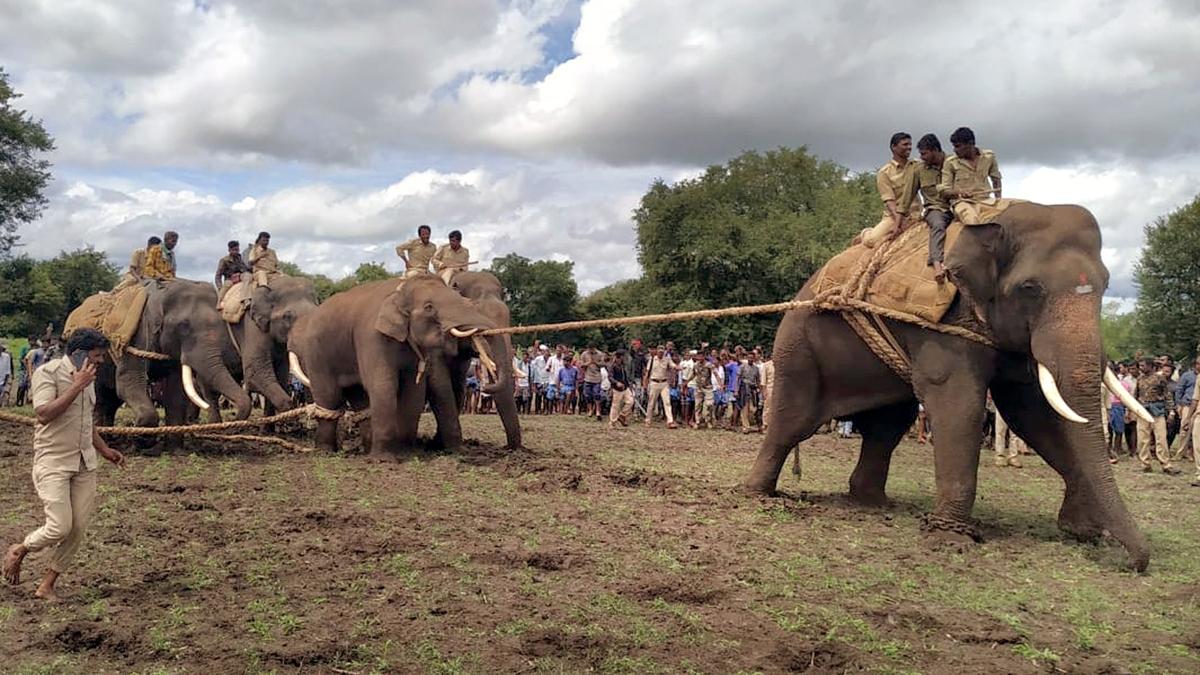
Elephants continue to be the primary species involved in conflict situation, accounting for 22,483 incidents.
| Photo Credit: file phjoto: M.A. SRIRAM
The spate of tiger deaths owing to poisoning reported from M.M. Hills Wildlife Sanctuary during the year, elephant deaths from electrocution and other unnatural causes, and frequent crop raiding by animals underscore the severity of human-animal conflict in villages abutting forest boundaries, in South Karnataka region.
Urgent intervention
As the State observes Wildlife Week in the first week of October, it draws attention to burning issues that call for urgent intervention to mitigate the impact of conflict situation.
The real challenge, according to activists, is to put in place measures to minimise, if not avert, both human and animal deaths, and property loss which affects local villagers bearing the brunt of the conflict.
As per the Forest Department’s e-Parihara dashboard (April 2024 – October 2025) there have been 35,580 reported cases of crop raiding and other conflict cases, and the issue has grown from being a localised problem to a widespread challenge affecting livelihoods, ecosystems, and conservation goals, posing a challenge to the department as also the local community members.
Paid and pending
According to the data, 20,417 cases have been approved for compensation while 14,245 are pending, indicating the strain on administrative mechanisms to respond promptly.
The forest ranges that are among the worst-affected are in south Karnataka region and include the Virajpet range, Kushalnagar, Srimangala, Omkar, Veeranahosahalli, Ponnampet, Sakleshpura, Hediyala, Methikuppe, Anechowkur, N. Begur, Nuguhd Kote, Gundlupet, Hanur range,m etc., all of which are in Mysuru-Kodagu-Hassan-Chamarajanagar belt.
The estimated ex gratia amount which has been approved for the period April 2024 to October 2025 is ₹22.82 crore, of which ₹21.61 crore has been disbursed, reflecting the government’s continued financial burden in mitigating losses arising from crop damage, livestock kills, and human casualties.
Elephant highest
The data indicates that elephants continue to be the primary species involved in conflict situation, accounting for 22,483 incidents, followed by leopards (9,378), wild boars, and tigers.
Though the department has taken up installation of rail barricades to reduce human-elephant conflict in south Karnataka region, there are gaps which cannot be plugged given the topography and the terrain, and elephants manage to navigate their way to circumvent the barricades. But officials maintain that in areas where the barricading has been completed, there is a decline in conflict with elephants.
Habitat fragmentation
The escalation of conflict has been attributed to habitat fragmentation, encroachment, and disturbance by way of approving linear project through the forests or close to the areas used by animals for their seasonal migration.
Unless such issues are resolved, the long-term consequences of unchecked conflict would be severe as there would be resentment among affected communities who could resort to revenge killing. And the recent poisoning of six tigers in M.M. Hills is a pointer to such a situation.
Published – October 04, 2025 09:08 pm IST



