


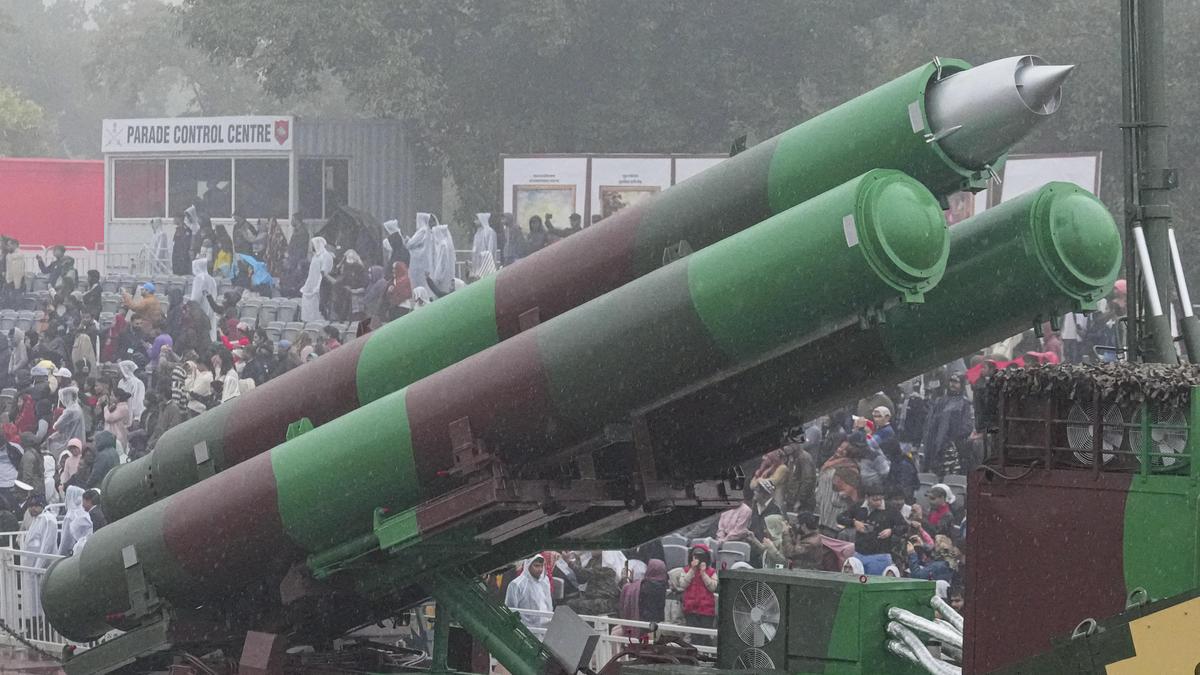
A report by the Switzerland-based Centre for Military History and Perspective Studies states that by the morning of May 10, 2025, India’s ability to sustain stand-off attacks depended largely on the availability of advanced munitions such as BrahMos and SCALP-EG cruise missiles.
| Photo Credit: PTI
A report by the Switzerland-based Centre for Military History and Perspective Studies (CHPM) states that by the morning of May 10, 2025, the Indian Air Force (IAF) had achieved air superiority over significant portions of Pakistani airspace, allowing it to conduct long-range precision strikes against enemy infrastructure with relative freedom.
The report that has been authored by military historian Adrien Fontanellaz, reveals that India’s ability to sustain stand-off attacks depended largely on the availability of advanced munitions such as BrahMos and SCALP-EG cruise missiles.
In contrast, the Pakistan Air Force (PAF) progressively lost its capacity to replicate the complex air operations it had carried out successfully on May 7, following the destruction of forward air-surveillance radars and the growing threat posed by India’s S-400 air defence systems to Pakistani AWACS and standoff strike platforms. Pakistani strikes conducted between May 7 and 10 were largely neutralised by Indian defences
The CHPM report notes that on May 7, one of two Indian strike formations — comprising Rafale or Mirage 2000I fighter aircraft — penetrated Pakistani airspace at very low altitude before executing pop-up manoeuvres to release precision-guided bombs. The aircraft continued to guide the munitions until impact, deliberately exposing themselves to interception by Pakistani fighters and engagement by ground-based air defence systems.
As early as the morning of May 7, Pakistani artillery opened fire along the Line of Control, prompting immediate Indian retaliation. Later that night, the PAF launched a large-scale offensive involving more than 300 drones, JF-17 fighters, and CM-400AKG missiles.
The drone swarms targeted Indian Army forward posts, command headquarters, logistics nodes and air bases, while also attempting to trigger Indian air-defence radars for electronic intelligence collection. The PAF employed Songar armed drones, Yihaa-III (Turkish Designed) suicide drones, and conducted cyberattacks against military and civilian targets. Higher-altitude Bayraktar TB2 and Akinci drones were used alongside Pakistan Army salvos of Fatah-I and Fatah-II rockets and Hatf-II ballistic missiles.
Despite the scale of the assault, the report states that Pakistan failed to saturate Indian air defences. Most incoming munitions were intercepted, and Indian surface-to-air missile batteries repeatedly relocated to avoid detection.
Detecting preparations for another Pakistani strike on May 9, India launched a swift counterstrike. Between 02:00 and 05:00 on May 10, the IAF fired BrahMos, SCALP-EG and Rampage missiles from within Indian airspace using Su-30MKIs, Jaguars and Rafales.
Seven targets up to 200 km inside Pakistan were struck, including a surface-to-air missile battery and five air bases. Nur Khan Air Base near Islamabad suffered damage to a command-and-control centre, while Murid Air Base, the hub of Pakistan’s MALE drone fleet, saw drone hangars and control facilities hit. Rahim Yar Khan, Rafiqi, and Sukkur air bases were also targeted, the report reads.
The CHPM concludes that Operation Sindoor marks a decisive evolution in India’s counter-terrorism doctrine, equating major terrorist attacks with acts of war. The operation removes the distinction between terrorist groups and their state sponsors and underscores India’s resolve to respond decisively, without being deterred by Pakistan’s nuclear arsenal.
Published – January 26, 2026 03:26 pm IST



