

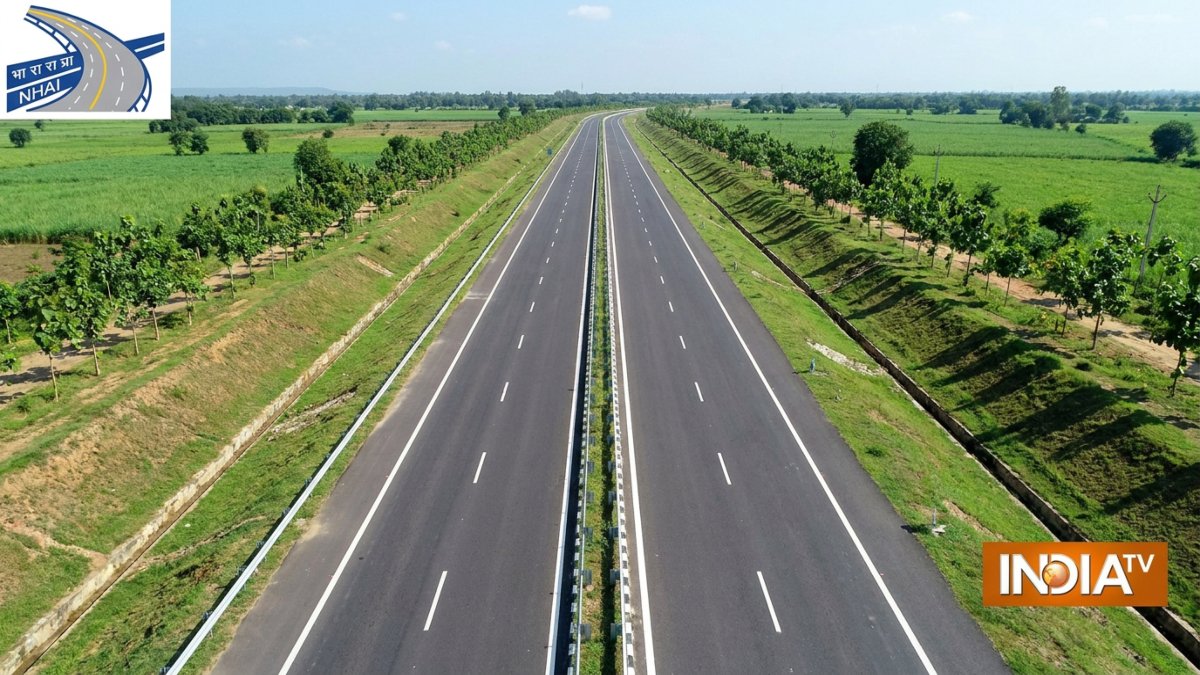

As the country’s high-speed road network continues to expand, the National Highways Authority of India (NHAI) has introduced new guidelines for designing and developing access-controlled high-speed national highways. These changes update the regulations governing design and construction and aim to standardise road design, enhance safety, and improve traffic flow.
Where are all these guidelines applicable?
The new guidelines will apply to upcoming 4-lane and 6-lane greenfield and brownfield high-speed national highways. According to NHAI, the lanes and widths of these roads will now be determined based on traffic projections. This initiative forms a crucial part of the Government of India’s Viksit Bharat 2047 roadmap.
The width of the lane and road will be determined based on traffic
NHAI has prepared a uniform design framework for high-speed national highways. Under this, corridors with traffic up to 15,000 vehicles will have a 4-lane highway and a 4-lane structure. Such corridors will be 60 meters wide.
Corridors with 15,000 to 25,000 vehicles will have a 4-lane highway and a 6-lane structure, and will be 70 meters wide. Corridors with 25,000 to 40,000 vehicles will have a 6-lane highway and a 6-lane structure. Its width will also be kept at 70 meters.
Entry and exit details will be available in advance
The new guidelines focus on road safety. Given the high-speed traffic, a system will be implemented to provide drivers with advance information about entry and exit points on highways. This will allow drivers to change lanes and directions in time, reducing the need for sudden braking or lane changes.
Interchanges will be built on major roads
Interchanges with ramps will be built at crossings of expressways, national highways, state highways, and important roads with high traffic. Interchanges will also be provided on roads connecting major traffic-generating locations such as ports, airports, multi-modal logistics parks (MMLPs), industrial areas, and major tourist destinations.
Ban on illegal entry and stray animals
To prevent unauthorised entry onto the high-speed corridor, a 1-metre-high boundary wall is provided along the outer edge. This is intended to prevent incidents such as people entering the highway illegally and stray cattle from entering the road.
ALSO READ:
NHAI to upgrade 1033 helpline to provide faster, better assistance on National Highways



