


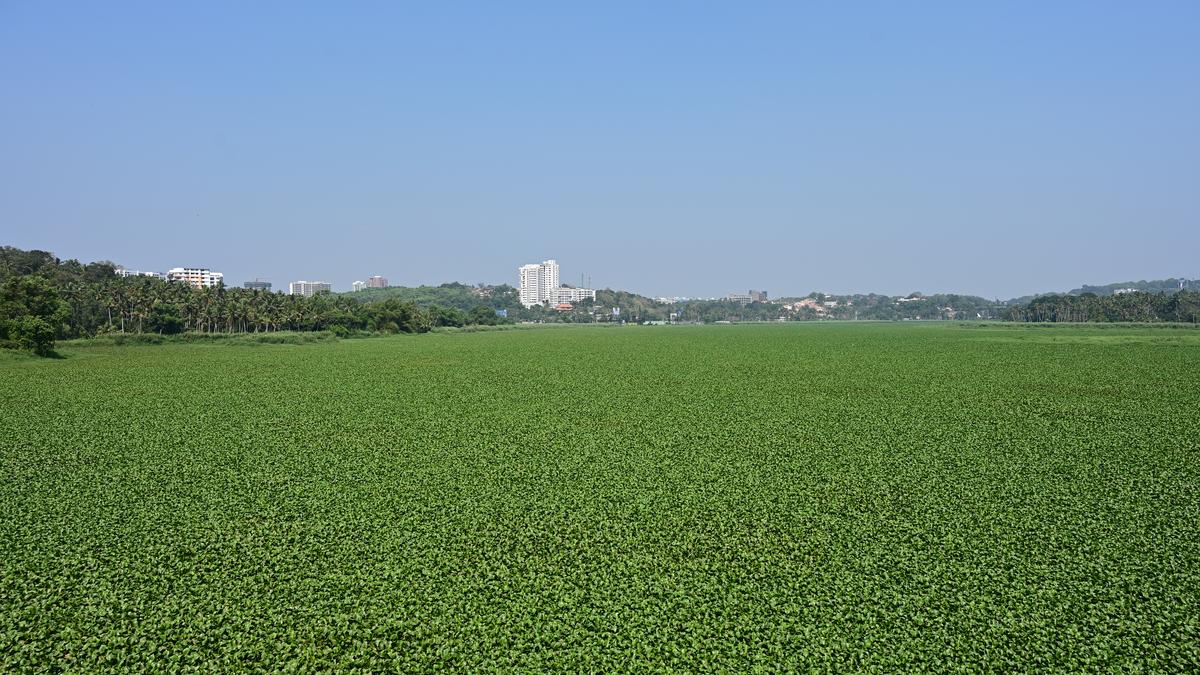
The Akkulam lake covered in water hyacinth.
| Photo Credit: Special Arrangement
A new study by the University of Kerala’s Department of Aquatic Biology and Fisheries has revealed a “clear trajectory of ecological decline” in the Veli-Akkulam estuary on the Thiruvananthapuram coast with biological invasions degrading the once-pristine waterbody over a three-decade period.
The study reveals how invasive species such as the Mozambique and Nile tilapias have altered the food web structure, energy flow and ecological balance of the estuary. The study, ‘Bio-invasion and decadal changes in the trophic dynamics of a temporarily closed estuary: An Ecopath model from Veli-Akkulam Estuary, Kerala, India,’ has appeared in the journal Marine Environmental Research.
“The Veli-Akkulam estuary has transitioned from a moderately organised, lower-productivity system to a highly productive but structurally simplified, invasion-dominated ecosystem. The convergence of eutrophication, altered hydrology and invasive proliferation has generated a detritus-driven network marked by weakened top-down control, compressed trophic (related to nutrition) hierarchy and low energy transfer efficiency,” the paper notes.
The Veli-Akkulam system is a shallow, bar-built estuary on the Thiruvananthapuram coast. It is a seasonally-closed system that connects periodically to the Lakshadweep Sea. A constructed bund bifurcates the 0.85 sq km system into two segments – the western Veli estuary and the northeastern Akkulam estuary.
Among the major findings are the alarming proliferation of invasive species in the Veli-Akkulam system, which was free from them six decades ago. Starting with the water hyacinth, it has since experienced a gradual invasion of exotic species such as the Mozambique tilapia (Oreochromis mossambicus) and the Nile tilapia (Oreochromis niloticus). Other new exotic entrants include the Amazon suckermouth catfish (Pterygoplichthys pardalis) and the North African catfish (Clarias gariepinus).
Invasive species have restructured the food web, undermining top-down controls and promoting opportunistic dominance, while the loss of native species such as Karimeen (Etroplus suratensis) and the rise of detritivores reflect a shift toward a less resilient structure. “These changes threaten biodiversity and essential services such as fisheries and water quality. Urgent, ecosystem-based management is needed to focus on invasive species control, habitat restoration and catchment-scale interventions,” it said.
“This research clearly shows that biological invasions are not isolated species events — they are ecosystem-level transformations. If left unmanaged, such shifts may irreversibly compromise ecosystem services, fisheries productivity, and biodiversity stability,” A. Biju Kumar, Vice-Chancellor, Kerala University of Fisheries and Ocean Studies (KUFOS) and co-author of the study, said.
The results indicate that the estuary has moved towards a less complex and potentially more unstable trophic structure, Sreekanth, G.B., ICAR-Central Coastal Agricultural Research Institute, Goa, one of the authors, said.
Other authors included Regi S.R, (Department of Zoology, Sree Narayana College, Chempazhanthy), Kiranya B. (KUFOS), and Smrithy R. (Aquatic Biology Department, University of Kerala).
The study recommends urgent measures that can steer the estuary toward a more balanced, resilient and self-sustaining ecological state. Suggested measures include targeted removal or control programmes for invasive species, reintroduction of native species, effective source-based wastewater treatment facilities, ecosystem restoration and long-term monitoring and adaptive management.
“As the first decadal assessment of its kind for this region, this study serves as a vital tool for policymakers to implement adaptive strategies that can save this fragile wetland from irreversible collapse,” Dr. Regi said.
Published – February 18, 2026 06:58 pm IST



