


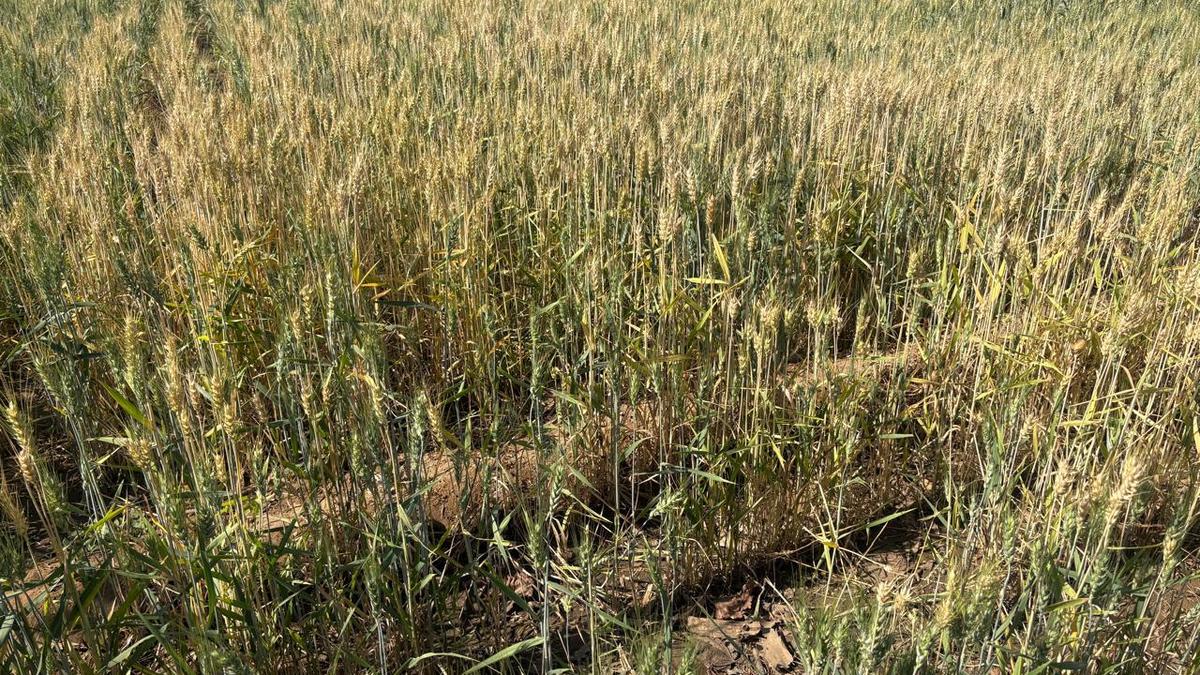
The first-ever wheat crop grown on desert land at Banseli village in Rajasthan’s Ajmer district.
| Photo Credit: Special Arragnement
An innovative experiment to grow wheat for the first time in the arid land, using desert ‘soilification’ technology powered by an indigenous bioformulation, holds the potential to stop the expansion of western Rajasthan’s Thar desert towards the National Capital Region. The desertification process has speeded up with gradual destruction of the Aravali ranges.
Amid the changes in the rainfall pattern, spread of sand dunes, unscientific plantation drives and degradation of land, the researchers at the Central University of Rajasthan (CUoR) here have taken up an experiment for wheat farming, fighting against odds and coming to terms with the harsh desert ecology.
The researchers have essentially carried out modification of desert sand into soil using polymers for reaping its full agricultural potential. After the laboratory experiment with three bioformulations and three crops — bajra, guar gum and chickpea — the scientific exploration has been shifted to an agricultural field for growing wheat.
The groundbreaking achievement was made with 13 kg seeds of wheat-4079 indigenous variety, which were grown at 1,000 sq. metres of desert land at Banseli village near Pushkar in Ajmer district in November 2024. Following the application of bioformulation during the crop cycle, the wheat required only three irrigations, which demonstrated the technology’s high water-retention efficacy.
Akhil Agrawal, Associate Professor in CUoR’s Department of Microbiology, who led the group of researchers, told The Hindu that the bioformulation developed by the team had enhanced water retention in sandy soil, promoted cross-linking of sand particles to improve soil structure, and stimulated beneficial microbial activity that boosted the crop’s stress resistance.
The crop was harvested in April 2025, yielding 26 kg of wheat per 100 sq. metres. The ratio of seeds sown and harvested was 1:20, which was twice in the polymer-amended sand in comparison with the arid land zone.
The project was executed with the support of the Krishi Vigyan Kendra (KVK) and the State government’s Horticulture Department, whose facilitation helped scale the field-level trials in a real desert environment. The KVK officials designed the layout plan on the land, which is situated at the edge of Thar desert.
“This experiment is an example of applied science turning into societal impact,” Prof. Agrawal said, adding that it had proved that even barren desert land could become agriculturally productive using the right biotechnological approach. Research scholar Diksha Kumari, who executed the field implementation, said the reduced water input and healthy crop growth in a “hostile environment” were important aspects of the work.
The number of irrigation cycles were reduced to four using the bioformulation when compared to five to six cycles for normal wheat agriculture, as the solution converted sand into soil-like structure.
Higher yield
In the second phase, an experimental field was prepared in a 400 sq. feet area on the university campus by spreading 100 tonnes of sand brought from Jaisalmer. The bajra, guar gum and chickpea were tested in the field trial, where the researchers got 54% higher yield in bioformulation-amended sand.
Encouraged by the success of the pilot wheat crop, the CUoR plans to expand the technology to other crops such as millet and green gram in the dry regions of Rajasthan and beyond.
Published – September 27, 2025 01:34 am IST



