


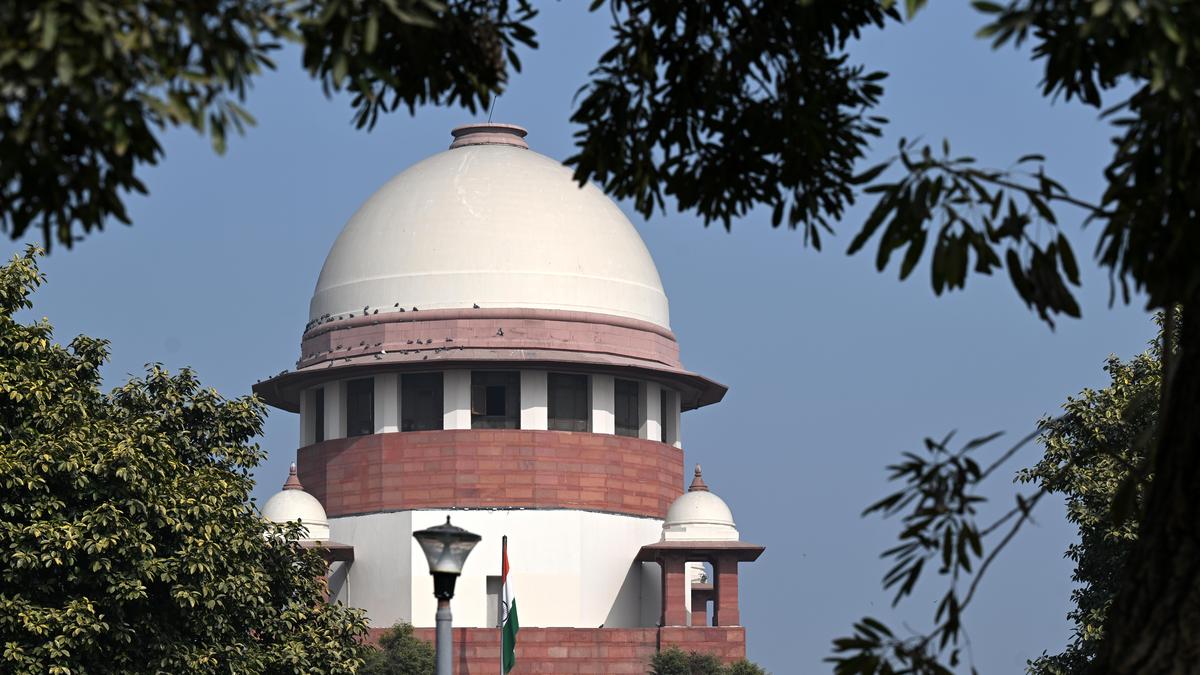
Justice Joymalya Bagchi on the Bench said the 2025 Act would have to be examined by the court. “We have to examine whether the provisions of the new Act suffer from the vice of unconstitutionality… Whether it is manifestly unjust or arbitrary,” Justice Bagchi observed orally. File
| Photo Credit: The Hindu
Chief Justice of India (CJI) Surya Kant on Friday (February 27, 2026) said a balance has to be struck between “actual, visible, tangible national interest” and “unfortunate, hypothetical loss” while hearing a petition highlighting that India’s new law on nuclear accidents has placed “abysmally low” liability on private operators and even exempted any accountability on the part of the suppliers.

Chief Justice Kant, heading a Bench, pointed out that bringing nuclear power to India was a necessity to meet the nation’s energy requirements.
“Today, if we do not bring nuclear power, you will not be able to meet your requirements. You do not want to allow the coal industry, you cannot compromise on forestry, you do not have gas… So, where are we going?” the Chief Justice asked the petitioner counsel, advocates Prashant Bhushan and Neha Rathi.

The petition filed by former IAS officer E.A.S. Sarma has challenged the Sustainable Harnessing and Advancement of Nuclear Energy for Transforming India (SHANTI) Act of 2025, primarily on the ground that it allowed private sector and foreign companies to operate nuclear power plants in India and has further capped the liability of these operators at an “absurdly low level and exempted the supplier from any liability”.

Mr. Bhushan pointed out that the Act capped the government’s residual liability at “300 million Special Drawing Rights — a figure that is abysmally low and effectively ensures that victims of death, injury, or property damage cannot recover even a small fraction of their actual losses”.
The senior lawyer pointed out that the Chernobyl nuclear disaster loss was estimated between $235 billion to $700 billion, the Fukushima Daiichi nuclear power plant accident that occurred in Japan in 2011 estimated the clean-up costs to reach approximately $400-445 billion.
“In contrast to this, SHANTI Act, 2025 caps the liability of the largest plant operator in India at a mere ₹3,000 crore (i.e., approximately $331 million amounting to less than 0.1% of the cost of damage caused by the accidents at Chernobyl or Fukushima). The exemption of suppliers from any liability in the SHANTI Act is bound to encourage manufacturers and suppliers to cut corners in safety so as to maximise their profits,” Mr. Bhushan submitted.
Justice Joymalya Bagchi on the Bench said the 2025 Act would have to be examined by the court. “We have to examine whether the provisions of the new Act suffer from the vice of unconstitutionality… Whether it is manifestly unjust or arbitrary,” Justice Bagchi observed orally.
He said it would have to be examined whether an upper cap on nuclear damage indemnity would be violative of Article 21 of the Constitution.
“An operator who does a hazardous activity has to cover the entire liability in case of an accident,” Mr. Bhushan submitted.
Published – February 27, 2026 10:34 pm IST



