


A young bull can be seen grazing peacefully on the open fields of Sekkipatti early in the morning. When the sun reaches the zenith, it ambles to the village square and lounges in the shade of the Muthalamman temple. By evening, it saunters to the dargah around half-a-kilometre from the village, and when the lights come on, it wanders back to lie down on one of the village’s bylanes. During the jallikattu season, this temple bull is very much in demand.
It is then that the youth from Sekkipatti, a village in Melur taluk in Madurai district, rein in the bull and take it to various jallikattu events in Madurai and also nearby districts. As the name ‘Odungakudiyar Dargah temple bull’ is called out during events, it is let loose and saunters into the arena with an air of nonchalance as spectators look in awe.
For those new to the world of jallikattu, the name of the bull may be startling, but it is intrinsic to the people of Sekkipatti.
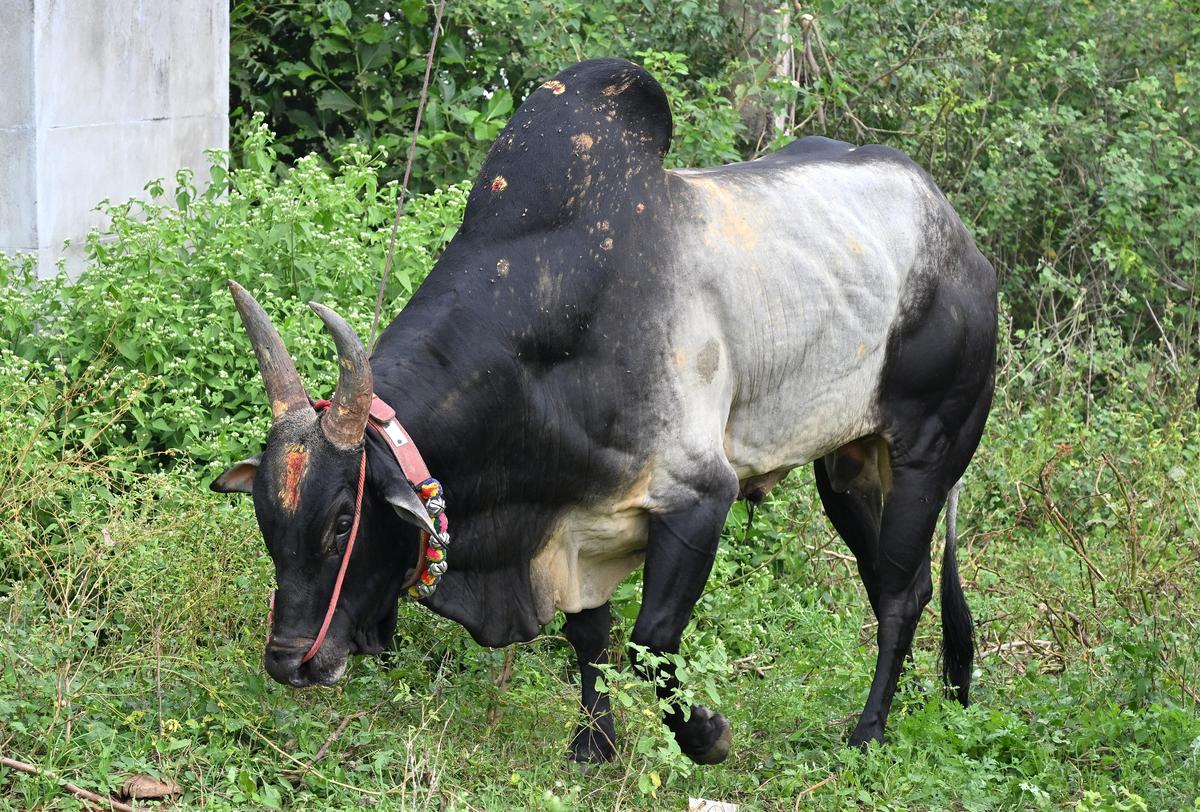
The Odungakudiyar Dargah temple bull grazing in Sekkipatti.
| Photo Credit:
R. ASHOK
Odungakudiyar is a legend that has travelled more than 300 years. Sekkipatti is a village that sits just near the border of Dindigul district and is primarily agrarian. Unlike other villages in the area, Sekkipatti, though just around 13 km away from Melavalavu, has no overt display of caste or religious affiliations. There are no party or religious flags fluttering in the breeze.
On the culvert of the Muthalamman temple, the second name that is etched is that of Kasiman Sahib. To date, during all temple festivals, the descendants of Kasiman Sahib are bestowed temple honours in the form of sacred ash, says Prabhakaran, the priest. Similarly, on the temple premises, a list naming donors who have contributed for its renovations can be found. Among the names, are those of numerous Muslim families.
M. Karthikeyan, a resident of the village, says there is no discrimination between Muslims and Hindus there.
“We call them using terms of traditional familial kinship like mama (uncle) or macchan (nephew),” he adds.
A little ways off from the temple stands Odungakudiyar Dargah, and for the villagers, this is also another of their gods. “The first tonsure ceremony of a child is done at the dargah. Before we begin farming, we take the sapling to the dargah and offer prayers. Offer sugar and burn incense. Once harvest is completed, the first produce is also offered at the dargah,” says Senthil, another villager.
“When a bull is proffered as part of a vow, we name it Odungakudiyar. It is said that during the early days, a bull was offered to the village deity Karuppanasamy, but he told the devotee that from now on it should be offered to his brother Odungakudiyar. That is why our temple bull bears this name,” says Karthikeyan.
Though the villagers are unaware as to when the dargah came into existence, they have no doubt that it is part and parcel of their lives. The dargah also has a sacred grove, a patch of bushy wilderness, attached to it. Villagers have protected the site by attributing to Odungakudiyar various powers characteristic of a guardian deity of the village.
Now, work is on to renovate the dargah. “The dargah is the property of the village, and we are all contributing to the renovation,” says Ismail. This bonhomie between Muslims and Hindus has been a part and parcel of the social ethos of southern Tamil Nadu, say historians.
G. Sethuraman, a history professor, said that in north India, this comradeship was absent. The advent of Muslims in the north was in the form of aggressive invasion, which began with Mahmud of Ghazni in the early 11th Century. These invasions resulted in the destruction of Hindu temples and forcible conversion. This fear and hurt led to an inheritance of animosity for Muslims. Mr. Sethuraman pointed out that these invaders were unable to find a foothold in south India during the period as the Vijayanagara Kingdom was strong. By the time the Arcot kings entered the picture, the Vijayanagara empire was on its last legs, and the British were a force to be reckoned with. Thus, though Muslims ruled south India for sometime, they were similar to feudal kings without much power.
Introduction through trade routes
Islam also entered south India through trade routes in the form of Arab merchants. There was a peaceful interaction of cultures, though there were conversions. A shared regional and linguistic identity seemed to supersede religious affiliation. The advent of Sufism combined with the Bhakti Movement also helped in a flourishing syncretic tradition.
Tamildasan and V. Thavam, who have done a documentary on the dargah, said the first mention of Odungakudiyar could be found at the Thiru Kotteesuwaramudaiyar Sivan Temple, a State-protected archaeological monument, also in Melur. An inscription at this temple, dated to the 14th Century CE, mentions an ‘Odungakudi Kulam’.
Odungakudi, a Sufi saint, may have been buried at the dargah. As time passed, the village has preserved this symbiotic religious practice. Muslims participate in the annadhanam at the Muthalamman temple, while Hindus participate in the Kandhuri festival at the dargah.
What astounded the documentary makers was the fact that in Sekkipatti, there are 3,000 Hindu families, but only 40 Muslim ones, yet syncretism is very much alive and thriving.
At a time when the majority narrative suppresses little known religious practices, documentaries like this hope to preserve the religious harmony that exists in Tamil Nadu, Mr. Thavam adds.
Published – December 19, 2025 09:05 am IST




