


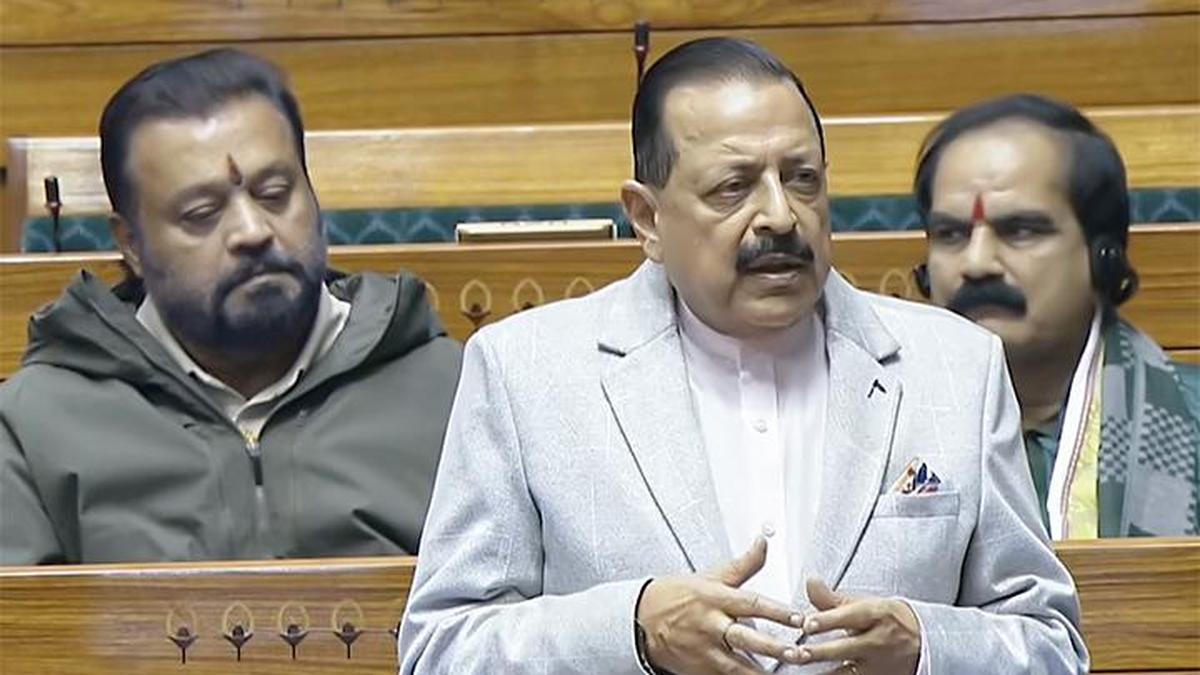
Union MoS Jitendra Singh speaks in the Lok Sabha during the ongoing Winter Session of Parliament, on December 17, 2025.
| Photo Credit: ANI
The Lok Sabha on Wednesday (December 17, 2025) passed the Sustainable Harnessing and Advancement of Nuclear Energy for Transforming India (SHANTI) Bill, 2025 despite demands by several Opposition parliamentarians for referring the legislation to a parliamentary panel. The Bill now moves to the Rajya Sabha for discussion following which it can become law.
Parliament Winter Session: Follow LIVE updates on December 17, 2025
Congress MP Manish Tewari, who opened discussions on the Bill following introductory remarks by Science Minister Jitendra Singh, sought to know if it was a “coincidence” that a legislation enabling private sector participation in the nuclear sector coincided with interest expressed by the “conglomerate house… Adani” in November to enter the nuclear sector. Mr Singh, amidst uproar in the House following this, retorted that the Bill had nothing to do with any specific company and such an aspersion “brought disrepute to the House.”
Mr. Tewari then burrowed into what is perhaps the most significant element of the SHANTI Bill: the removal of a clause in the existing Civil Liability for Nuclear Damage Act, 2010 that allows the operator of a nuclear power plant to claim recourse from suppliers if their equipment was found being responsible in case of an accident.
In 2008, the Bharatiya Janata Party (BJP) had moved a no-confidence motion against the Manmohan Singh government for, among other things, the absence of such a clause. Subsequently, this was also a reason for the lack of foreign participation in India’s nuclear sector despite the U.S.-India nuclear deal that granted India a waiver from Nuclear Suppliers Group sanction as it opened foreign companies to potentially unlimited liability.
“I now see that there is no reference to suppliers… god forbid if there is an accident… shouldn’t a foreign supplier be liable,” Mr. Tewari questioned.
Also Read | SHANTI Bill spurs private sector to make, run nuclear plants
Mr. Singh acknowledged that the BJP had voiced opposition in the past and said that the existence of the clause “had caused reservations in collaborators” but the scenario today was different from 2010. “Times have changed… technology has changed. We are now into small modular reactors which didn’t exist as a technology at that time. There will now be reactors – following the just announced Nuclear Mission – that will give power in dense areas. The risk of catastrophe has now changed. This Bill is coming in because the scenario has changed,” he said.
Aditya Yadav of the Samajwadi Party accused the government of bringing in the Bill by “sacrificing the old laws… that kept public interest first” because the government faced with a “dollar that has crossed ₹90” and “unable to attract foreign investment” was “desperately trying to throw a red carpet to American companies” under pressure from the “prevailing Trump tariffs”.
Supriya Sule, the MP from the Nationalist Congress Party (Sharad Pawar) asked how it was possible to cap the liability of plant operators at ₹3,000 crore. “How can you put a cap on that… how have you calculated this magic number,” she asked.
Congress MP Shashi Tharoor reiterated this point. “The clean-up costs of the Fukushima disaster have already exceeded $182 billion dollars. Chernobyl’s (disaster) impact at $700 billion dollars… however, the total liability as per this Bill is capped at ₹3,000 crore (or about $400 million). This hasn’t changed in 15 years, doesn’t account for inflation and the experience we have had so far,” he said.
Mr. Singh said that ₹3,000 crore was only the maximum liability of the plant operator and if higher amounts were required it would come in from a nuclear insurance pool as well as additionally, source funds from the newly proposed Nuclear Liability Fund (pooled through tariffs).
EDITORIAL | Stepping stone: On nuclear policy, the SHANTI Bill
“If we cross those limits then we can benefit from CSC (Convention on Supplementary Compensation for Nuclear Damage). The reason for a ‘graded operator liability’ was because it was necessary to encourage companies to invest in developing small reactors,” he said. He underlined that several of the Bill’s provisions had been retained from India’s existing nuclear laws and the current government had only “tightened” provisions and made nuclear management relevant to current realities.
Privatising the nuclear power sector – that currently makes up 1.5% of India’s installed power capacity and 3% of the electricity produced – has been on the government’s agenda in recent years to boost clean energy production, improve grid stability and move towards its 2070 net-zero (zero net-carbon emissions) targets. This includes scaling up installed nuclear power to 100 GW up from the current 8.8 GW by 2047 and a ₹20,000-crore mission announced in the Budget this year to develop ‘small modular reactors’ and a slew of customised 220 MW Pressurised Heavy Water reactors (Bharat Small Modular Reactors).
Published – December 17, 2025 10:06 pm IST



